• العربية
  • فارسی
Brand
  • Iran Insight
  • Politics
  • Economy
  • Analysis
  • Special Report
  • Opinion
  • Podcast
  • Iran Insight
  • Politics
  • Economy
  • Analysis
  • Special Report
  • Opinion
  • Podcast
  • Theme
  • Language
    • العربية
    • فارسی
  • Iran Insight
  • Politics
  • Economy
  • Analysis
  • Special Report
  • Opinion
  • Podcast
All rights reserved for Volant Media UK Limited
volant media logo

Israel says it busted another Iran-backed assassination cell
Oct 31, 2024, 09:50 GMT+0Updated: 15:29 GMT+0
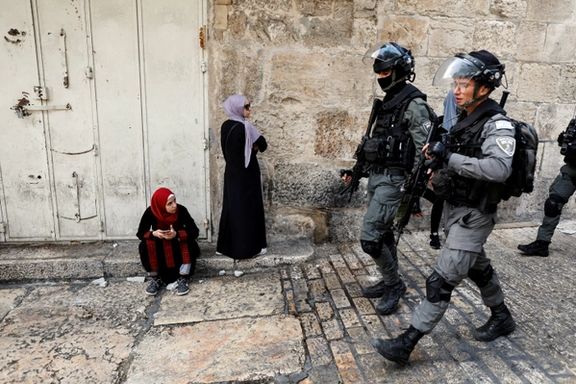
Israeli security personnel patrol an alley in Jerusalem's Old City April 17, 2022.

Israel said it uncovered another Iran-backed spy operation following a wave of arrests over the past month, as spy cells are allegedly activated across the country.

Israel has historically been one of the toughest places to recruit spies and foreign operatives, but recent weeks have seen a surge in arrests of Jewish immigrants from Russia and Azerbaijan.

The latest citizens to be arrested were a married couple, Rafael and Lela Goliev, who live in the mixed Arab and Jewish city of Lod. The 32-year-olds were arrested after carrying out tasks on behalf of an Iranian infrastructure that recruits Israeli immigrants from the Caucasus countries, Israeli authorities say.

The investigation revealed that Rafael Goliev was recruited into the plot by fellow Azeri Elshan Agayev, 56, acting on behalf of Iranian officials.

“As part of the operation, Golayev carried out surveillance missions on security sites in Israel, including the Mossad's headquarters, and collected intelligence on an academic working at the Institute for Security Studies who the Iranians marked as an assassination target,” a statement from Israel Police said.

Goliev was also asked to locate a person who would serve as the assassin for the Iranian operation. Some of the tasks were carried out by Goliev with the help of his wife Lela who will be served with an indictment today.

The two, both of Azeri origin, had been in contact with the handler since 2021, but in the last month, it is the sixth cell busted for working for Iran. In the last year, the incidences have spiked, reaching a head in October with all the cases coming from either Russia or Azerbaijan.

The city of Lod in Israel
100%
The city of Lod in Israel

Israel’s former head of Interpol, Asher Ben Artzi, told Iran International on Thursday as the news broke that the situation reflects a disconnected segment of Israel’s immigrant population. Following the collapse of the Soviet Union, several Jews used the right of return to move to Israel and thousands more Russians have fled to the Jewish state in the wake of the war in Ukraine.

“These people come from a very closed society, it’s not like native born Israelis who could never conceive of doing such a thing,” he said. “In all my years in the security services here, I never thought I would see this day. It’s a tragic thing that people who come here seeking refuge, can do this all for the pursuit of greed.”

Israel’s former head of Interpol, Asher Ben Artzi (undated)
100%
Israel’s former head of Interpol, Asher Ben Artzi

Immigrants from the former Soviet Union tend to live in more closed communities and integrate less than other immigrants, as well as often being among the less economically well-off segments of the population.

Iranian-born Israeli Beni Sabti, also a researcher at the INSS, told Iran International that Iranians are catching “people or communities in Israel who are not paid enough and are dissatisfied in life”, a vulnerable sector of society which now numbers around one million of Israel’s 10 million population.

Ronen Solomon, an Israeli defense and intelligence analyst, told Iran International that using Azeri for communications may have revealed a gap in Israel’s monitoring capabilities, which are more robust for Persian and Hebrew languages.

Ben Arzti, a veteran of Israel’s security and intelligence sector, noted that Iran enjoys greater operational freedom in Azerbaijan, enabling it to potentially recruit and groom agents there for deployment to Israel.

Solomon further suggested that the recruited Azeris may come from Iran’s Azeri speaking population, making them especially vulnerable to recruitment efforts.

Like previous plots, Solomon said the fact they communicate on Telegram also exposes the weakness of the social media platform which protects the identity of users even when engaged in criminal activity.

Other targets of surveillance in the operation included the Moldovan consulate in Tel Aviv, the national electric company, the port of Haifa, public shelters in Tel Aviv, and graves of victims of the October 7 attacks.

According to the indictment, Goliev received an amount of approximately $600 for each day of surveillance and photography in the mission. His handlers ordered him to purchase an operational phone, high quality cameras, a laptop as well as to use the coding software they installed on the laptop, in order to transfer the information they collected safely. In total, the couple received around $26,000, the police said.

Tamir Hyman, the former head of Israeli defense intelligence and head of the INSS, told Israel’s Ynet: "It is not surprising that the members of the Institute for National Security Studies are a target for Iran and its proxies. Although the institute is an independent research institute, and is not part of the defense establishment, it is the leading defense research institute in Israel and as such, Iran seeks to harm its people.”

Last week, an indictment was filed against seven residents of northern Israel who operated as part of an organized squad recruited by an Iranian agent, and during the war engaged in information gathering and photography of military facilities and bases - among others, those that were the target of the Iranian missile attack on October 1.

Most Viewed

US blockade enters murky phase as tankers spoof signals and buyers hesitate
1
ANALYSIS

US blockade enters murky phase as tankers spoof signals and buyers hesitate

2
INSIGHT

Ideology may be fading in Iran, but not in Kashmir's ‘Mini Iran'

3
INSIGHT

Hardliners push Hormuz ‘red line’ as US blockade tests Iran’s leverage

4
VOICES FROM IRAN

Hope and anger in Iran as fragile ceasefire persists

5

US sanctions oil network tied to Iranian tycoon Shamkhani

Banner
Banner

Spotlight

  • Hardliners push Hormuz ‘red line’ as US blockade tests Iran’s leverage
    INSIGHT

    Hardliners push Hormuz ‘red line’ as US blockade tests Iran’s leverage

  • Ideology may be fading in Iran, but not in Kashmir's ‘Mini Iran'
    INSIGHT

    Ideology may be fading in Iran, but not in Kashmir's ‘Mini Iran'

  • War damage amounts to $3,000 per Iranian, with blockade set to add to losses
    INSIGHT

    War damage amounts to $3,000 per Iranian, with blockade set to add to losses

  • Why the $100 billion Hormuz toll revenue is a myth
    ANALYSIS

    Why the $100 billion Hormuz toll revenue is a myth

  • US blockade targets Iran oil boom amid regional disruption
    ANALYSIS

    US blockade targets Iran oil boom amid regional disruption

  • Iran's digital economy battered by prolonged blackout
    INSIGHT

    Iran's digital economy battered by prolonged blackout

•
•
•

More Stories

Iran will 'pull the trigger,' warns hardline Tehran newspaper

Oct 31, 2024, 09:32 GMT+0

Hardliners aligned with the office of Iran’s Supreme Leader have intensified their stance against Israel, calling for renewed attacks in retaliation for Israel’s October 26 strikes on Iranian military targets.

Vatan-e Emrooz, known for its hardline positions against the United States and Israel, emphasized that hostilities with Israel neither began on October 7, 2023, nor ended on October 26, 2024, when Israel launched air strikes against Iran. The paper asserted that “Iran will pull the trigger,” meaning a possible retaliation against Israel.

Ultraconservative Saeed Jalili, an adviser to Khamenei on Iran's Supreme National Security Council, stated that “the enemy should be slapped in the face,” according to the government-owned Iranian Students News Agency (ISNA).

Jalili, who ran against President Masoud Pezeshkian in the June presidential election, added that Iran cannot permit Israel to act with impunity. Quoting verses from the Quran to support his stance, Jalili further claimed that the ideology of the Islamic Revolution has upended Israel’s calculations.

Meanwhile, the Kayhan, a hardline newspaper linked to Khamenei's office, wrote that a cease-fire with Israel is impossible.

As it often does, the ultra-hardline Kayhan linked regional issues to US interests, writing that US Presidents Biden and Trump both suggested Iran must choose between dismantling "resistance groups"—its regional proxies—or entering a war, assuming that either path would pressure Iran into compromising on its nuclear program and regional ambitions. However, it appears Tehran has opted to confront Israel directly, showing neither fear of war nor inclination toward negotiations, Kayhan said, praising the uncompromising stance.

Also ruling out a cease-fire in the wars in Lebanon and Gaza, the Kayhan wrote that no one can reach a sustainable settlement at the UN or in meetings in Paris, Doha or Cairo. The daily argued that the United States and France that give bunker-buster bombs, missiles and air defense systems to Israel and the regional countries that keep Israel's lifelines open lack the honesty and qualification to broker cease-fire negotiations.

The daily added that the "assassination" of Hamas and Hezbollah leaders eliminated all the chances for a cease-fire.

The commentary added that while Iran seeks peace and stability in the region, it remains doubtful about the prospects for a cease-fire, grounding its diplomatic efforts in a thorough understanding of ongoing developments. Kayhan further noted that President Biden’s congratulations to Israel following Sinwar’s “martyrdom” and the outcomes of the Persian Gulf Cooperation Council meeting indicated that calls for a cease-fire were premature and ill-timed.

The daily, funded by Khamenei’s office, emphasized that Iran supports any decision made by "the resistance" and welcomes regional and international efforts backing the “legitimate defense” of the people in Gaza and Lebanon.

Kayhan also quoted Iran’s Foreign Minister Abbas Araghchi, stating that "Iran has identified its targets in Israel" and emphasizing that "US forces operating the THAAD air defense system in Israel are legitimate targets for Iranian forces." Araghchi further warned that "The United States will bear responsibility for any possible Israeli attack on Iran."

The newspaper interpreted Araghchi’s remarks to mean that “Israel, along with US bases and forces in the region, will no longer be safe,” suggesting that the Islamic Republic now views US interests and forces in Iraq, Syria, and possibly Bahrain as legitimate targets.

Canada labels Iran a major cyber threat in new security report

Oct 31, 2024, 06:47 GMT+0

Canada has identified Iran as one of its top strategic cyber threats in its 2025 National Cyber Threat Assessment, citing Tehran's expanding cyber activities and surveillance of global opponents as a growing security risk.

“Iran’s persistent efforts to track and monitor regime opponents through cyberspace present a growing cyber security challenge for Canada and our allies,” the report says.

Iran has become a player in global cyber warfare, conducting increasingly sophisticated attacks on regional and international targets. Iranian cyber capabilities have evolved over the past decade, with state-sponsored groups targeting a variety of sectors, including government, finance, energy, and media.

Canada’s 2025 National Cyber Threat Assessment lists Iran, alongside Russia and China, as a primary cyber threat to national security, warning that Iran’s digital reach now extends beyond the Middle East to target Western nations.

As per the assessment, Iran has used its ongoing cyber clashes with Israel to strengthen its espionage and offensive cyber tactics, which it now deploys against Western targets.

Canadian intelligence officials say that while Canada may not be a primary focus of Iran’s cyber activities, Iranian actors “likely have access to computer networks in Canada, including critical infrastructure.”

According to the statement, the Iranian actors have used high-profile events, like the downing of Flight PS752 over Tehran, as themes in phishing campaigns aimed at the Iranian diaspora and Canadian officials. These campaigns have targeted key sectors, including aerospace, defense, and telecommunications, in pursuit of Iran’s intelligence-gathering objectives.

In just the past few weeks, major tech companies Google, Microsoft, and Meta have all reported malicious activities linked to Iran, warning that Iranian efforts could escalate, potentially inciting violence against political figures to sow chaos and compromise the integrity of the upcoming elections in the US.

Microsoft Threat Analysis Center (MTAC) research related to the US elections released last week said Iran is gearing up for additional influence operations.

“Iranian groups tasked with targeting the US elections may make an effort—as they have in the past—to run influence operations both shortly before and soon after the election by leveraging cyber intrusions from weeks to months prior,” the report said.

On October 14, a report revealed that MTAC's investigation identified an online persona, controlled by Iran, pretending to be an American and urging Americans to boycott the elections over both candidates' support for Israel’s military actions.

In response, a spokesperson for Iran's mission to the United Nations denied any Iranian interference in the US presidential elections. "These allegations are entirely baseless and utterly unacceptable," the spokesperson stated.

As Iran’s cyber capabilities and global reach expand, Canada and its allies face an increasingly complex challenge in countering Tehran’s disruptive and coercive cyber strategies.

Draft Lebanon ceasefire to push Hezbollah from Israeli border - Channel 11

Oct 30, 2024, 21:22 GMT+0

The United States will help oversee a Hezbollah-Israel ceasefire by which UN forces and the Lebanese army replace the Iran-backed group in the south of the country, according to an unverified draft published by Israel's Channel 11.

"During initial 60-day implementation period, Lebanon will dismantle and confiscate all military assets, arms, and infrastructure of all non-state armed groups south of the line (of the Litani River)," the document said.

The White House in a statement neither confirmed nor denied the authenticity of the document.

"There are many reports and drafts circulating. They do not reflect the current state of negotiations," it said.

The origin and author of the printed document stamped "DRAFT" and subtitled "for discussion only" was not immediately clear and none of the other relevant parties have yet commented on its authenticity. It was dated October 26.

The period of calm would start with a 60-day ceasefire and envisions 10,000 Lebanese soldiers eventually deploying to the rugged Lebanese region from which Hezbollah draws much of its support and has been heavily bombed and invaded by Israeli forces.

UN Resolution 1701, a 2006 international agreement by which Hezbollah would be largely replaced and checked by UN forces, would be the basis of the ceasefire according to the document.

Hezbollah's new leader Naim Qassem said on Wednesday that the group would agree to a ceasefire under certain unspecified conditions if Israel wanted to stop the war, but that Israel had so far not agreed to any proposal that could be discussed.

Lebanon's health ministry has said 2,822 people have been killed in Israel's military campaign in Lebanon since October 2023 and more than 1.2 million people have been displaced.

Around 60,000 Israelis have been displaced by nearly a year of fighting near northern border areas and Israeli Prime Minister Benjamin Netanyahu has made returning them safely to their homes a main war goal.

Obscure group formed by Khamenei could nudge Iran toward the bomb

Oct 30, 2024, 21:02 GMT+0
•
Jack Roush

A little-known but influential body handpicked by Iran's Supreme Leader may provide the spur Ali Khamenei needs to ditch his avowed refusal of nuclear weapons and reach for the ultimate deterrent in the wake of punishing Israeli attacks.

Iran’s ongoing conflict with Israel has led to calls for weaponization of the country’s nuclear program, first from hardline commentators, then MPs, then top advisors.

Khamenei has so far resisted all such calls publicly. His rejection of weapons of mass killing on religious grounds is regularly cited by Iranian officials as proof that Iran’s nuclear activities are peaceful and cannot be otherwise.

Given Khamenei’s official stance, most comments by Iranian officials to date have been read as posturing. However, some recent publications by the group, the Strategic Council on Foreign Relations (SCFR), may suggest a meaningful shift in Iran’s defense doctrine.

Khamenei established the SCFR in 2006 as an advisory body to assist his office in the development of foreign policy and strategic planning. Due to the Islamic Republic’s opaque workings Khamenei’s decision-making is difficult to parse, but it is clear that informal bodies like the SCFR have become increasingly significant in this process.

Since Iran’s missile attack against Israel on October 1, the SCFR has released multiple publications regarding the nuclear issue. This includes two interviews discussing how Russia and China’s nuclear doctrines have become more aggressive in response to recent actions by the United States and its allies. Both highlight the importance of nuclear weapons in enhancing deterrence capability, drawing evident parallels with Iran’s position vis-à-vis Israel.

Another paper outlines the strategic rationale behind Iran’s missile attack against Israel. It highlights Iran’s willingness to do more to deter Israel, warning that future responses would be harsher. These publications follow more explicit calls by the SCFR for Iran to reconsider its nuclear doctrine in recent months.

"It is only natural for Iran---as a nation facing threats and unilaterally bearing all the costs of alleviating Western countries’ “nuclear concerns” without reaping any economic or security benefit---to pose fundamental questions about the pertinence and sagacity of its current nuclear and defense doctrine," an article on the SCFR website reads.

An official in Iran's Strategic Council on Foreign Relations speaks at an event hosted by the group
100%
An official in Iran's Strategic Council on Foreign Relations speaks at an event hosted by the group

Groundwork for a shift

Such statements may not bear the supreme leader’s seal, but precedent suggests that they can be the groundwork for an eventual shift in Khamenei’s position, indicating that his advisors’ recent comments may be more than mere posturing.

Over the past several years, the advisory body has established itself as a sounding board for changes in the foreign policy of the Islamic Republic.

SCFR publications frequently anticipate public decisions by the supreme leader and other state officials – indicating that Khamenei may first convey his intentions to the SCFR for deliberation.

One example of this is a 2020 publication signaling support for closer strategic cooperation with Russia, prior to Iran’s accession into the Shanghai Cooperative Organization, support for the invasion of Ukraine, and the recently completed bilateral security agreement.

Another example is Iran’s adoption of sanctions relief and resumed negotiations with Western states as key foreign policy objectives under the presidency of Masoud Pezeshkian.

Before his term, the Islamic Republic appeared less interested in these efforts, as Khamenei prioritized the development of a “resistance economy” to counter the pressure of international sanctions.

As early as 2023, the SCFR promoted pursuit of sanctions relief as part of the agenda for Iran’s foreign policy in 2024, moving away from the “resistance economy” approach. In the lead up to Iran’s 2024 election, the SCFR released additional statements engaging with the subject. Since taking office, Pezeshkian has pursued these objectives with Khamenei’s tacit support.

Altogether, recent SCFR publications mark a change in tone from the advisory body’s earlier insistence that Iran is a responsible actor on the issue of nuclear proliferation, in line with Khamenei’s rhetoric, to one of more nuclear risk-readiness.

This brings concerning implications, especially in the context of Iran’s efforts to increase its stockpile of enriched uranium earlier this year.

In recent years, Khamenei has used the SCFR to extend a lifeline to politically isolated figures, deepen ties with ascendent officials, and keep policymakers under his personal influence.

This is demonstrated by the recent appointment of former SCFR secretary Abbas Araghchi as Foreign Minister, and his replacement by Ali Baqeri Kani, a prominent member of Ebrahim Raisi’s presidential administration. Khamenei has also increasingly relied upon the SCFR as an instrument for personal diplomacy—particularly in maintaining ties with the leaders of Iran’s armed allies in the region.

As Iran and Israel draw ever closer to a full-scale war, the SCFR’s recent publications may suggest that the Islamic Republic will continue to weigh the option of amending its nuclear doctrine.

This course will also be influenced by the expected implementation of a security agreement with Russia, which may enhance Tehran’s confidence.

Should the Iranian nuclear program be openly weaponized, the Islamic Republic will be further emboldened in its efforts to destabilize the region, support Russia’s war in Ukraine, and challenge U.S. interests.

It would also bring a significant risk of further proliferation, particularly as the regime formalizes the Axis of Resistance through a codified alliance structure.

Iranian officials and media weigh response to Israel’s attack

Oct 30, 2024, 16:15 GMT+0

Days after Israel’s unprecedented air strikes on multiple military targets in Iran, media outlets in Tehran, think tanks, and some Iranian officials are now assessing the attack’s impact and implications.

This marks a shift from earlier efforts to downplay the significance of Israel’s operation and may reflect Supreme Leader Ali Khamenei’s directive to "neither downplay nor exaggerate the impact of the attack."

Meanwhile, Khamenei stated that it was up to other officials to determine how to respond to Israel. Several observers, including Iran International political analyst Morad Veisi, interpreted this as a sign that Khamenei was once again attempting to sidestep responsibility for a potential conflict with Israel.

In a Tuesday report, the pro-reform website Rouydad24 website in Tehran stated that Saturday’s attack has effectively ended the shadow war between Iran and Israel, raising the question of whether Iran is now prepared for open conflict.

The website quoted Mohammad Khajoui the director of the Lebanese Studies Group at the Middle East Strategic Studies affiliated with the Iranian Foreign Ministry as saying that it is still too early to answer that question.

The website noted that while some argue the attack inflicted significant losses on Iran, others see it as a mere show by Israel. Regardless, Rouydad24 asserted that both Iran and Israel now face an unprecedented situation, with the outcome still uncertain. It suggested that the direction forward may ultimately be influenced by the results of the U.S. election and any potential cease-fire in Gaza and Lebanon.

Khajoui argued that both sides will try to magnify the importance of their own initiatives and to downplay the actions of the other side. This, he said, makes an accurate assessment of the situation difficult.

The Middle East expert explained that since the 1979 Islamic Revolution, Iranian politicians have been divided on how to approach Israel. One faction, driven by ideological beliefs, advocates for Israel’s elimination, while another believes that, as a Western-backed state, Israel could be controlled rather than destroyed. Ultimately, Iran’s political system settled on a strategy of empowering anti-Israel groups in the region rather than directly engaging in attacks against Israel.

Iran openly supported anti-Israeli groups, overlooking the fragile balance that risked escalating into full-scale war. Following Hamas’s October 7, 2023, incursion, Jerusalem sought to turn its setback into an advantage by weakening both Hamas and Hezbollah. However, as tensions escalated, Iran inched closer to direct involvement, leading to the current situation, Khajoui explained.

He added that Iran is unable to respond swiftly to Israel’s attack, placing Tehran in a difficult position as it was unprepared for the current situation. Meanwhile, all options available to Iran come at a high cost. Iran also recognizes that if it chooses inaction or steps back, Israel is likely to press forward. For now, Iran’s only viable approach is to await the outcome of the US election and a potential cease-fire in Gaza and Lebanon.

Meanwhile, Iranian lawmaker Fada Hossein Maleki informed reporters that Khamenei has entrusted the Iranian armed forces with decision-making on how to respond to Israel. However, as analyst Morad Veisi noted, “Iran’s Supreme Leader, Ali Khamenei, frequently deflects responsibility on challenging decisions, issuing ambiguous statements that enable him to sidestep blame if things go wrong.”

Based on the Iranian Constitutional Law, the Supreme Leader is the sole authority to decide on matters of war and peace, and he knows better than anyone else that he is the commander-in-chief of the armed forces. So, in fact, he is handing over decision-making to himself, but tries to evade responsibility and blame others if his decisions backfire.

Maleki, a member of the Iranian parliament's national security and foreign relations committee, stated that Iran’s response to Israel would be determined with “prudence.” This remark suggests that Tehran may not be able to reach a decision as swiftly as some in the press might anticipate.