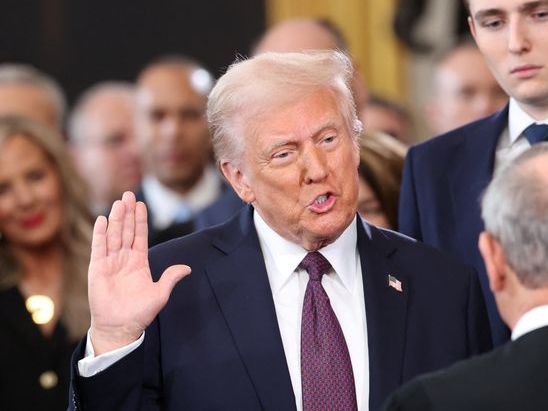
U.S. President Donald Trump takes oath on the day of his Presidential Inauguration, Washington, U.S., January 20, 2025
The administration of Iran's president Masoud Pezeshkian's has hinted at willingness to engage with US under Donald Trump and to open Iranian markets to US companies.
In a recent interview with NBC, President Pezeshkian stressed Tehran's readiness for dialogue with the US, while also stating that the Islamic Republic had no intentions of assassinating Donald Trump over the 2020 killing of the IRGC's Qasem Soleimani in Baghdad.
A senior aide to Pezeshkian, Ali Abdolalizadeh, claimed on Saturday that an agreement with the Trump administration could be reached within two or three months.
Ensaf News, a reformist outlet highly supportive of Pezeshkian, reported last week that the US and Israeli flags, which were painted on the ground for people to step on as they entered the presidential compound, were removed “several weeks ago.”
US and Israeli flags painted on the ground at the presidential office now removed according to Ensaf News
Khamenei repeats opposition to 'hostile' US
In his speech on December 30, Supreme Leader Ali Khamenei reiterated that the US remains “hostile” to Iran and urged the nation to remain “a thousand times more vigilant”.
Khamenei advised against surrendering to American demands but did not explicitly address the prospect of negotiations with the US or the European parties to the nuclear deal.
As the government’s overtures grow, ultra-hardliners continue to highlight Khamenei’s past objections to negotiation with the US in general and with the Trump administration in particular, while also reiterating threats of avenging him for Soleimani's killing.
Is the government acting against Khamenei’s wishes?
The Pezeshkian administration’s moves appear at odds with Khamenei’s repeated declarations that the Islamic Republic would not engage with the Trump administration and his vow to avenge Soleimani’s assassination.
Notably, Khamenei refused to respond to a 2019 message from Trump delivered by then-Japanese Prime Minister Shinzo Abe.
Many Iranian analysts and politicians, however, argue that the Pezeshkian government could not proceed with such overtures without the Supreme Leader’s tacit approval.
For instance, the reformist newspaper Ham-Mihan accused state-run media outlets, such as Kayhan and the state broadcaster (IRIB), of portraying negotiations with the Trump administration as a "thick red line" after the US elections in November 2024.
“But the circumstances and a review of the positions and reactions show that this red line has long been gone and Iran does not rule out negotiations with the future US administration,” Ham-Mihan wrote.
Similarly, Ensaf News interpreted Pezeshkian’s remarks in the NBC interview as evidence that he has already received the green light to proceed with his plans to engage with the new US administration.
Pezeshkian signals the possibility of economic cooperation with the West
During Pezeshkian's interview with NBC, he also referred to the signing of a strategic cooperation agreement with Russia, suggesting that this did not mean the exclusion of the West in Iran's relations.
“We are going to sign a strategic agreement with Russia, the same ways as we did with China, and the same ways as we requested to have [one] with Europe … This does not just apply to Russia, we are prepared to sit down and sign this [type] of agreement with all countries that want to have a close, reasonable, and mutual agreement,” he said.
Foreign Minister Abbas Araghchi has also emphasized that the nature of the agreement with Russia was “primarily economic” and Kazem Jalali, Iran's ambassador to Moscow, has said that Iran “is not interested in joining any [Eastern or Western] blocs.”
However, Iran has been supplying thousands of suicide drones and allegedly missiles to Russia that have been extensively used to target civilians and civilian installations in Ukraine since mid-2022.
But in the past few months, Iran's deep economic crisis compounded by sanctions Trump imposed in his first term, has become more serious, with its national currency losing 30% of its value since August. More officials and commentators allowed to speak in public have been calling for negotiations with the US.
Pezeshkian’s aide, Abdolalizadeh, has argued that Iran should not have excluded the US from its economic dealings with the international community after the conclusion of the 2015 nuclear deal known as the JCPOA (Joint Comprehensive Plan of Action).
“After the JCPOA, we allowed all countries to cooperate with Iran, but we blocked the Americans, and this raised the question of why the US was not allowed to be in Iran for economic cooperation?” he said, adding that the Obama team did not make their complaint public, but Trump would not tolerate such exclusion. “He said he would rip the JCPOA and we said we would burn it. Both sides regret it now.”
He added that, if sanctions are lifted, Iran's oil and gas sectors could become attractive opportunities for American and multinational companies.
Former Iranian diplomat and Princeton professor Hossein Mousavian also suggested in a recent opinion piece for The Hill that direct talks with the US, even at the presidential level, are no longer off-limits.
Mousavian, often labeled a "loyal regime insider" by the Iranian diaspora in the West, proposed that a potential agreement could pave the way for significant economic cooperation, with projects valued in the hundreds of billions of dollars across industries such as petrochemicals, aviation, and clean energy.
Navigating between East and West
Pundits in Iran say the Pezeshkian administration’s overtures to the new US administration, along with its efforts to avoid appearing overly eager to align with Moscow or Beijing, should be viewed through the lens of a ‘positive balancing’ foreign policy.
This approach contrasts with the traditional “Neither East nor West” slogan inscribed at the entrance of the foreign ministry building in central Tehran.
“This strategy neither accepts isolationism nor unquestioning submission to the demands of others,” political analyst Reza Raisi said in an article published by the reformist Ham-Mihan newspaper.
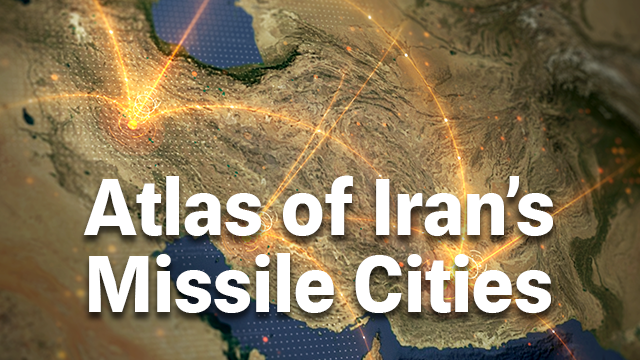
Iran will never negotiate over its military capabilities, the foreign ministry spokesman told reporters on Monday, in response to questions about potential Western demands to limit Tehran’s ballistic missile program.
"Iran has never discussed its military capabilities with anyone and never will," spokesperson Esmail Baghaei said, when asked if Iranian diplomats had addressed potential missile limitations during their meeting with European representatives last week.
The issue of limiting the country's long-range missiles has been a topic of discussion for years.
When the 2015 JCPOA nuclear agreement was signed, Tehran committed not to develop missiles capable of delivering nuclear warheads. The United Nations recognizes the agreement as part of Resolution 2231, which formalized the terms of the JCPOA.
“Paragraph 3 of Annex B of resolution 2231 (2015)calls upon Iran not to undertake any activity related to ballistic missiles designed to be capable of delivering nuclear weapons, including launches using such ballistic missile technology,” it reads in part.
Iran has continued the research and development of ballistic missiles, insisting that these missiles are not intended to carry nuclear weapons.
During Donald Trump's first term as president, the administration demanded that Iran halt its missile program as a precondition for negotiating a new nuclear agreement following its withdrawal from the JCPOA in 2018.
An Iranian ballistic missile that was shot down near Israel last year.
In 2024, amid rising tensions in the region, Tehran launched hundreds of ballistic missiles targeting Israel on two occasions. While most of the missiles were intercepted by Israel and its allies' air defense systems, a few caused damage inside Israel.
Although Tehran has not developed nuclear weapons, expert have cautioned that its ballistic missiles could be modified to carry warheads if it chooses to pursue them in the future, potentially following the North Korean model.
Tehran, already burdened by international sanctions, is bracing for an even tougher sanctions regime as Donald Trump makes his return to the White House. This has prompted growing calls from some Iranian government officials and politicians for negotiations with the incoming administration to ease US sanctions.
In comments to reporters, Baghaei repeated previous threats by Tehran that if UN sanctions are brought back this year as part of the JCPOA “snapback mechanism,” Iran might withdraw from the Non-Proliferation Treaty (NPT).
Supreme Leader Ali Khamenei, however, has yet to signal any willingness to compromise on key issues, such as high-level uranium enrichment or the ballistic missile program.
When a reporter asked the spokesman about leaving the NPT as a retaliatory option, Baghaei said, "If the snapback mechanism is used as a tool to pressure Iran or extract concessions, our response will be proportional. It has been clearly stated that any misuse of this mechanism means there will no longer be justification for Iran to remain in certain existing agreements. This position has been expressed before as well."
The Khamenei-funded newspaper Kayhan wrote on Monday that US President-elect Donald Trump can only come to Iran to face punishment for ordering the 2020 assassination of IRGC commander Qassem Soleimani.
“Trump can only come to Tehran to face qisas [retribution],” Kayhan wrote, referencing the Islamic principle of justice, interpreted as retaliation or punishment equal to the crime committed.
The editorial reflects the hardline media's continued opposition to any overtures of negotiation with the United States, which some Iranian officials have hinted at in recent months, including President Masoud Pezeshkian.
Veteran diplomat and vice president Mohammad Javad Zarif recently remarked that Trump should not be viewed as a "monster" and suggested that dialogue might be possible.
However, Kayhan said such positions undermine Iran's power.
Last week, Iran's ultraconservatives condemned Pezeshkian for his comments to NBC News, in which he denied Iran’s intention to assassinate Trump to avenge the January Soleimani's killing.
Hardline media outlets intensified their rhetoric, with another newspaper, Javan, labeling government officials as "Trump's representatives" and openly advocating for capital punishment.
Iran's Supreme Leader Ali Khamenei on Sunday led the funeral prayers for two high-profile Supreme Court judges killed by an assailant the previous day.
"They were rewarded by God through their martyrdom at the hands of the enemies of God," Khamenei told the families of the two judges after leading their funeral prayers.
Judges Mohammad Moghiseh and Ali Razini had decades-long histories of handing down death sentences and lengthy prison terms to dissidents in numerous cases.
The cases handled by the two judges, both of the clerics, involved political dissidents, activists, followers of the Baha’i faith, dissident clerics, and those accused of security-related "crimes."
However, Khamenei said after his prayers that "Razini and Moghiseh accomplished great deeds throughout their lives, which made them deserving of this reward from God.”
On Saturday, a 31-year-old janitor entered the first floor of the Branch 39 of Iran's Supreme Court, pulled a firearm from under his clothing, and opened fire on Ali Razini, Mohammad Moghiseh, and a security officer, the Iranian government's newspaper Iran reported.
"After targeting the three individuals, he left the courtroom with the same weapon, fled to the third floor, and then committed suicide by shooting himself in the heart," the report added.
Iran's former justice minister Mostafa Pourmohammadi told the state TV the assailant was looking for a third judge on the third floor, but the judge was not in the building at the time.
Based on investigations, the janitor's presence in the courtroom until his departure from the room took only 13 seconds, the newspaper's report said.
It did not specify the type of weapon used in the rare deadly shooting but mentioned that six shots were fired in rapid succession. Other reports in local media mentioned that a semi-automatic handgun was used.
Iran's Judiciary Chief (second from left) visits the house of Ali Razini, one of the two judges who were shot dead in Tehran on January 18, 2025
The Iran newspaper also noted that investigations revealed the young janitor had no prior disputes with the judges, but his motive remains unclear.
In his interview with the state TV, Pourmohammadi said the janitor mentioned the MEK exiled opposition group, indicating that it was a targeted, preplanned attempt to seek revenge against the judges who were allegedly involved in the mass executions of prisoners, mainly MEK supporters, in the 1980s.
The Islamic government has identified the attacker as a janitor, but this has raised questions about how a janitor could have obtained a firearm, smuggled it into a heavily guarded court building, and demonstrated the skill and speed required to carry out such a precise attack.
Pro-establishment protesters in Iran wearing shrouds with Khamenei's name printed on them
The protest by a guest on a program aired by Iran’s state television has ignited widespread debate over the Islamic Republic's emphasis on the veneration of death and its aversion to expressions of joy.
At the conclusion of each episode of the program The Black Box, guests are presented with a black box containing a folded white shroud tied with a black ribbon, along with a mock death notice featuring their photo. In this program, intended to be a light-hearted one-on-one talk show, guests are then asked to share their feelings about confronting their own mortality.
The shroud symbolizes the government’s Shia ideology, representing a wish for the recipient to achieve the honor of martyrdom or simply depart from an unworthy earthly life and go to paradise.
Around fifty episodes of the program have been aired over the past ten months with guests chosen from among recognized political, artistic, athletic, and academic personalities.
Many Iranians only heard the controversial program’s name a few days ago because Iran's ideologically driven state television has lost most its audience to satellite TV channels. Many Iranians turn to these both for news and entertainment.
The program drew widespread attention after a guest shared a video on social media. In his post, Hadi Amel, a popular television wrestling reporter, criticized the state broadcaster for the insensitivity of the gift he was presented with at the end of the show.
Amel revealed that he had protested immediately in the studio, demanding that the footage of the incident not be aired. Despite his request, he noted in his post, a re-run of the episode was broadcast last week. "It was unethical. They broke my heart," he said.
Amel’s post and a video clip of the controversial scene quickly went viral on Persian social media with thousands commenting.
In the aired program, Amel is visibly shocked upon opening the black box and discovering the gift symbolizing his "future." "I don’t like this. I don’t like talking about death," he says, placing the death notice face down on the table.
The presenter appears equally uncomfortable, turning to the production team and asking, "Is this what you wanted?" He then calls the gesture "bad taste."
“You wouldn’t kill so many people, commit such injustices, carry out executions, or engage in so much corruption if you truly understood the meaning of a shroud, a death notice, or the day of death,” a viewer said in an audio message sent to Iran International TV, addressing the Islamic Republic authorities. “You are the ones who should be gifted shrouds, as you are nearing your final day,” he added.
Shortly after, an excerpt from another episode surfaced on social media, showing the shocked reaction of another guest, Maryam Razzaghi-Azar, a prominent professor of pediatric endocrinology. Upon receiving the gift, she protested, stating that she did not want her children to see the shroud and death notice. She then insisted that the presenter tear it to pieces.
The intense public backlash compelled Peyman Jebelli, the head of the state broadcasting organization (IRIB), to address the controversy. Speaking to reporters, he acknowledged the criticism, agreeing that the gift was in poor taste. Jebelli also claimed to have reprimanded the producers responsible for the decision.
Despite the public outcry, pro-establishment figures and social media users argued that the criticism was unfounded because only two of the nearly fifty guests of the program were offended by the gift while some others, including ultra-hardliner lawmaker Hamid Rasaei, had even welcomed it.
Speaking to Iran International TV, prominent Washington-based Iranian sociologist Hossein Ghazian explained that the program’s controversy stems from its production and broadcast by a state-owned media outlet. He suggested that if a similar concept had been produced by, for example, a Belgian television channel, it might have been seen as creative. However, Iranians reacted negatively because the program is perceived as a reflection of the state’s ideology, he noted.
Ghazian argued that, within this ideology, life is viewed as a fleeting phenomenon unworthy of significant focus, while death is regarded as eternal. “In political terms, this implies that people should not expect much improvement in their living conditions from the government,” he added.
The IRIB has completely degenerated,” psychologist Azadeh Jazini wrote in an X post to fellow citizens. “This toxic system, which opposes life and happiness, has now stooped to presenting gifts that induce mental collapse. Stay away from this media outlet, not just for your own mental well-being but also to protect the mental health of your children.
A woman passes by Bangladesh's central bank in Dhaka, Bangladesh, July 19, 2023.
Following reports on surging rebranded Iranian liquefied petroleum gas (LPG) exports to Bangladesh, its Central Bank warned all domestic banks to stay alert regarding the import of products from countries that are subject to global sanctions.
Similar instructions have been incorporated into Bangladesh Bank's anti-money laundering and terrorist financing policy, a source told local Business Standard newspaper.
LPG, a mixture of heavier gases such as propane, butane, and pentane (rather than methane or natural gas), is a petroleum product and ranks among Iran's top non-oil exports.
According to Iran’s customs statistics, the country exported $2.2 billion worth of LPG, along with $1.7 billion of pure propane, $1.1 billion of pure butane, and $1 billion of other heavy gases during the first half of the Iranian fiscal year, which began on March 21. Iran classifies these raw petroleum products as non-oil exports. Collectively, petroleum gases account for 24% of the country’s non-oil exports.
Iran exports 11-12 million tons of LPG annually, mostly to China, earning approximately $8 billion.
A day after the Central Bank’s warning, Lloyd's List reported on January 18 that, amid concerns over Chinese buyers hesitating to risk violating US sanctions, a very large crude carrier suspected of transporting Iran-origin LPG to China made an unusual U-turn in December. After spending two weeks at anchor, the vessel discharged its cargo in Bangladesh.
In October 2024, The Business Standard, a Bangladeshi publication, reported that the LPG Operators Association of Bangladesh (LOAB) had raised concerns about the growing imports of Iranian LPG. According to the report, Iran has been offering Bangladeshi buyers prices $40–$50 per ton below market rates, with monthly LPG exports to Bangladesh recently reaching 150,000 tons. This surge has enabled Iran to capture a quarter of Bangladesh's LPG market.
The newspaper published a letter from LOAB to port authorities and the central bank, listing several tankers suspected of carrying Iranian LPG in Bangladeshi waters. The letter warned that, aside from the potential sanctions-related consequences, Iran's underpricing disrupts the competitive energy market in the country.
Mahammed Jamal Hosen, representing the Bangladesh LPG Distributors and Dealers Welfare Association, said in the letter that "Many banks will face direct consequences of potential US sanctions, and in the long term, Bangladesh's reputation as a destination for foreign direct investment will be at risk."
The letter identified a dozen companies that allegedly forged Iranian LPG documents through intermediaries in the UAE, particularly Dubai, and rebranded the shipments as LPG from Iraq's Basra Gas Company before routing them to Bangladesh.
The Business Standard says “for instance, in August 2024, two local LPG companies imported over 10,000 tons of LPG on a vessel named G YMM. The documents submitted to customs and port authorities showed the liquid gas came from Basrah Gas Company in Iraq. However, The Business Standard on 6 September obtained a response from Andrew Wiper, managing director of Basrah Gas, confirming that the vessel G YMM has never loaded LPG from his company”.