• العربية
  • فارسی
Brand
  • Iran Insight
  • Politics
  • Economy
  • Analysis
  • Special Report
  • Opinion
  • Podcast
  • Iran Insight
  • Politics
  • Economy
  • Analysis
  • Special Report
  • Opinion
  • Podcast
  • Theme
  • Language
    • العربية
    • فارسی
  • Iran Insight
  • Politics
  • Economy
  • Analysis
  • Special Report
  • Opinion
  • Podcast
All rights reserved for Volant Media UK Limited
volant media logo

Trump puts Iran pressure front and center at Presidential rally

Jan 21, 2025, 02:08 GMT+0Updated: 21:50 GMT+0
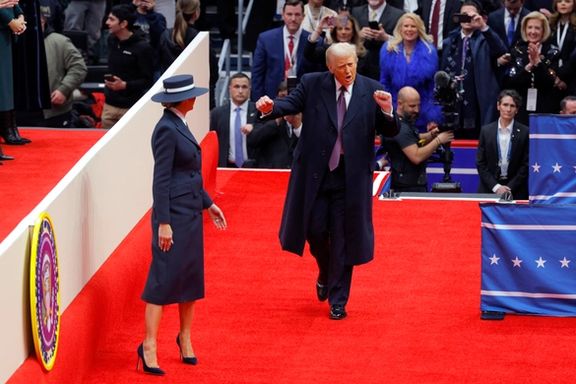
Trump dances as he takes to the stage at his first presidential rally

President Donald Trump told hostage families he would have deprived Iran of the money to aid the Oct. 7 attack, putting the Mideast crisis at the center of his first rally since being sworn in on Monday.

"We've got to stop some wars there are some stupid things going on," Trump told thousands of supporters at an indoor gathering in Washington DC.

"Israel would've never been hit on October 7," Trump said, "Iran was broke. Anyone that bought oil from Iran ... China passed, everybody passed."

The newly-minted head of state whose sanctions piled pressure on Iran's oil revenue in his first term and hit Tehran's spending on armed allies in the region, also ordered a deadly drone strike on a top Iranian commander, Qassem Soleimani.

Since that 2020 attack, Iranian officials have blasted Trump in strong terms, but since his November re-election, some quarters have softened their tone and mooted talks.

"They were broke; they didn't have money for Hamas, and they didn't have money for Hezbollah," Trump continued, then addressing the families: "Your sons would be alive, and they certainly wouldn't be incarcerated where they are. It's such a shame."

Later in the evening Trump inked a raft of executive orders at the White House, telling reporters that Israel had weakened Iran badly over a 15-month conflict in the region.

"They're weakened in a different way, the one attack by Israel really set them back - the pagers," Trump said, referring to an attack on Hezbollah leaders' communication devices last year which maimed many and injured Iran's envoy to Lebanon.

"And others," Trump added. "The attack on air defense was a bad attack for Iran."

Israel appears to have knocked out much of Iran's anti-air capability with an Oct. 26 series of air raids in retaliation for an Islamic Republic missile attack on Israel.

Speaking before Trump at the rally, his Mideast envoy Steve Witkoff, who was instrumental in talks which led to a Gaza-Israel ceasefire last week, told rally-goers Trump could solve the region's deepest problems.

"President Trump's leadership has redefined what is possible in the pursuit of progress and stability in the Middle East. his decisive pragmatic approach ensures that even the most entrenched conflicts are met with fresh perspectives and innovative strategies."

Trump counted the so-called Abraham Accords between several Arab countries and Israel as one of the top accomplishments of his first term.

Witkoff said with Trump's leadership he "would be engaging with leaders across the region to find pathways toward sustainable peace and stability."

"Every nation deserves the right to determine its own destiny free from the interference of foreign powers," he added, in a possible reference to regional states in Iran's orbit.
Most Viewed

US blockade enters murky phase as tankers spoof signals and buyers hesitate
1
ANALYSIS

US blockade enters murky phase as tankers spoof signals and buyers hesitate

2
INSIGHT

Ideology may be fading in Iran, but not in Kashmir's ‘Mini Iran'

3
INSIGHT

Hardliners push Hormuz ‘red line’ as US blockade tests Iran’s leverage

4
VOICES FROM IRAN

Hope and anger in Iran as fragile ceasefire persists

5

US sanctions oil network tied to Iranian tycoon Shamkhani

Banner
Banner

Spotlight

  • Hardliners push Hormuz ‘red line’ as US blockade tests Iran’s leverage
    INSIGHT

    Hardliners push Hormuz ‘red line’ as US blockade tests Iran’s leverage

  • Ideology may be fading in Iran, but not in Kashmir's ‘Mini Iran'
    INSIGHT

    Ideology may be fading in Iran, but not in Kashmir's ‘Mini Iran'

  • War damage amounts to $3,000 per Iranian, with blockade set to add to losses
    INSIGHT

    War damage amounts to $3,000 per Iranian, with blockade set to add to losses

  • Why the $100 billion Hormuz toll revenue is a myth
    ANALYSIS

    Why the $100 billion Hormuz toll revenue is a myth

  • US blockade targets Iran oil boom amid regional disruption
    ANALYSIS

    US blockade targets Iran oil boom amid regional disruption

  • Iran's digital economy battered by prolonged blackout
    INSIGHT

    Iran's digital economy battered by prolonged blackout

•
•
•

More Stories

We will defeat Iran's axis of terror, Netanyahu tells Trump

Jan 20, 2025, 21:28 GMT+0

Israel and the United States will work together to defeat Iran and end its regional influence, Israeli prime minister Benjamin Netanyahu said in a message congratulating US president Donald Trump on his inauguration day.

“I am confident that we will complete the defeat of Iran’s terror axis and usher in a new era of peace and prosperity for our region,” Netanyahu said addressing Trump in a video released on Monday.

“You withdrew from the dangerous Iran nuclear deal, you recognized Jerusalem as Israel’s capital … and you recognized Israel's sovereignty over the Golan Heights,” Netanyahu said, reflecting on Trump’s first term and his pro-Israel, anti-Iran policies.

With Trump’s return to the White House, significant shifts in US foreign policy are anticipated, particularly in the Middle East.

Israel's former defense minister Yoav Gallant also mentioned Iran in his congratulation note on Trump's inauguration day.

"Our ties are critical to Israel’s security and prosperity - to the return of the hostages, to the removal of the Iranian threat, to achieving our common goal of dismantling the ‘axis of evil’," he wrote in a post on X.

The Trump administration is expected to take a hard stance against Tehran. Both the president and senior members of his team have promised a return of the so-called maximum pressure campaign on Iran.

During his 2024 campaign, Trump said he wished prosperity for Iran but stressed the long-standing Washington red line that the theocracy must not be allowed to acquire nuclear weapons.

Anticipating potential pressures, some in Iran including senior aides to Iran’s president Masoud Pezeshkian have openly called for talks with the Trump administration, suggesting even that the country’s markets can be opened to American companies.

This has not gone down well with the more hardline factions of the Islamic Republic, who inspired and encouraged by the supreme leader Ali Khamenei, warn against any advance by Tehran toward Washington.

US should help Israel strike Iran nuclear sites, Trump confidant says

Jan 20, 2025, 21:15 GMT+0

There is no point in negotiating with Iran about its nuclear program and President Donald Trump should instead help Israel bomb it, Senator Lindsey Graham said.

The comments by the hawkish South Carolina senator who is a longtime Trump confidant are among the most direct yet by a senior decision-maker supporting a US military intervention on Iran.

"The next question for the world is what do we do about the Iran nuclear program," Graham told CBS Face the Nation on Sunday.

"With diplomacy, there's a one in a trillion chance you'll degrade the Iranian nuclear program. There's a 90% chance you'll degrade it through military action by Israel supported by the United States.

The veteran senator is one of the biggest advocates of a more muscular policy abroad and is a vocal supporter of Israel and its Prime Minister Benjamin Netanyahu, whom he credited with delivering heavy blows to Iran-backed groups Hezbollah and Hamas.

Trump said in November that Iran "can't have nuclear weapons" but "I’d like them to be a very successful country."

Sworn in on Monday, Trump has repeatedly suggested he is disinclined to pursue regime change in Iran and has not publicly mentioned any military option on Iran.

Graham said he would engage Trump "to take this moment in time to decimate the Iranian nuclear program, to help Israel deliver the knock-out blow."

"(The Islamic Republic) is a religious nazi regime," Graham continued. "They want to destroy the Jewish State, they want to purify Islam and drive us out of the Mideast, it would be like negotiating with Hitler.

Iran extolls deterrence of nuclear program on Trump's first day back

Jan 20, 2025, 16:55 GMT+0

Iran's nuclear program is central to strengthening national security and deterring international threats, a top official said on Monday as hawkish President Donald Trump returned to the White House after repeatedly vowing to deny Tehran a bomb.

“Over the years, adversaries have tried to weaken Iran in this field and entangle the country in international issues," Behrouz Kamalvandi, the spokesperson for the Atomic Energy Organization of Iran (AEOI) said during a military conference in Tehran

"That is precisely why they do not want Iran to have full, indigenous control over it.”

Kamalvandi emphasized that the nuclear program not only strengthens Iran's international position but also drives domestic progress.

“This industry has significant impacts on people’s lives,” he added, highlighting applications for energy, medicine, agriculture, and environmental protection.

Iranian officials have repeatedly asserted that the country's nuclear program is peaceful, referring to a religious ruling by Khamenei prohibiting weapons of mass destruction, including nuclear bombs.

However, Kamalvandi's remarks emphasized its potential to create deterrence and balance power on the international stage, aligning it with broader security objectives.

“Power in today’s international world is distributed based on balance and realism. Islam recognized this long ago and considered power as a foundation for creating deterrence."

Iranian hardliners have previously advocated for developing nuclear weapons as a deterrent. Following Israeli airstrikes on October 26, Javan, a newspaper affiliated with the Islamic Revolutionary Guard Corps, urged Tehran to consider developing nuclear arms to counter external threats.

Last year in October, amid heightened tensions with Israel, thirty-nine Iranian lawmakers called on Iran's Supreme National Security Council to review the country's defense doctrine and consider adopting nuclear weapons.

Kamalvandi’s remarks come at a time when tensions with the United States are widely expected to escalate following Donald Trump’s inauguration.

Tehran has expressed concern that Trump’s administration might embolden Israeli Prime Minister Benjamin Netanyahu to consider striking Iran’s nuclear facilities, further intensifying the region's volatile security dynamics.

Casting his vote on Election Day in November, Trump appeared to downplay any attempt to knock out Iran's ruling system but said Iran could not have nuclear arms.

“My terms are very easy,” Trump said, adding that Iran "can't have nuclear weapons." "I’d like them to be a very successful country,” he added, but declined to detail specific plans for US-Iran relations should he return to office.


Iran's Zarif flies to Switzerland to take part in Davos summit

Jan 20, 2025, 10:36 GMT+0

Iran's Vice-President for Strategic Affairs Mohammad Javad Zarif departed Tehran for Switzerland on Monday morning to attend the World Economic Forum's annual meeting.

In addition to meetings and panel discussions, state media reported that Zarif is scheduled to participate in a conversation with CNN host Fareed Zakaria on the event's sidelines.

While business and political leaders began gathering in Davos on Monday for the four-day summit, US President-elect Donald Trump's swearing in ceremony was expected to dominate discussions despite his absence from the event.

Trump will address participants virtually on Thursday.

Last year, the World Economic Forum faced calls to revoke its invitation to Iran’s then Foreign Minister Hossein Amir-Abdollahian due to his close ties to the Islamic Revolutionary Guard Corps (IRGC) and support for Hamas.

Iran forced to continue use of harmful fuel oil to maintain gas supplies, President says

Jan 20, 2025, 09:53 GMT+0

On Monday, Iranian President Masoud Pezeshkian said the government was forced to burn mazut, a highly polluting fuel, to prevent interruptions to household gas supplies this year.

"We were not supposed to burn mazut at all, and we announced this. But then we got stuck. If we hadn't used it, we would have had to cut off gas supplies to households, because our consumption is many times higher than in other countries. We were forced to," Pezeshkian said in a speech broadcast on state TV.

"In order to stop these problems from happening next year, we've started to create plans," he added, without providing further details.

Iran, one of the largest oil producers in the world, has faced a severe gasoline shortage since last summer. That shortage has prompted refineries to bulk out the fuel's volume with other substances, like mazut.

In November 2024, the government issued a decree ordering an increase in household gas tariffs and authorizing provinces to use mazut in all power plants and industries.

Despite repeated promises since to phase out the use of the highly polluting fuel oil in power plants, several reports suggest the practice has not stopped.

Tehran has also implemented rolling power cuts for residential and commercial areas this winter due to a severe shortage of natural gas, the primary fuel source for the country's power plants. The government initially presented the rolling blackouts as a necessary measure to avoid using mazut or diesel.

According to a 2023 report by Radio Farda, official Oil Ministry reports showed that the country intensified its use of mazut in December 2022 to 38.5 million liters per day, a 22 percent increase, and 42 million liters per day in January 2023.

Mazut, the non-standard gasoline contains harmful additives and has significantly contributed to the air pollution crisis in the country.

In 2023, UN special rapporteur on human rights and the environment David Boyd called on Iran to halt the practice, declaring it a human rights violation.

"Iran is burning mazut, one of the dirtiest fuels, to generate electricity. This produces massive volumes of toxic air pollution, which poisons millions of people in Iran, violating their human rights, including the right to a healthy environment. Iran must stop burning mazut!," the post on X read.

The use of the low-grade fuel mazut by power plants in Iran has been linked to severe harm to public health and even fatalities, with Iranians frequently expressing frustration over the worsening air quality and pollution in many cities.