• العربية
  • فارسی
Brand
  • Iran Insight
  • Politics
  • Economy
  • Analysis
  • Special Report
  • Opinion
  • Podcast
  • Iran Insight
  • Politics
  • Economy
  • Analysis
  • Special Report
  • Opinion
  • Podcast
  • Theme
  • Language
    • العربية
    • فارسی
  • Iran Insight
  • Politics
  • Economy
  • Analysis
  • Special Report
  • Opinion
  • Podcast
All rights reserved for Volant Media UK Limited
volant media logo

Nobel laureate demands global action on Iran's 'gender apartheid'

Jan 23, 2025, 10:13 GMT+0Updated: 11:49 GMT+0
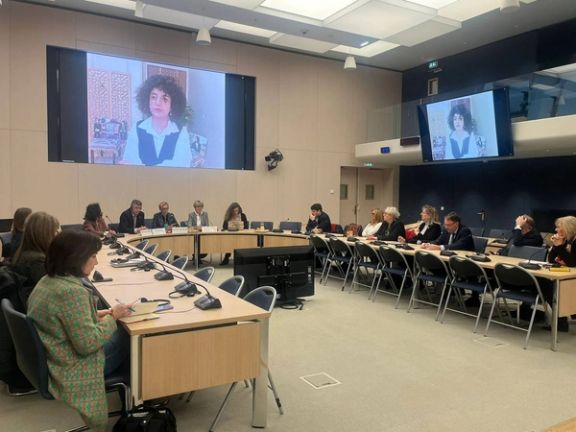
Mohammadi delivering a speech to the Delegation for Women’s Rights of the French Senate and National Assembly, 23 January 2025.

Nobel laureate Narges Mohammadi called on France's Senate to support the criminalization of gender apartheid and prioritize the fight for human and women's rights in Iran in a video call from Tehran on Thursday.

"Fighting gender apartheid is not merely a struggle for women’s liberation from systemic oppression; it is an essential step toward achieving democracy, peace, and justice. One cannot oppress and enslave half of society while speaking of democracy, freedom, and equality," Mohammadi said during her speech to the Delegation for Women’s Rights of the French Senate and National Assembly.

Released on medical leave on December 4, the prominent human rights activist was due to return to prison on December 25. Her lawyer requested an extension which was supported by medical evaluations, but the decision remains pending.

In her address, Mohammadi raised concerns about the rise in executions in Iran, including those targeting women political prisoners. She highlighted the cases of Pakhshan Azizi and Varisheh Moradi, detained in Evin Prison and facing execution.

"The Iranian regime is exacting revenge on women for the ‘Woman, Life, Freedom’ movement. Pakhshan Azizi and Varisheh Moradi… now face the looming threat of execution. The regime wields the noose as a tool of terror to break the resolve of Iran’s brave and conscientious women," Mohammadi said.

Varishe Moradi was sentenced to death in November by Tehran's Revolutionary Court on charges of "armed rebellion." Pakhshan Azizi received the same sentence in July.

Mohammadi urged the international community, including the French Parliament and Senate, to adopt a firm stance on human rights in dealings with the Iranian government.

"Make human rights a prerequisite and the central focus of all negotiations. Any negotiations that sideline fundamental human rights, women’s rights, and civil liberties risk emboldening religious authoritarianism and undermining the Iranian people’s efforts for democracy, freedom, and equality," she added.

The activist has spent over a decade in prison and has been sentenced to 36 years, 154 lashes, and 135 days in solitary confinement.

Her human rights advocacy has earned her international accolades, including the 2023 Nobel Peace Prize, UNESCO's Guillermo Cano World Press Freedom Prize, and the Courage Award from Reporters Without Borders.

The United Nations human rights office reported in January that Iran in 2024 executed 901 people, including 31 women, marking a sharp rise in capital punishment cases.

"To stop the ever-increasing executions and to achieve human rights and women's rights, put pressure on the Islamic Republic," she said as last year's tally was a record high for decades.

Calling on international support, she added: "Prioritize international mechanisms such as universal jurisdiction to hold regime officials accountable, rather than normalizing a regime responsible for crimes against humanity."

Most Viewed

US blockade enters murky phase as tankers spoof signals and buyers hesitate
1
ANALYSIS

US blockade enters murky phase as tankers spoof signals and buyers hesitate

2
INSIGHT

Ideology may be fading in Iran, but not in Kashmir's ‘Mini Iran'

3
INSIGHT

Hardliners push Hormuz ‘red line’ as US blockade tests Iran’s leverage

4
VOICES FROM IRAN

Hope and anger in Iran as fragile ceasefire persists

5

US sanctions oil network tied to Iranian tycoon Shamkhani

Banner
Banner

Spotlight

  • Hardliners push Hormuz ‘red line’ as US blockade tests Iran’s leverage
    INSIGHT

    Hardliners push Hormuz ‘red line’ as US blockade tests Iran’s leverage

  • Ideology may be fading in Iran, but not in Kashmir's ‘Mini Iran'
    INSIGHT

    Ideology may be fading in Iran, but not in Kashmir's ‘Mini Iran'

  • War damage amounts to $3,000 per Iranian, with blockade set to add to losses
    INSIGHT

    War damage amounts to $3,000 per Iranian, with blockade set to add to losses

  • Why the $100 billion Hormuz toll revenue is a myth
    ANALYSIS

    Why the $100 billion Hormuz toll revenue is a myth

  • US blockade targets Iran oil boom amid regional disruption
    ANALYSIS

    US blockade targets Iran oil boom amid regional disruption

  • Iran's digital economy battered by prolonged blackout
    INSIGHT

    Iran's digital economy battered by prolonged blackout

•
•
•

More Stories

Iran calls UN chief plea to renounce nuclear program ‘audacious’

Jan 23, 2025, 08:22 GMT+0

Iranian Foreign Minister Abbas Araghchi has criticized the UN chief’s call for Iran to renounce nuclear weapons, calling it audacious and insisting that Tehran remains firmly committed to its obligations under global nonproliferation agreements.

Writing on X on Thursday, Araghchi pointed to Iran’s record, saying that it signed the Nuclear Nonproliferation Treaty (NPT) as a founding member in 1968, and that the country’s Supreme Leader has issued a religious edict banning all weapons of mass destruction.

He also highlighted the 2015 nuclear deal, known as the JCPOA, which subjected Iran to what he described as "the most intrusive inspection regime in IAEA history."

"This is a permanent and clear commitment which Iran has remained committed to—even after the US unilaterally withdrew from the deal in 2018," Araghchi said.

The comments come after UN Secretary-General Antonio Guterres urged Iran on Wednesday to mend ties with its neighbours and the United States by demonstrating a clear commitment to renounce nuclear weapons development.

Speaking at the World Economic Forum in Davos, Guterres emphasised the importance of relations between Iran, Israel, and the United States, describing them as a central challenge given the absence of diplomatic ties between Iran and its two longstanding adversaries.

Meanwhile, a senior Iranian official defended Tehran’s nuclear programme as critical for national security. Behrouz Kamalvandi, spokesman for the Atomic Energy Organization of Iran (AEOI), said on Monday that the programme serves as a deterrent against international threats.

"Over the years, adversaries have tried to weaken Iran’s progress in this field and entangle the country in international conflicts," Kamalvandi said during a military conference in Tehran.

The issue remains a flashpoint within Iranian political circles. Hardliners have previously advocated for pursuing nuclear weapons as a deterrent, particularly in response to external threats.

Following Israeli airstrikes on 26 October, Javan, a newspaper aligned with the Islamic Revolutionary Guard Corps (IRGC), called for Tehran to reconsider its position and explore the development of nuclear arms as a countermeasure.

Breathing the air that’s no more

Jan 22, 2025, 21:30 GMT+0
•
Tehran Insider

A vast, dark cloud blankets Tehran. We don't even need to say when: it’s almost all the time, with fewer than ten days of clean air last year.

“Every morning, I wake up dreading my kids going out and taking in poison instead of air,” says Marjan, a 45-year-old mother of two. “Is there such a thing as a right to clean air? Because if there is, that’s yet another one taken away from us.”

Air pollution is nothing new in Iran, especially in the capital Tehran. But in recent years it has reached unseen levels, choking the city and its residents under a toxic shroud.

“If it weren’t for my husband’s and my jobs, we would have left Tehran long ago. But it’s hard to find work in smaller towns, and the bigger ones have bad air too,” Marjan adds.

The causes of Iran’s air crisis are manifold. Low-quality gasoline powers vehicles and mazut or heavy fuel oil power most of the country’s power plants.

Despite holding the world’s second-largest gas reserves after Russia, Iran faces chronic shortages of refined gas due to high demand, inefficiency and sanctions, which prevent access to the technology needed for conversion. Substandard fuels like mazut have to be utilized.

Public transportation is outdated and underdeveloped, failing to provide a viable alternative to private cars, which themselves are inefficient and poorly designed. Low-quality motorcycles, aging buses and trucks all play a part.

Who's at fault?

Farhad, who spends over two hours daily commuting, describes the predicament he and many like him face daily.

“They try to blame people, saying there are too many single-occupancy cars. But public transport is limited. For many journeys, on many routes, you have no choice but to drive your car.”

And the cars are at least as much to blame as their drivers, Farhad adds.

“My car is Iran-made. It’s garbage, but it’s the only one I can afford. Foreign cars sell for many times their global price because of all the tariffs and bans. The government basically rigs the market to sell these death chariots and keep the state-backed manufacturers afloat.”

Iran-made vehicles are inefficient and unsafe, contributing to over 20,000 traffic fatalities each year. That's at least two every hour.

Deaths caused by air pollution are harder to quantify. Officials say the number is roughly the same as those killed in car accidents, but most experts say it's higher. Over half of the country’s population is exposed to polluted air.

The elderly and kids are more at risk.

Abandoning the capital

“Whenever my son stepped outside to go to school, his eyes would burn and shut tightly. It was so severe he couldn’t open them. Doctors told us it was the air.”

Parisa worked as a marketing assistant in Tehran. She and her husband decided they had to move for their 9-year-old’s sake.

“It wasn’t easy adjusting to village life,” she says. “It’s cheaper here but there’s no work. We’ve been lucky to have found remote work, but we’re constantly worried that they might call us back to the office. Our son can’t go back to that toxic air.”

Efforts to reduce mazut consumption, such as cutting residential and industrial electricity, have done little to alleviate the crisis. Protests over power outages and pollution have erupted in several cities.

Not just Tehran

Isfahan, another major city, suffers from unique challenges. The drying of its much-loved, almost mythical river, Zayandeh Roud, has worsened air quality. Several heavy industries surround the city, adding to the problems.

Many Isfahanis, known for pride in their historic city, are considering relocation. But where to?

“Isfahan is no longer livable,” says Shahryar, a 55-year-old shopkeeper. “The river is dry, and the air is poisoned. Some days, the smog is so thick it blankets and darkens the city. It kills people and their spirit.”

Iranians are gasping for air. Literally. And they blame the state. Sanctions, unchecked urban sprawl, inefficient cars, rising demand for energy—all that is to be pinned on those ruling the country.

Shahryar—like a good old Isfahani— sums up the situation with a verse of classical Persian poetry. “Whichever way I turned, my fear only grew.”
Trump to redesignate Yemen's Houthis as Foreign Terrorist Organization - report

Jan 22, 2025, 21:15 GMT+0

US President Donald Trump is set to list Yemen’s Iran-backed Houthis as a Foreign Terrorist Organization (FTO), Al-Arabiya English reported citing officials familiar with the matter.

The Biden administration had earlier revoked the Houthis' designation.

The report came hours after the Houthis released the crew of the Galaxy Leader more than a year after they seized the Bahamas-flagged vessel off the Yemeni Red Sea coast, a video released by the Houthis Al-Masirah TV showed.

The crew were handed to Oman "in coordination" with the three-day-old ceasefire in Gaza's war between Israel and Palestinian militant group Hamas, the video showed.

Iran arrests ten Baha'i women as crackdown on minorities continues

Jan 22, 2025, 21:00 GMT+0

Ten Baha'i women were arrested on Wednesday to serve the jail terms they had been handed over in October, the Hengaw human rights organization reported, as the crackdown on the Baha’i minority continues.

The women were arrested and transferred to prison on the morning of Wednesday, January 22, when security forces raided their homes in Isfahan, the Hengaw report said.

Charged in the Isfahan Revolutionary Court with "educational and propaganda activities against the sacred Islamic law”, a source familiar with the case told Iran International that the court classified the verdict as "confidential and security-related”.

According to information obtained by Iran International, the court cited activities such as organizing educational classes on music, yoga, painting, English language, and nature tours for Iranian and Afghan children and teenagers as evidence of the charges.

The women have had all phones, laptops, digital devices, gold items, necklaces, rings, and US and Australian dollars confiscated from their homes as a "supplementary punishment" for the benefit of the "Muslims' Fund (the state).”

Roya Azadkhosh, Nasrin Khadami, Mojgan Pourshafi, Azita Rezvanikhah, Boshra Motahar, Sara Shakib, Shoorangiz Behamin, Sanaz Rasteh, Maryam Khorsandi, and Firouzeh Rastinejad had previously been sentenced by Branch 37 of the Isfahan Provincial Court of Appeals to five years of imprisonment each.

Additionally, each of these individuals was sentenced to a fine of 50 million tomans, five years of deprivation from social services, and a two-year travel ban.

The Baha’i citizens were initially arrested on Sunday, April 25, 2022, in Baharestan, Isfahan, and were temporarily released on bail in May of the same year, pending the completion of judicial proceedings.

Unofficial sources estimate that over 300,000 Baha'is live in Iran. The Constitution of the Islamic Republic officially recognizes only Islam, Christianity, Judaism, and Zoroastrianism.

Since the 2022 Women, Life, Freedom uprising which has seen woman in Iran under even greater threat of arrest than ever before, the risks for Baha'i women have soared, with dozens summoned to court facing vague criminal charges.

Khamenei denies Iran is weakened, dares enemies to find out

Jan 22, 2025, 17:29 GMT+0

Iran has not been weakened by over a year of Mideast combat with Israel, Supreme Leader Ali Khamenei said in some of his first remarks after Donald Trump returned to the White House, daring so-called enemies to test Tehran's mettle.

"That delusional fantasist claimed that Iran has been weakened," Khamenei told a group of his supporters in Tehran, without elaborating. "The future will reveal who has truly been weakened."

In the last week, US President Donald Trump, his predecessor Joe Biden and Israeli Prime Minister Benjamin Netanyahu, have all described Iran as weakened.

They cited Tehran's reduced influence in the region following the fall of its ally Bashar al-Assad's government in Syria, Israeli attacks on its air defense capabilities and the killing of leaders of its armed Palestinian and Lebanese allies.

Khamenei said former Iraqi dictator Saddam Hussein started the invasion of Iran in September 1980 and then-US president Ronald Reagan provided significant support to his regime, both "under the illusion that Iran was weak."

"They, along with dozens of other deluded individuals, ultimately met their demise, while the Islamic regime grew stronger day by day. I tell you, this experience will be repeated once again this time," he added.

His comments came two days after Trump's return to the White House and at a time when his administration is potentially weighing whether to support a possible Israeli air strike on Iran's nuclear facilities.

Asked whether Trump would support such an attack, his national security advisor Mike Waltz said: "This is a moment to make those key decisions, and we'll be doing that over the next month."

Speaking on CBS's Face the Nation on Sunday, Waltz also said Iran's regional position is under strain with its air defenses destroyed and key allies diminished. He credited Israeli attacks for what he called a strategic shift in the Middle East.

Khamenei, however, referred to the recent ceasefire in Gaza as a victory for the Iran-led Resistance Front and "a clear sign of the realization of the prediction that resistance is alive and will endure."

He emphasized that without US support, Israel would have collapsed within the first weeks after October 7, 2023, when Tehran-backed Hamas militants attacked Israel and killed 1,200 people, mostly civilians.

"Over the past year and a few months, the Zionist regime committed every atrocity it could, bombing homes, hospitals, mosques and churches in a small area like Gaza, Khamenei said.

"Yet in the end, it not only failed to achieve the goal set by its miserable and discredited leader—eliminating Hamas and governing Gaza without resistance—but was also forced to sit at the negotiation table with Hamas and accept its terms for a ceasefire."

Trump has signaled stepped-up support for Israel and a renewed hard line on Iran.

The hawkish new president is due to lift Biden's freeze on delivering 2,000-pound bombs to Israel in his first days in the White House, Israeli news outlet Walla News reported this week, citing Israel's ambassador to Washington.

"What is happening before the eyes of the world seems like a legend," Khamenei continued, "where a massive military apparatus like that of the United States, indifferent to human values, provides bunker-busting bombs to the oppressive and bloodthirsty Zionist regime."