• العربية
  • فارسی
Brand
  • Iran Insight
  • Politics
  • Economy
  • Analysis
  • Special Report
  • Opinion
  • Podcast
  • Iran Insight
  • Politics
  • Economy
  • Analysis
  • Special Report
  • Opinion
  • Podcast
  • Theme
  • Language
    • العربية
    • فارسی
  • Iran Insight
  • Politics
  • Economy
  • Analysis
  • Special Report
  • Opinion
  • Podcast
All rights reserved for Volant Media UK Limited
volant media logo

IRGC Navy unveils another underground missile base in southern Iran
Feb 1, 2025, 14:47 GMT+0Updated: 14:27 GMT+0
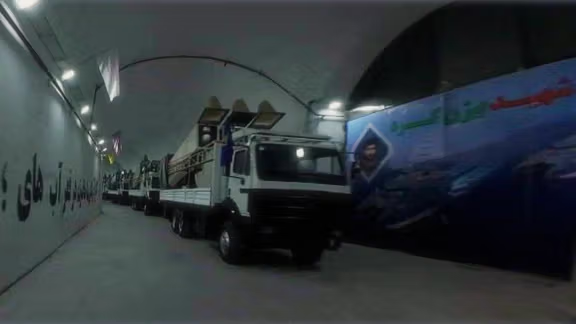
A photo of the new IRGC Navy underground missile base which was unveiled on February 1, 2025

The Islamic Revolutionary Guard Corps (IRGC) Navy on Saturday unveiled another underground missile base in the coastal areas of southern Iran, state TV reported.

"We are preparing ourselves to confront any enemy, at any scale, in any manner, and in any geography," said IRGC Navy Chief Alireza Tangsiri after unveiling the new underground missile city.

The missile bases are unveiled as a message to Iran's enemies, IRGC Chief Commander Hossein Salami said, calling on them to "make more precise calculations and to ensure they do not make mistakes that would put both themselves and others in trouble."

Should they make any mistake, "all these systems you see will be activated," he warned.

The IRGC also unveiled a new cruise missile, named Ghadr-380, which has "anti-jamming capabilities" and a range of more than 1,000 km (more than 600 miles), according to IRGC Navy Commander Alireza Tangsiri.

"Cruise missiles with the capability of countering enemy destroyers' electronic warfare are stationed in the IRGC's new underground missile city," the IRGC-affiliated Sabereen News reported.

"These missiles, with significant upgrades to their weapon systems and electronic warfare countermeasures, are ready for deployment in the shortest possible time," the report added.

This is the third underground missile base being unveiled by the Revolutionary Guard over the past month.

On January 18, the IRGC Navy unveiled an underground naval missile base at an undisclosed Persian Gulf location, two days before Trump's return to the White House.

The base is one of several built underground for vessels capable of launching long-range missiles and carry out distant warfare, IRGC Chief Commander Hossein Salami said after visiting the secret base during war games.

Footage released by IRGC-affiliated media and the state TV showed tunnels with long rows of "a new version of Taregh-class radar-evading speedboats which can launch cruise missiles."

Also on January 10, the IRGC's Aerospace Force unveiled what state TV called an underground missile city.

The base was used in the Iranian missile attacks against Israel in what the Islamic Republic codenamed operations True Promise 1 and 2 in April and October 2024, the IRGC-affiliated Tasnim said.

"The volcano lying under these mountains can erupt in the shortest time possible," state TV's report said.

Iran has been conducting multiple military exercises in the past few weeks, including air defense drills near nuclear sites like Natanz and a 110,000-strong Basij mobilization in Tehran, to showcase its capabilities and project a message of strength in the region, following consecutive defeats for its allies since September.

IRGC commander-in-chief Hossein Salami said earlier this month that the ongoing military exercises aim to make the enemies refine their assessments of Iran’s defense capabilities and demonstrate that the country’s deterrence is unaffected by external events, a tacit reference to the fall of Tehran’s longtime ally Bashar al-Assad in Syria.

Most Viewed

US blockade enters murky phase as tankers spoof signals and buyers hesitate
1
ANALYSIS

US blockade enters murky phase as tankers spoof signals and buyers hesitate

2
INSIGHT

Ideology may be fading in Iran, but not in Kashmir's ‘Mini Iran'

3
INSIGHT

Hardliners push Hormuz ‘red line’ as US blockade tests Iran’s leverage

4
VOICES FROM IRAN

Hope and anger in Iran as fragile ceasefire persists

5

US sanctions oil network tied to Iranian tycoon Shamkhani

Banner
Banner

Spotlight

  • Hardliners push Hormuz ‘red line’ as US blockade tests Iran’s leverage
    INSIGHT

    Hardliners push Hormuz ‘red line’ as US blockade tests Iran’s leverage

  • Ideology may be fading in Iran, but not in Kashmir's ‘Mini Iran'
    INSIGHT

    Ideology may be fading in Iran, but not in Kashmir's ‘Mini Iran'

  • War damage amounts to $3,000 per Iranian, with blockade set to add to losses
    INSIGHT

    War damage amounts to $3,000 per Iranian, with blockade set to add to losses

  • Why the $100 billion Hormuz toll revenue is a myth
    ANALYSIS

    Why the $100 billion Hormuz toll revenue is a myth

  • US blockade targets Iran oil boom amid regional disruption
    ANALYSIS

    US blockade targets Iran oil boom amid regional disruption

  • Iran's digital economy battered by prolonged blackout
    INSIGHT

    Iran's digital economy battered by prolonged blackout

•
•
•

More Stories

India confirms three nationals missing in Iran, seeks Tehran’s assistance

Feb 1, 2025, 14:20 GMT+0

India announced on Friday that three of its nationals who traveled to Tehran for business have gone missing.

The Indian Ministry of External Affair said it has formally requested assistance from the Islamic Republic to locate the missing individuals.

"Three Indian nationals who had gone to Iran for business purposes, they are missing. We are in touch with their families. We have taken up the matter with the Iranian Embassy in Delhi and with the Iranian Ministry of Foreign Affairs in Tehran," Ministry of External Affairs (MEA) spokesperson Randhir Jaiswal said during a weekly briefing.

Jaiswal said the Indian Embassy in Tehran is in touch with local officials to make sure about the missing people's safety.

According to Indian media, 33-year-old Yogesh Panchal arrived in Tehran on December 5 but lost contact with his family two days later. Mohammad Sadeeque also traveled to Iran in December, while Sumeet Sud entered the country in January.

Past cases have seen Indian nationals detained in Iran, often as crew members aboard foreign vessels held in Iranian waters. Over the years, Iranian intelligence arrested many foreigners and kept them as de facto hostages, according to Amnesty International and other human rights groups.

Iran’s foreign ministry has yet to comment on the situation.

In bitter paradox, Iran grows more polluted even as it runs low on fuel

Feb 1, 2025, 12:52 GMT+0
•
Dalga Khatinoglu

Iranians are caught in an economic and environmental catch-22 as a fuel shortage is paradoxically coinciding with an uptick in polluting greenhouse gas emissions which by the government's own admission has killed tens of thousands of people.

The dual crisis has become so severe that schools across Iran have been forced to close for 24 days in the past three months. Government offices and businesses are faring no better.

“Iran loses approximately 50,000 lives annually due to air pollution. This is the human cost of air pollution," Iran’s Health Minister Mohammadreza Zafarghandi announced.

The financial cost of air pollution in Iran is at least $12 billion annually, he added, a figure that some estimates say could rise to $20 billion.

These vast human and financial costs come alongside a significant reduction in the domestic use of cleaner fossil fuels which are set aside for profitable export abroad.

Meanwhile, Iran has ramped up the consumption of highly polluting fuels like mazut, or heavy fuel oil.

In the absence of official statistics, Iran International has found evidence that Tehran has significantly increased its exports of cleaner fuels such as natural gas, liquefied petroleum gas (LPG), and kerosene while sharply increasing domestic consumption of highly polluting fuels like mazut.

The latest statistics from Turkey’s Energy Market Regulatory Authority show that in the first 11 months of last year, Turkey increased gas imports from Iran by 40%, reaching nearly 6.5 billion cubic meters. Iran also exports gas to Iraq, though no official figures on the volume are available.

Natural gas is the cleanest fossil fuel, followed by LPG (a combination of propane and butane).

Data from energy consultancy Kpler obtained by Iran International shows Iran’s LPG exports have grown significantly over the past four years, peaking at 337,000 barrels per day in 2024 or more than double the amount exported in 2020.

Radio Farda recently published a report citing a confidential Ministry of Petroleum document indicating Iran has also increased kerosene exports while nearly halving its domestic consumption.

The same document indicates that domestic mazut consumption in the first seven months of current fiscal year beginning in late March last year rose by over half compared to the same period last year.

In contrast, Iran’s exports of mazut - the most polluting fossil fuel - have been on a consistent downward trend in recent years while domestic use has surged.

Kpler data seen by Iran International shows Iran exported an average of 232,000 barrels per day of mazut last year—a 42% drop compared to 2021.

Iran has reduced its mazut exports because the mazut it produces contains 3.5% sulfur—seven times higher than the standard required for marine fuel. This high sulfur content has created significant challenges for exporting the fuel.

If Iran halted the export of cleaner fuels like natural gas or LPG, there would be no need to rely on mazut domestically, and diesel consumption would also halve.

Currently, Iran consumes around 700,000 barrels of diesel and 780,000 barrels of gasoline daily.

Greenhouse gas emissions up

According to the latest data from the Global Carbon Project, Iran’s greenhouse gas emissions in 2023 reached about 818 million tons, marking a 10% increase since 2020, a rise by nearly half since 2010 and a staggering 155% surge since 2000.

Globally, despite its relatively middling population size, Iran is the six biggest emitter of greenhouse gas.

Natural gas accounts for 70% of Iran’s energy consumption and over the past decade, Iran’s gas production and consumption grew by more than 5% annually.

However in recent years this growth has plummeted to just 2%, and the International Energy Agency reported in January that it dropped below 2% last year and was expected to shrink to just 1% in 2025.

Despite slowing gas production and mounting shortages, President Masoud Pezeshkian’s government has allocated the export of 16 billion cubic meters of gas in the upcoming fiscal year, or nearly double the amount for the target this year.

Iran stands firm on Hezbollah support amid rising pressure

Feb 1, 2025, 11:39 GMT+0

Iranian officials, during the commemoration of Hezbollah leader Hassan Nasrallah in Lebanon, doubled down on their support for the group amid escalating pressures from the US and Israel.

"The Islamic Republic of Iran, despite all opposing statements, firmly supports the resistance in the region, and this is a definitive decision," said Saturday Iran’s ambassador to Lebanon, Mojtaba Amani.

Senior Iranian official Vahid Jalalzadeh backed this position, portraying Hezbollah as a key player in Lebanon’s trajectory. "Today, in this place, we announce that we are witnessing the defeat of the enemy," he said, describing the group's ongoing struggle amid regional tensions.

Iran’s renewed backing comes at a time of crisis for Hezbollah. During Israeli strikes last year, the group suffered some of its worst losses in years. In a series of coordinated attacks in September and October, thousands of Hezbollah operatives were eliminated through targeted explosions and airstrikes. Key figures, including Nasrallah himself, were killed, dealing a severe blow to the group’s leadership and command structure.

The funerals of Hezbollah Secretary General Hassan Nasrallah and Executive Council Chief Hashem Safieddine will take place on Sunday, February 23, according to Al Hadath.

Meanwhile, Israel has accused Iran of funneling millions of dollars to Hezbollah through secret cash deliveries. According to a Wall Street Journal report, Iranian envoys have been flying into Beirut with suitcases stuffed with US dollars, while Turkish nationals have allegedly been acting as couriers to transfer additional funds from Istanbul. These allegations have been raised in formal complaints to the US-led ceasefire committee, though existing ceasefire terms focus on arms smuggling rather than financial transactions.

Washington, too, is increasing pressure on Lebanon’s leadership. As Prime Minister-designate Nawaf Salam assembles his cabinet, US officials are urging Lebanese leaders to prevent Hezbollah or its allies from controlling key positions, particularly the finance ministry. US diplomats have warned that Lebanon’s ability to secure vital international aid for post-war reconstruction could be at risk if Hezbollah maintains its political grip.

Swedish daily: Iranian cleric arrested, facing deportation

Feb 1, 2025, 09:49 GMT+0

An Iranian cleric, an imam at an Islamic Center in suburban Stockholm, has been arrested for nearly two weeks and faces deportation from Sweden, Expressen reported Friday.

Almost two weeks ago, individuals in civilian clothing went to the home of cleric Mohsen Hakimollahi at midnight and took him away, a close associate told Expressen.

“He has been missing for more than ten days and we learned through various channels that he is in one of the Swedish Migration Board's detention centers and will soon be deported from the country,” added the source.

The Imam Ali Islamic Center, considered the largest Shiite institution in Northern Europe, has not issued a public statement on the matter.

Hakimollahi, aged 63, was transferred from Iran to Sweden to manage the Shiite center and had resided in the country for several years, developing connections with local political figures and religious organizations.

He was initially granted a temporary work permit in 2011, which was renewed three times prior to him obtaining permanent residency in 2017. However, that status has now been taken away.

"I can confirm that we are not conducting any preliminary criminal investigation connected to this individual," said Gabriel Wernstedt, spokesperson for Sweden’s Security Service (Säpo).

Wernstedt explained that Sweden's security police can apply special laws to counter security threats to the country. These laws allow authorities to detain non-citizens until their deportation. Such decisions are made based on various intelligence assessments.

In a separate development, the Swedish TV channel, TV4 Nyheterna, reported on Tuesday that Rouzbeh Parsi, of Iranian origin and the head of the Middle East program at the Swedish Institute of International Affairs (UI), communicated with authorities in Tehran who actively sought to amplify official Iranian foreign policy talking points in Western policy circles. Parsi later rejected the accusation. However, his brother, Trita Parsi in the US is known as a supporter of Tehran's foreign policy positions.

The detention of the cleric occurs after years of strained relations between Iran and Sweden, after 2019 when Sweden apprehended and sentenced Hamid Nouri, a former Iranian prosecutor for his involvement in the 1988 mass executions of political prisoners in Iran.

After serving five years of a life sentence, Nouri was swapped for a Swedish diplomat and an Iranian-Swedish national held in Iran on what human rights organization said were fabricated charges.

Another Iranian-Swedish individual, Ahmadreza Jalali, is still in custody in Iran facing a death sentence.

Hakimollahi’s phone has been inaccessible since his detention, and Expressen's attempts to contact his family for a statement have been unsuccessful.

US bipartisan resolution calls for ‘all options’ on Iran’s nuclear threat

Feb 1, 2025, 08:55 GMT+0

A Senate resolution introduced on Friday urges Washington and its allies to maintain a firm stance, ensuring that all possible options remain available against the threat of a nuclear-armed Iran.

Led by Senator Lindsey Graham (R-SC), the bipartisan resolution was co-sponsored by Senators John Fetterman (D-PA) and Katie Britt (R-AL), alongside Representatives Jared Moskowitz (D-FL) and Mike Lawler (R-NY).

“If the Iranian Ayatollah and his henchman obtain a nuclear weapon, it would be one of the most destabilizing and dangerous events in world history,” Graham said in a statement. “They are trying to acquire a nuclear weapon as part of their religious agenda to purify their faith, destroy the Jewish State, and drive Westerners out of the Middle East.”

During his first term in 2018, President Donald Trump withdrew from the Obama-era JCPOA nuclear deal, demanding greater concessions from Tehran. The Biden administration later spent 18 months in indirect talks with Iran to negotiate a new agreement, but the effort failed. Now, Iran has enough enriched uranium to produce four to five nuclear warheads in a relatively short time.

The resolution does not explicitly authorize the use of military force, but it affirms that Iran’s nuclear ambitions must be met with strong opposition. It also calls on Iran to immediately cease uranium enrichment, the development of nuclear warheads, and the possession of delivery systems capable of carrying such weapons.

Although Trump and his aides have taken a tough stance on Iran's nuclear threat, they have not outlined their plans for the coming months. It remains to be seen whether he will tighten economic sanctions or pursue negotiations.

Fetterman stressed the urgency of the issue, saying that “Iran’s pursuit of nuclear weapons is a threat we cannot ignore.” He added, “The United States, Israel, and our allies cannot afford to sit back while the Iranian regime continues down this dangerous path. This resolution sends an unmistakable message: all options are on the table to prevent a nuclear-armed Iran.”

Britt doubled down, insisting that a firm foreign policy is the key to keeping Iran in check. “Peace is achieved through strength, and our resolution sends an important bipartisan message to Iran that the US will not tolerate Tehran’s aggression,” she said.

Moskowitz described Iran’s nuclear ambitions as an unacceptable escalation that poses a direct threat to the security of the US and its allies. “Iran must dismantle its nuclear program now. This resolution makes clear the United States won’t stand for anything less and will consider all options to protect our national security,” he said.

Lawler also warned of the consequences of a nuclear-armed Iran, calling it a danger “not only to our closest ally, Israel but also to the whole world.” He added, “We must keep all options on the table when it comes to dealing with this unprecedented situation.”

Also on Friday, an exiled Iranian opposition group presented what it described as evidence that Tehran is secretly developing nuclear-capable warheads for missiles capable of reaching Europe.

At a press conference in Washington, DC, the National Council of Resistance of Iran (NCRI) pointed to the Shahroud missile site in northeastern Iran, where it said the Islamic Republic is working on nuclear warheads for solid-fuel missiles with a range of over 3,000 kilometers (1,864 miles).

The NCRI attributed the information to its network of sources inside Iran but did not provide further details on the evidence.