• العربية
  • فارسی
Brand
  • Iran Insight
  • Politics
  • Economy
  • Analysis
  • Special Report
  • Opinion
  • Podcast
  • Iran Insight
  • Politics
  • Economy
  • Analysis
  • Special Report
  • Opinion
  • Podcast
  • Theme
  • Language
    • العربية
    • فارسی
  • Iran Insight
  • Politics
  • Economy
  • Analysis
  • Special Report
  • Opinion
  • Podcast
All rights reserved for Volant Media UK Limited
volant media logo

US sees Iran's advocates of nuclear arms emboldened

Mar 25, 2025, 18:09 GMT+0Updated: 08:47 GMT+0
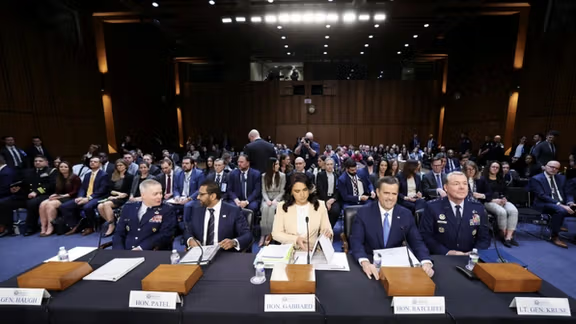
US director of national intelligence Tulsi Gabbard appears at a congressional hearing alongside other intelligence leaders, Mar. 25 2025

Iran is not building nuclear weapons but recent discourse in Tehran urging the acquisition a bomb is emboldening advocates for such a move in decision-making circles, US director of national intelligence Tulsi Gabbard said on Tuesday.

"The intelligence community continues to assess that Iran is not building a nuclear weapon and Supreme Leader Khamenei has not authorized the nuclear weapons program that he suspended in 2003," Gabbard told a congressional hearing.

"The IC continues to monitor closely if Tehran decides to reauthorize its nuclear weapons program," she added. "In the past year, we've seen an erosion of a decades long taboo in Iran on discussing nuclear weapons in public, likely emboldening nuclear weapons advocates within Iran's decision-making apparatus."

A top foreign policy advisor to Khamenei and former foreign minister said last year that Iran is capable of producing nuclear weapons and an existential threat could cause a rethink of the Supreme Leader's religious injunction against them.

Kamal Kharrazi's remarks were among the clearest by a senior official mooting the possibility of a nuclear deterrent after over a year of direct and proxy combat with US-allied Israel dealt the Islamic Republic some of its biggest ever military setbacks.

Tehran denies seeking nuclear weapons but US President Donald Trump has demanded the Islamic Republic come to a new deal over its disputed nuclear program or face a military intervention.

"Iran will likely continue efforts to counter Israel and press for US military withdrawal from the region by aiding arming and helping to reconstitute its loose consortium of like minded terrorists and militant actors, which it refers to as its Axis of Resistance," Gabbard continued.

"Although weakened, this collection of actors still presents a wide range of threats," she added, citing Israel, US military personnel in the Middle East and commercial shipping as potential targets.

Gabbard's appearance alongside other senior US intelligence leaders comes amid dismay in Washington about the inclusion of a prominent journalist in a chat including including some of the officials discussing sensitive military plans.

The inclusion of The Atlantic editor Jeffrey Goldberg in the discussion over commercial messaging app Signal about forthcoming US attacks on Iran-backed Houthi fighters in Yemen has stoked criticism over their handling of intelligence.

Asked how stepped-up sanctions under Trump might affect Iran's behavior, Gabbard said the president's "maximum pressure" campaign had yet to be fully felt.

"These sanctions have just begun to be reinstated, so the full effects are not yet, have not yet borne fruit," she said. "But the message that the President has sent with his maximum pressure campaign is certainly heard."

Most Viewed

US blockade enters murky phase as tankers spoof signals and buyers hesitate
1
ANALYSIS

US blockade enters murky phase as tankers spoof signals and buyers hesitate

2
INSIGHT

Ideology may be fading in Iran, but not in Kashmir's ‘Mini Iran'

3
INSIGHT

Hardliners push Hormuz ‘red line’ as US blockade tests Iran’s leverage

4
VOICES FROM IRAN

Hope and anger in Iran as fragile ceasefire persists

5

US sanctions oil network tied to Iranian tycoon Shamkhani

Banner
Banner

Spotlight

  • Hardliners push Hormuz ‘red line’ as US blockade tests Iran’s leverage
    INSIGHT

    Hardliners push Hormuz ‘red line’ as US blockade tests Iran’s leverage

  • Ideology may be fading in Iran, but not in Kashmir's ‘Mini Iran'
    INSIGHT

    Ideology may be fading in Iran, but not in Kashmir's ‘Mini Iran'

  • War damage amounts to $3,000 per Iranian, with blockade set to add to losses
    INSIGHT

    War damage amounts to $3,000 per Iranian, with blockade set to add to losses

  • Why the $100 billion Hormuz toll revenue is a myth
    ANALYSIS

    Why the $100 billion Hormuz toll revenue is a myth

  • US blockade targets Iran oil boom amid regional disruption
    ANALYSIS

    US blockade targets Iran oil boom amid regional disruption

  • Iran's digital economy battered by prolonged blackout
    INSIGHT

    Iran's digital economy battered by prolonged blackout

•
•
•

More Stories

Iran rejects Western trigger mechanism threat as pressure tactic

Mar 25, 2025, 14:44 GMT+0

Iran warned on Tuesday that it would respond strongly to any use of the so-called snapback mechanism by Western countries, a tool within the 2015 nuclear deal that could reimpose international sanctions on Tehran lifted by the deal.

Behrouz Kamalvandi, spokesman for the Atomic Energy Organization of Iran (AEOI), dismissed Western threats to invoke the mechanism as "hollow," arguing that Iran's reduction of its nuclear commitments was a direct result of the United States' withdrawal from the deal and the failure of other signatories to uphold their obligations.

"If they had fulfilled their commitments and the sanctions had been lifted, and if the US had not withdrawn from the JCPOA, naturally Iran would have fulfilled its commitments," Kamalvandi said, using the acronym for the nuclear deal.

"If Iran has stopped its commitments, it is because it does not benefit from this general agreement."

He emphasized that Iran views the trigger mechanism as a pressure tactic, similar to economic and military threats.

"The Islamic Republic of Iran considers the trigger mechanism as a tool of pressure, like other economic and military threats, and will certainly stand firmly against these issues and defend the country's rights," Kamalvandi said.

While he highlighted Iran's openness to dialogue, he stressed that it would not succumb to pressure. "Iran is always ready for interaction, but this does not mean accepting pressure," he said, adding that the country's policies are determined by Supreme Leader Ali Khamenei.

The 2015 nuclear deal, formally known as the Joint Comprehensive Plan of Action (JCPOA), offered Iran sanctions relief in exchange for curbs on its nuclear program. The US withdrew from the deal in 2018 under then-President Donald Trump, reimposing sanctions on Tehran.

Iran has repeatedly warned of severe consequences, including NPT withdrawal, if snapback sanctions are triggered.

Activating the snapback would then fall to one of the three European countries, or E3, parties to the deal, France, Britain and Germany. Those powers are currently negotiating with Iran about future steps to salvage the agreement.

US lawmakers are pressing European allies to trigger the JCPOA's snapback mechanism, citing its nuclear deal violations. The bipartisan move, driven by concerns over Iran's near weapons-grade uranium enrichment, aims to curb Tehran's nuclear ambitions before key deal provisions expire in October 2025.

Britain has mooted willingness to eventually trigger the UN sanctions.

Iran has enriched uranium to up to 60% fissile purity, closer to the 90% needed for a bomb.

Iran's uranium stock refined to up to 60% grew by 92.5 kilograms (kg) in the past quarter to 274.8 kg, one of the IAEA reports said. According to an IAEA yardstick, the amount is enough in principle for six nuclear bombs if enriched further.

While Tehran has reduced IAEA inspections since 2021 and in 2023 barred a third of the inspectors, it continues to argue that its nuclear activities are peaceful.

Iran must explain past uranium traces before a new deal, UN nuclear chief says

Mar 25, 2025, 11:25 GMT+0

The UN nuclear watchdog warned that any new agreement with Iran is impossible before Tehran resolves outstanding questions about uranium traces found at undeclared sites.

"Common sense dictates you cannot build on a shaky basis," the head of the International Atomic Energy Agency (IAEA) said in an interview with Bloomberg, stressing that unresolved issues concerning uranium traces discovered at undeclared locations must be addressed.

"We discovered traces of uranium at places that were not supposed to have hosted any nuclear activity," he said, adding that satisfactory answers from Iran are still lacking. "We haven't had, I must say, answers or satisfying answers, to these questions."

The IAEA chief indicated that the current state of discussions with Iran regarding the unresolved uranium traces is not meeting the agency's expectations. "Well, we are not I must admit, we are not where we would like to be."

He acknowledged US President Donald Trump's outreach to Iran's Supreme Leader and his own recent and planned visits to Tehran, but underscored the necessity of addressing these past issues to establish a solid foundation for future negotiations.

"These things come together because you have, on one hand, these unresolved questions from the past. And then, yeah, at the same time the possibility of having some viable agreement form for the future."

The IAEA chief also highlighted the catastrophic potential of a nuclear-armed Iran in the volatile Middle East.

"The addition of that to the pot of nuclear weapons would be catastrophic," he said.

He called for continued efforts by the United States, European allies, and Iran to find a viable path forward as a matter of necessity, but only after the past discrepancies are resolved.

Iran has enriched uranium to up to 60% fissile purity, closer to the 90% needed for a bomb.

Iran's uranium stock refined to up to 60% grew by 92.5 kilograms (kg) in the past quarter to 274.8 kg, one of the IAEA reports said. According to an IAEA yardstick, the amount is enough in principle for six nuclear bombs if enriched further.

While Tehran has reduced IAEA inspections since 2021 and in 2023 barred a third of the inspectors, it continues to argue that its nuclear activities are peaceful.

EU says Iran threatens global order, supports talks to stop nuclear armament

Mar 24, 2025, 09:41 GMT+0

European Union foreign policy chief Kaja Kallas warned on Monday that Iran poses a serious threat to global stability and must never be allowed to obtain a nuclear weapon, during a press conference in Jerusalem with Israeli Foreign Minister Gideon Sa’ar.

"On Iran, we agree the immense threat Iran poses to the region and global stability. Iran is a threat also supporting Russia's war in Ukraine," Kallas said.

"Iran must never be allowed to acquire or build a nuclear weapon. And EU supports all diplomatic efforts to that effect," she added.

Sa’ar said it was “only natural” for Israel to expect European backing in the ongoing conflict the country is fighting against Iran's allies, and framed the war as part of a broader global struggle.

“We are now fighting the war of the free world,” he said. “Iran, Houthis, Hamas, and Hezbollah attack us because we are nearby", he said after last week saw three of Iran's allies once again firing on the Jewish state as ceasefires collapsed.

"But make no mistake, the war is against Western civilization—against its values and its ways of life," he added.

Earlier this month, the European Union's top diplomat called for an international nuclear deal with Iran along the lines of the 2015 JCPOA agreement, days after US President Donald Trump mooted military action to dismantle it.

High Representative Kaja Kallas told a United Nations Security Council session on EU-UN cooperation: "The constant expansion of Iran’s nuclear programme fully contradicts Iran’s own commitments as endorsed by the Security Council."

Iranians discuss Trump envoy’s interest in visiting Tehran

Mar 24, 2025, 08:43 GMT+0
•
Maryam Sinaiee

Steve Witkoff’s suggestion that he or another member of President Donald Trump’s team could potentially visit Iran for talks has received widespread coverage in Iranian online media.

At the end of an interview with Tucker Carlson on Friday, President Trump’s special envoy to the Middle East expressed hope that he or someone else from the administration might visit Tehran, as Carlson had suggested. Witkoff acknowledged the complexity of the Iran issue due to its nuclear dimension and the need for technical expertise. “I’m going to welcome that opportunity if I’m involved,” he stated.

So far, there has been no official Iranian reaction to Witkoff’s remarks. However, Nour News, a media outlet close to Iran's Supreme National Security Council, said in a tweet in English on Sunday that Witkoff’s tone “won’t clear up misunderstandings as no behavioral changes have occurred,” referring to US policies toward the Islamic Republic. Nour News added that the US is still pursuing talks while exerting pressure on Tehran. “If Washington wants a new nuclear verification process, it must first present real evidence of Iran's intent to obtain nukes!”

The lack of more commentary in online publications may be due to limited resources during the Nowruz holidays. Some public figures, however, have also commented on the interview via social media, where high engagement suggests significant public interest.

Throughout the lengthy interview, Witkoff reiterated that President Trump was open to negotiating a resolution with Iran, allowing the country to reintegrate into the global economy without the burden of sanctions. He emphasized Trump’s preference for diplomacy over military action and suggested that a verification program could be established to ensure Iran’s nuclear program remains peaceful.

Speaking on Fox News on Sunday, Witkoff reinforced the administration’s message to Iran, urging diplomatic engagement to resolve ongoing tensions. “And if we can't, the alternative is not a great alternative,” he warned, stressing that the U.S. would not allow Iran to develop nuclear weapons.

Diverging perspectives within the Trump administration

Witkoff’s remarks—particularly his focus on controlling Iran’s nuclear program through verification—contrast with statements from President Trump and other senior officials, who have called for the complete dismantling of Tehran’s nuclear program. White House National Security Advisor Michael Waltz reiterated on Sunday that the Trump administration seeks the full dismantlement of Iran’s nuclear program in a transparent manner that satisfies the international community.

Reactions from Iranian figures

“Dear friends in the Foreign Ministry, Witkoff has expressed interest in visiting Iran!” wrote Nosratolah Tajik, a relatively moderate politician and former diplomat, in a brief post on X on Saturday. He suggested that Tehran should invite Witkoff before formally responding to President Trump’s letter to Supreme Leader Ali Khamenei—both as a gesture of diplomatic goodwill and a display of political savvy, while also helping to deflect public criticism.

“It’s not just me saying this—former senior diplomats from the Foreign Ministry also advise against rejecting Witkoff’s expression of interest in visiting Iran,” wrote senior reformist journalist Mohammad Sahafi, referencing Tajik’s post.

An expatriate dissident, Akbar Ganji, echoed this sentiment, advocating for direct talks between Iran and the US, starting with a meeting between Iranian officials and Witkoff and eventually progressing to a summit between the Iranian and US presidents to finalize an agreement.

Former Reformist diplomat and political editor Abdolreza Raisi also backed the idea of hosting Witkoff in Iran. “How can we refuse to host him now that he’s expressed interest in visiting, especially to verify such claims and put the ball in their court?” he wrote in a post on X.

Skepticism from US analysts

Jason Brodsky, Policy Director at United Against Nuclear Iran (UANI), suggested in a post on X that certain Iranian officials and regime sympathizers may be attempting to exploit perceived divisions within the Trump administration. According to Brodsky, these figures are bypassing Secretary of State Marco Rubio and National Security Advisor Mike Waltz while engaging with officials they believe are more receptive to negotiations.
US seeks full dismantling of Iran's nuclear program, Trump's advisor says

Mar 23, 2025, 15:07 GMT+0

The Trump administration is seeking full dismantlement of Iranian nuclear program in a way that the entire world can see, White House National Security Advisor Michael Waltz told CBS News on Sunday.

“It is time for Iran to walk away completely from its desire to have a nuclear weapon. And they will not, and cannot be allowed to have a nuclear weapons program, that’s enrichment, weaponization, and its strategic missile program,” Waltz said.

“The President has all options on the table. But we want to be clear, this isn't some kind of, you know, kind of tit for tat that we had under the Obama administration, or Biden. This is the full program. Give it up, or there will be consequences,” he added.

His comments came in contrast to the much more conciliatory tone of Trump’s Middle East envoy, Steve Witkoff, who spoke of the US president's intention to resolve Iran's nuclear dispute diplomatically.

Earlier this month, Trump wrote a letter to Iran’s Supreme Leader Ali Khamenei in an attempt to explore a new nuclear agreement and prevent military escalation, Witkoff told Fox News on Sunday.

"We don't need to solve everything militarily," Witkoff said.

He emphasized that Iran cannot have a nuclear bomb, saying, “It cannot happen and it will not happen.”

"Our signal to Iran is let's sit down and see if we can, through dialogue, through diplomacy, get to the right place. If we can, we are prepared to do that. And if we can't, the alternative is not a great alternative."

On Friday, Witkoff told the Tucker Carlson show, “We should talk. We should clear up the misconceptions. We should create a verification program so that nobody worries about weaponization of your nuclear material."

He also said Trump believes the issue “has a real possibility of being solved diplomatically” and “acknowledged that he's open to an opportunity to clean it all up with Iran.”

His remarks raised questions about the Trump's administration's approach toward Iran, as Trump's Secretary of State, Marco Rubio, and National Security Advisor, Michael Waltz, have taken a much tougher stance, insisting over the past few weeks that Iran's nuclear program must be dismantled and that Iran will face military action unless it complies with US demands.