• العربية
  • فارسی
Brand
  • Iran Insight
  • Politics
  • Economy
  • Analysis
  • Special Report
  • Opinion
  • Podcast
  • Iran Insight
  • Politics
  • Economy
  • Analysis
  • Special Report
  • Opinion
  • Podcast
  • Theme
  • Language
    • العربية
    • فارسی
  • Iran Insight
  • Politics
  • Economy
  • Analysis
  • Special Report
  • Opinion
  • Podcast
All rights reserved for Volant Media UK Limited
volant media logo

Iran executed at least 1,000 people so far this year, rights group says

Sep 23, 2025, 17:25 GMT+1Updated: 00:36 GMT+0

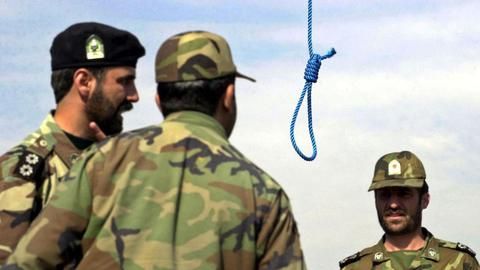
Iran has executed at least 1,000 people so far this year or the most in over three decades, according to Norway-based Iran Human Rights (IHR), which called for a United Nations investigation into what it described as crimes against humanity.

“This is the highest number of recorded executions in more than 30 years,” IHR said in a statement. Iran executed at least 5,000 political prisoners in 1988, according to Amnesty International.

From Jan. 1 to Sept. 23, IHR said it had verified 1,000 executions, including 64 in the past week alone — an average of more than nine a day.

The group said the figures represented a minimum, as many cases went unreported.

“In recent months the Islamic Republic has begun a mass killing campaign in Iran’s prisons, the dimensions of which, in the absence of serious international reactions, are expanding every day,” IHR Director Mahmood Amiry-Moghaddam said in a statement.

“The widespread, arbitrary executions of prisoners without due process and fair trial rights amount to crimes against humanity and must be placed at the top of the international community’s agenda.”

IHR said most executions were for drug-related and other non-lethal offences, which do not meet the “most serious crimes” threshold under international law.

According to its data, 50% were for drug charges, 43% for murder, 3% for security-related charges such as baghy (armed rebellion) and moharebeh (waging war against God), 3% for rape and 1% for espionage for Israel.

Only 11% of executions were announced by official sources, with none of the drug-related cases disclosed publicly, the group added.

The organization urged the UN Human Rights Council’s Fact-Finding Mission on Iran to investigate the executions, citing their “scale, systematic nature and political function to intimidate and create societal fear.”

At least 975 people were executed in Iran in 2024, a 17% increase from the previous year, making it one of the world’s leading users of the death penalty, according to rights monitors.

Most Viewed

US blockade enters murky phase as tankers spoof signals and buyers hesitate
1
ANALYSIS

US blockade enters murky phase as tankers spoof signals and buyers hesitate

2
INSIGHT

Ideology may be fading in Iran, but not in Kashmir's ‘Mini Iran'

3
INSIGHT

Hardliners push Hormuz ‘red line’ as US blockade tests Iran’s leverage

4
VOICES FROM IRAN

Hope and anger in Iran as fragile ceasefire persists

5

US sanctions oil network tied to Iranian tycoon Shamkhani

Banner
Banner

Spotlight

  • Hardliners push Hormuz ‘red line’ as US blockade tests Iran’s leverage
    INSIGHT

    Hardliners push Hormuz ‘red line’ as US blockade tests Iran’s leverage

  • Ideology may be fading in Iran, but not in Kashmir's ‘Mini Iran'
    INSIGHT

    Ideology may be fading in Iran, but not in Kashmir's ‘Mini Iran'

  • War damage amounts to $3,000 per Iranian, with blockade set to add to losses
    INSIGHT

    War damage amounts to $3,000 per Iranian, with blockade set to add to losses

  • Why the $100 billion Hormuz toll revenue is a myth
    ANALYSIS

    Why the $100 billion Hormuz toll revenue is a myth

  • US blockade targets Iran oil boom amid regional disruption
    ANALYSIS

    US blockade targets Iran oil boom amid regional disruption

  • Iran's digital economy battered by prolonged blackout
    INSIGHT

    Iran's digital economy battered by prolonged blackout

•
•
•

More Stories

Iran, E3 hold last-ditch talks in New York before snapback deadline

Sep 23, 2025, 16:45 GMT+1

Iran and European powers held last-ditch talks in New York on Tuesday to try to prevent the revival of UN sanctions on Tehran, though diplomats on both sides cautioned that chances of success remain slim.

Foreign ministers of Iran, Britain, France and Germany – the so-called E3 – met on the sidelines of the UN General Assembly, joined by EU foreign policy chief Kaja Kallas, amid warnings that a 30-day “snapback” process to reimpose sanctions will expire on September 27.

In the meeting between Iranian and European top diplomats in New York, "some ideas and proposals for continuing diplomacy were raised, and it was decided that consultations with all involved parties would continue," according to Iran's Foreign Ministry.

"The course of discussions over the past month aimed at finding diplomatic solutions regarding Iran’s nuclear issue and preventing an escalation of tensions was reviewed in the meeting," according to the Foreign Ministry statement.

The E3 triggered the process on August 28, accusing Iran of failing to comply with a 2015 nuclear deal designed to prevent it from developing nuclear weapons. Tehran denies it seeks such arms, insisting its nuclear program is for peaceful purposes.

“Iran has been in contact with E3/EU officials and (the UN nuclear chief Rafael) Grossi since this morning at the UN Different ideas have been raised and discussed,” a senior Iranian official told Reuters on Tuesday.

Another Iranian official said “everyone seems to be trying” to find a resolution.

  • Iranian lawmakers urge review of defense doctrine, call for nuclear weapons

    Iranian lawmakers urge review of defense doctrine, call for nuclear weapons

  • Iran warns against sanctions 'confrontation' as IAEA cites difficult talks

    Iran warns against sanctions 'confrontation' as IAEA cites difficult talks

Iranian Foreign Minister Abbas Araghchi warned European states to choose “cooperation or confrontation.”

Speaking on state TV, he said: “They have tested Iran repeatedly and know we do not respond to the language of pressure and threat ... I hope we can find a diplomatic solution in the coming days, otherwise Tehran will take appropriate measures.”

According to diplomats, the E3 have offered to delay reinstating sanctions for up to six months if Iran restores access for UN inspectors, addresses concerns over its stockpile of enriched uranium and agrees to talks with the United States.

But two European envoys said Iran’s leaders have yet to meet these conditions. “The ball is in Iran’s camp,” one diplomat said. “It is up to it to quickly take the concrete steps in the coming days to avert snapback. If not, then sanctions will be reimposed.”

Another diplomat added, “The minimum would be for Iranians to present the special report and allow some token visit of inspectors to some sites, but even then that probably won’t fly – and chances are the US would veto.”

If no extension is agreed, all pre-2015 UN sanctions will automatically return on September 28, compounding economic pressures from US and European measures already in place.

President Masoud Pezeshkian said on Saturday that Iran would “overcome” any reimposition of sanctions. According to an insider cited by Reuters, growing discontent over the economy was rattling Iran’s leadership, with little sign of answers.

In June, following US and Israeli strikes on Iranian nuclear sites, Iran’s parliament passed a law suspending cooperation with the International Atomic Energy Agency. A deal with the IAEA was reached on September 9 to resume some inspections, though diplomats say its scope remains limited.

“I am in New York to use these remaining days for diplomatic consultations that might lead to a solution,” Araghchi said. “If it is not found, we will continue our path.”
Iran accepted diplomacy bids but West still levied sanctions, Larijani says

Sep 23, 2025, 16:35 GMT+1

Iran’s security chief Ali Larijani said on Tuesday that Tehran had accepted European and Russian proposals to avert the co-called snapback of UN sanctions, but the West triggered international sanctions on Iran nonetheless.

Larijani, who leads Iran's Supreme National Security Council, accused France of reneging on a pledge to hold back on the sanctions push if Iran made a deal with the International Atomic Energy Agency (IAEA).

“France, via the IAEA chief, promised to withdraw snapback demands if Iran agreed with the agency. Iran’s foreign minister signed this in Egypt, under security concerns and parliamentary mandates following bombed nuclear sites. France did not honor this,” official media quoted him as saying.

France, Britain and Germany triggered UN sanctions on August 28 through the so-called snapback mechanism of a 2015 international nuclear deal with Tehran.

On September 9, Iran and the IAEA signed a technical agreement in Cairo, mediated by Egypt, to pave the way for resuming nuclear inspections halted in June.

Ten days later, the UN Security Council rejected a resolution to keep sanctions lifted in a 4–9 vote, paving the way for sanctions to resume on September 28.

“European and Russian proposals, accepted by Iran with conditions, set a six-month negotiation period, but the West pursued snapback at the UN Security Council instead,” Larijani said.

Iran has warned that new attacks or sanctions would void the agreement, though it still sees the deal as a step toward de-escalation.

US missile demands ‘unacceptable’

Larijani also appeared to reveal details of a US proposal, saying Washington had demanded Iran reduce its missile range to under 500 km (310 miles) - “a condition no honorable person could accept,” he said.

For years, Iran has voluntarily limited its missile range, suggesting that 2,000 kilometers is sufficient to reach its main regional target, Israel.

However, a senior advisor to Iran's Supreme Leader suggested last year that the country might abandon its self-imposed missile range limit and could even pursue intercontinental capabilities if it faced an "existential threat".

Larijani made the remarks at the Tehran Chamber of Commerce, signaling preparations for the return of UN sanctions on September 28.

Iran’s Ministry of Intelligence had already issued secret guidance in August instructing ministries and major companies to prepare for the resumption of punitive UN measures.

Iran’s central bank says gold and FX reserves are secure

Sep 23, 2025, 12:35 GMT+1

Iran’s central bank governor Mohammadreza Farzin sought to reassure business leaders on Tuesday that the country’s foreign exchange and gold reserves remain secure as UN snapback sanctions loom later this month.

Speaking at a meeting with the National Entrepreneurs Assembly, Farzin said the Central Bank of Iran (CBI) has “full security and access” to reserves held abroad and is preparing special measures to support exporters, ease access to hard currency and expand financing channels.

He announced plans for up to €200 million in sukuk Islamic bonds, new credit for export-oriented firms and a joint committee with entrepreneurs to resolve banking hurdles.

Farzin stressed that the CBI’s priority is to curb inflation and maintain financial stability, pledging that “all monetary and foreign exchange decisions will be taken with these objectives in mind.”

  • Iran moves to curb media reports that could fuel panic over UN sanctions

    Iran moves to curb media reports that could fuel panic over UN sanctions

He also said the bank has introduced new instruments such as chain financing, gold-backed bonds and pre-sale of foreign currency to increase resilience in the market.

The remarks come as Iran braces for the automatic return of UN sanctions on September 28 after Britain, France and Germany triggered the mechanism last month.

  • Sanctions snapback augurs deeper pain for Iran's ailing economy

    Sanctions snapback augurs deeper pain for Iran's ailing economy

The snapback would reinstate international restrictions suspended under the 2015 nuclear deal, compounding existing US and EU sanctions that have already slashed oil revenues and battered the rial.

Iran’s currency has tumbled past 1,038,000 rials per dollar on the open market, while inflation hovers near 50%.

  • 'All engines of Iran’s growth have stopped' - Iranian business newspaper

    'All engines of Iran’s growth have stopped' - Iranian business newspaper

  • Iranian youth facing chronic anxiety as living costs climb - Tehran daily

    Iranian youth facing chronic anxiety as living costs climb - Tehran daily

Analysts warn that renewed sanctions could push inflation above 60–90% and deepen negative growth.

Despite official assurances, businesses say access to foreign exchange remains a critical obstacle, with many entrepreneurs urging structural reforms and clear rules for investors.

The central bank’s confidence message contrasts with mounting signs of distress, including protests over living costs, reports of suicides linked to financial hardship and warnings from experts that Iran’s energy and fiscal systems are at breaking point.

Iran receives Russian MiG-29 jets, expects more advanced systems, lawmaker says

Sep 23, 2025, 11:43 GMT+1

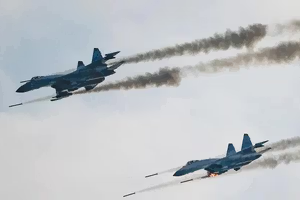
Russian MiG-29 fighter jets have arrived in Iran as part of a short-term plan to bolster its air force, with more advanced Sukhoi Su-35 aircraft to follow gradually, an Iranian lawmaker said on Tuesday.

Abolfazl Zohrevand, a member of parliament’s national security committee, told domestic media that the delivery of MiG-29s was intended as an interim measure while Tehran awaits the arrival of Su-35s “as a long-term solution.”

“Russian MiG-29 fighter jets have arrived in Iran and are stationed in Shiraz, while Sukhoi Su-35 jets are also on the way,” he said.

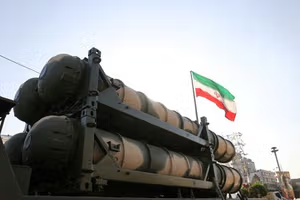
He also said that China’s HQ-9 air defense system and Russia’s S-400 system were being supplied to Iran “in significant numbers.”

Neither Moscow nor Beijing has confirmed the reported deliveries.

  • Iran buys Russian Sukhoi-35 fighter jets, state media reports

    Iran buys Russian Sukhoi-35 fighter jets, state media reports

  • Iran-Russia alliance rattled as official accuses Moscow of aiding Israel

    Iran-Russia alliance rattled as official accuses Moscow of aiding Israel

Iran has long sought to modernize its aging air force, which relies heavily on US-made jets purchased before the 1979 revolution and a small number of Russian and locally upgraded aircraft.

State media reported in January that the first Sukhoi Su-35s were formally handed over to Iran, but officials have not clarified how many are operational.

Western analysts say Iran’s request for 50 aircraftremains only partly fulfilled, with deliveries slowed by Russia’s own needs in Ukraine.

Tehran also faces vulnerability in air defenses after Israeli strikes earlier this year destroyed its last Russian-provided S-300 systems. Iran had acquired the four S-300 battalions from Russia in 2016.

Condom sales in Iran surged during Israel war, online retailer says

Sep 23, 2025, 07:58 GMT+1

Condom purchases in Iran jumped 26% during the country’s 12-day conflict with Israel in June, according to data from the country’s largest e-commerce platform Digikala.

The report on consumer behavior showed a surge in demand for a range of health-related products during the war, including sanitary pads, disinfectants, blood glucose test strips, medical bandages, nail extension supplies, blood glucose monitors, adult diapers, and sanitary underpads.

The report comes three months after Israel launched a surprise military campaign on June 13, striking military and nuclear facilities in Iran. Air attacks killed nuclear scientists along with hundreds of military personnel and civilians. Iran retaliated with drone and missile attacks which killed 31 Israeli civilians and one off-duty soldier.

The United States joined the conflict on June 22, conducting strikes on major nuclear sites including Fordow, Natanz and Isfahan, before brokering a ceasefire on June 24.

Global perspective

Similar spikes in condom sales have been reported in other countries during times of conflict or crisis. After North Korea’s nuclear test in October 2006, South Korean convenience stores recorded a surge, with condom sales averaging 1,930 per day, compared to about 1,508 per day previously.

In Russia, following the invasion of Ukraine in March 2022, major retailers reported sharp increases. The pharmacy chain Rigla noted a 26% rise, while online marketplace Wildberries saw sales climb by about 170% year-on-year, a surge linked to consumer fears of shortages and price hikes.

Similar behavior was documented in the United States during the early months of the COVID-19 pandemic, when condom makers such as Reckitt Benckiser reported sales jumps linked to consumer uncertainty and supply chain fears but not necessarily increased use.