• العربية
  • فارسی
Brand
  • Iran Insight
  • Politics
  • Economy
  • Analysis
  • Special Report
  • Opinion
  • Podcast
  • Iran Insight
  • Politics
  • Economy
  • Analysis
  • Special Report
  • Opinion
  • Podcast
  • Theme
  • Language
    • العربية
    • فارسی
  • Iran Insight
  • Politics
  • Economy
  • Analysis
  • Special Report
  • Opinion
  • Podcast
All rights reserved for Volant Media UK Limited
volant media logo

Iran rebuilding missile sites hit by Israel but key component missing - AP

Sep 24, 2025, 11:53 GMT+1Updated: 00:35 GMT+0
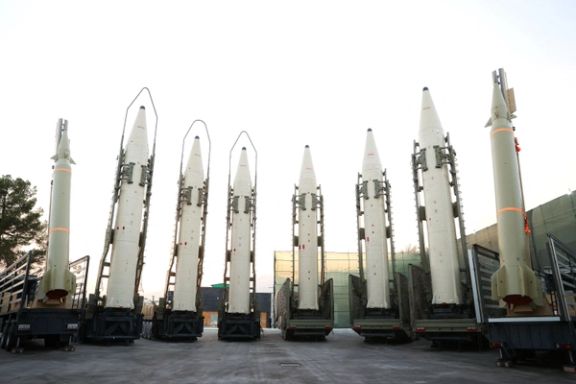
Iranian ballistic missiles are displayed during the ceremony of joining the Armed Forces, in Tehran, Iran, August 22, 2023.

Iran has begun rebuilding missile production facilities damaged in June’s 12-day war with Israel, but experts say a crucial element for solid-fuel production remains missing: planetary mixers, according to an Associated Press report analyzing satellite imagery.

Satellite images reviewed by AP show construction at missile sites in Parchin and Shahroud, where buildings housing mixers appear under repair.

“If they’re able to reacquire some key things like planetary mixers, then that infrastructure is still there and ready to get rolling again,” said Sam Lair of the James Martin Center for Nonproliferation Studies.

Solid-fuel missiles are central to Iran’s deterrence strategy after Israeli strikes decimated much of its air defense.

Iran operates solid-fuel missile production facilities at Khojir and Parchin, both near Tehran, as well as at Shahroud, about 350 kilometers (215 miles) northeast of the capital. All three sites were struck by Israel in October 2024, during earlier hostilities between the two countries.

Experts say the June strikes appeared designed to destroy buildings housing mixers, the machines essential for evenly combining missile fuel.

Iran had been producing more than 200 solid-fuel missiles a month before the war, according to AP.

Iran fired more than 570 ballistic missiles during the conflict, depleting an estimated third of its arsenal, according to the Jewish Institute for National Security of America.

Western officials believe Tehran could try to source mixers and propellant chemicals from China, which has previously supplied materials for Iran’s missile program. Beijing said it supports Iran’s sovereignty but voiced “deep concern” over rising regional tensions.

Iran’s Defense Minister Aziz Nasirzadeh said last month the country was now focused on producing “military equipment with higher precision and greater operational capabilities.”

Most Viewed

US blockade enters murky phase as tankers spoof signals and buyers hesitate
1
ANALYSIS

US blockade enters murky phase as tankers spoof signals and buyers hesitate

2
INSIGHT

Ideology may be fading in Iran, but not in Kashmir's ‘Mini Iran'

3
INSIGHT

Hardliners push Hormuz ‘red line’ as US blockade tests Iran’s leverage

4
VOICES FROM IRAN

Hope and anger in Iran as fragile ceasefire persists

5

US sanctions oil network tied to Iranian tycoon Shamkhani

Banner
Banner

Spotlight

  • Hardliners push Hormuz ‘red line’ as US blockade tests Iran’s leverage
    INSIGHT

    Hardliners push Hormuz ‘red line’ as US blockade tests Iran’s leverage

  • Ideology may be fading in Iran, but not in Kashmir's ‘Mini Iran'
    INSIGHT

    Ideology may be fading in Iran, but not in Kashmir's ‘Mini Iran'

  • War damage amounts to $3,000 per Iranian, with blockade set to add to losses
    INSIGHT

    War damage amounts to $3,000 per Iranian, with blockade set to add to losses

  • Why the $100 billion Hormuz toll revenue is a myth
    ANALYSIS

    Why the $100 billion Hormuz toll revenue is a myth

  • US blockade targets Iran oil boom amid regional disruption
    ANALYSIS

    US blockade targets Iran oil boom amid regional disruption

  • Iran's digital economy battered by prolonged blackout
    INSIGHT

    Iran's digital economy battered by prolonged blackout

  • Trump allows Iran oil sales for post-war rebuilding

    Trump allows Iran oil sales for post-war rebuilding

  • Iran must quickly prove it can rebuild across all fronts, vice president says

    Iran must quickly prove it can rebuild across all fronts, vice president says

  • Iran says it has new, more advanced missiles ready if attacked

    Iran says it has new, more advanced missiles ready if attacked

  • Rare missile tests streak through Tehran twilight

    Rare missile tests streak through Tehran twilight

•
•
•

More Stories

Israel says Iran-backed rocket threat expanding in West Bank

Sep 24, 2025, 11:27 GMT+1

The Israeli military said it uncovered a rocket in the West Bank city of Tulkarm on Tuesday, the second such incident in recent weeks, in what security officials described as part of an Iranian-directed effort to develop rocket capabilities in the territory.

Border Police sappers neutralized the device, and troops swept the area, the army said.

A week earlier, security forces raided a site near Ramallah, seizing dozens of rockets and arresting three suspects after an attempted launch.

Defense officials said, “foreign elements, led by Iran,” were working to promote rocket fire from the West Bank, which could place cities in central and northern Israel within range.

Iran has not commented on the allegations.

A rocket recovered in Tulkarm by the IDF on September 23, 2025
100%
A rocket recovered in Tulkarm by the IDF on September 23, 2025

British couple detained in Iran to face court on espionage charges

Sep 24, 2025, 09:12 GMT+1

A British couple held in Iran since January on espionage charges are due to appear in court on Saturday, their family said, expressing alarm at what they described as horrific conditions and repeated rights abuses.

Lindsay and Craig Foreman, from East Sussex, were arrested during a motorcycle world tour and accused of spying -- allegations they deny. Their son, Joe Bennett, said the pair were enduring “survival conditions” and urged the UK government to act.

The BBC reported that the couple’s family said they were “in the dark” about the upcoming court appearance, with their son confirming they had only been told the pair were due in court on Saturday.

“The systematic harassment and violations must stop. They need real, tangible support for their court appearances and to ensure proper medical attention, regular family contact and the urgent securing of their release,” Bennett said in a statement.

  • British couple detained in Iran taken to court without notice, family says

    British couple detained in Iran taken to court without notice, family says

  • Iranian authorities tortured British couple in prison, source says

    Iranian authorities tortured British couple in prison, source says

Rights groups and a source familiar with the case have alleged the couple were held in solitary confinement, beaten and threatened with execution by Iranian intelligence agents seeking forced confessions.

The Foreign, Commonwealth and Development Office said it was “deeply concerned” and continued to raise the case with Iranian authorities.

Britain has repeatedly rejected Tehran’s charges and pressed for the couple’s release. Western governments and rights organizations say Iran has a history of detaining foreign nationals as leverage in disputes, an accusation Tehran denies.

IAEA says Iran weeks from bomb fuel as Tehran vows to rebuild after US strikes

Sep 24, 2025, 08:49 GMT+1

Iran still has the capacity to advance its nuclear weapons program despite devastating US and Israeli airstrikes in June, the head of the UN’s nuclear watchdog said, as Tehran’s nuclear chief acknowledged that key facilities were “destroyed.”

“They have the capacity. A number of centrifuges may have escaped damage,” Rafael Grossi, director-general of the International Atomic Energy Agency (IAEA), told The Times.

“They have places where they manufacture these components -- rotors, bellows and things -- where they do all these activities. So if they wanted to, it would just be a matter of time.”

Grossi said it would take “not much time” to enrich Iran’s stockpile of uranium from its current 60% purity to 90% weapons-grade. “It’s a matter of weeks -- not months or years,” he said.

Although inspections have resumed at some sites after Tehran suspended cooperation following the June strikes, Grossi said his agency had yet to gain access to Iran’s uranium stockpile.

“They seem to be quite protective of this,” he said, adding that Iran believes the material could still be vulnerable to further attacks.

Iran says its uranium stockpile was buried under rubble after the strikes on its facilities and is now out of reach.

Grossi confirmed the Fordow enrichment plant had sustained “considerable damage,” saying: “The kinetic impact, the earth movement and all of that, we can say with a great degree of confidence, must have affected almost totally the equipment that was in place.”

  • Iran not allowed to cut IAEA ties over snapback sanctions, Grossi says

    Iran not allowed to cut IAEA ties over snapback sanctions, Grossi says

Eslami vows to rebuild facilities, rules out US talks

Mohammad Eslami, head of Iran’s Atomic Energy Organization and a vice president, told Sky News that the Fordow, Natanz and Isfahan facilities were hit by 30,000lb US bunker-busting bombs in June.

“It is quite normal that during a military attack on facilities, they incur damage and the infrastructure is destroyed,” he said. “What is important is that science, know-how, technology, and industry are long-standing and deeply-rooted in the history of Iran.”

Eslami added that enrichment was for peaceful purposes, dismissing Western claims that Iran sought nuclear weapons.

“The enrichment percentage, what is presented in public opinion and in the media, is fueled by politicians, adventurers, and our enemies,” he said. “The enrichment percentage is not necessarily for weapons when it is high. We need higher enrichment for our sensitivities and precision measurement tools. No one is selling us these items. We need these products for the safety system of our reactors and for sensitive processes used for managing our reactors.”

He ruled out talks with Washington. “There is no need to talk to them,” Eslami said.

“The US government has committed great injustice to the Iranian people, has inflicted heavy blows on Iran since the beginning of the Islamic Revolution, and has recently carried out military attacks against our country. An enemy is an enemy, even if they have not shown hostility, while their hostility is great, it is futile to talk to such an enemy.”

  • Iran, E3 hold last-ditch talks in New York before snapback deadline

    Iran, E3 hold last-ditch talks in New York before snapback deadline

Snapback sanctions deadline looms

The interviews come as European powers held last-ditch talks with Iran in New York before a September 27 deadline for the reimposition of UN sanctions, triggered under the 2015 nuclear deal’s “snapback” mechanism. Britain, France and Germany accuse Iran of non-compliance, while Tehran says its program remains peaceful.

Diplomats say sanctions will return automatically unless Iran restores access for UN inspectors and addresses concerns over its enriched uranium. The measures would reinstate UN travel bans, asset freezes, and arms restrictions, compounding already severe US and EU sanctions.

Iranian Foreign Minister Abbas Araghchi said in New York he was using the “remaining days for diplomatic consultations that might lead to a solution,” but warned that if no compromise was found, “we will continue our path.”

President Masoud Pezeshkian has pledged Iran would “overcome” renewed sanctions, though the rial has hit record lows and inflation is nearing 50%.

The United States estimates the strikes set back Iran’s nuclear ambitions by up to two years, but Grossi cautioned it was “subjective.”

“Yes, they can reconstruct it but it would take a considerable amount of time, which could be measured in years,” he said.

Iranian officials argue the country’s capabilities cannot be erased. “What is important is that science, know-how, technology, and industry are long-standing,” Eslami said.

As the clock ticks toward sanctions snapback, Grossi warned the stakes remain high. “It’s a matter of weeks, not months or years,” he said of Iran’s ability to reach weapons-grade enrichment — a timeline that underscores both the urgency of diplomacy and the fragility of containment.
Iran accuses US of harassing diplomats at UN with new restrictions

Sep 24, 2025, 07:28 GMT+1

Iran accused the United States on Wednesday of using new restrictions on its delegation to the United Nations as a tool of political pressure, after Washington limited Iranian diplomats’ movements in New York and denied visas to much of President Masoud Pezeshkian’s media team.

Foreign Ministry spokesman Esmail Baghaei said the curbs, which include restrictions on daily activities such as grocery shopping, were aimed at “disrupting Iran's diplomatic performance” during the UN General Assembly.

He described them as “a blatant violation” of US obligations under the 1947 UN Headquarters Agreement.

“The systematic harassment of Iranian diplomats has obstructed delegates from attending several multilateral events outside the so-called ‘permitted parameters’ this week alone,” Baghaei wrote on social media, calling the measures “a new low” in US hostility toward Iranians.

The US State Department said Monday that the restrictions were intended to prevent Iran’s delegation from “lavish shopping” in New York while ordinary Iranians face economic hardship, and to limit Tehran’s ability to “promote its terrorist agenda.”

It confined delegates to the area between UN headquarters and their hotel, with transit allowances for official meetings.

Iran’s semi-official Fars news agency reported separately that most of Pezeshkian’s media staff were denied visas, leaving only two aides -- his press chief and deputy -- to cover what it called a large number of events during the trip.

It noted that under the new rules, even the purchase of fountain pens is classified as a “luxury” requiring special permits.

The dispute comes as Pezeshkian prepare to address the 80th UNGA amid heightened tensions over Iran’s nuclear program, the looming reimposition of UN “snapback” sanctions later this month, and the fallout from a 12-day war with Israel in June.

Israel’s UN ambassador rules out fresh war with Iran

Sep 24, 2025, 02:06 GMT+1
•
Negar Mojtahedi

Israel’s ambassador to the United Nations Danny Danon told Iran International on Tuesday there is no prospect of renewed war with Tehran in the near future after US and Israeli strikes on Iran’s nuclear facilities earlier this year.

Danon said US and Israeli strikes in June delivered a major setback to Iran’s nuclear program and that it would take Tehran years to rebuild.

Asked whether Israel might carry out more attacks on Iran, Danon said it was unlikely.

“I don't think we're moving toward war, you know, Israel is a peaceful nation. And I think Iran should focus its energy supporting the Iranian people, not to spend billions on the proxies, on Hezbollah, on the Houthis.”

“They should support their own people in Iran. They deserve better than that,” he told Iran International at UN headquarters in New York,.

Still, he framed the strikes as a chance to rally the world to action, not the start of an open conflict.

Danon urged the international community to seize the moment not for escalation, but for pressure — through tougher sanctions and inspections.

“As of now, I see now is the time for the international community to step in and to apply more pressure,” he said.

He also voiced skepticism about Tehran’s alleged offer to Europeans to dilute its highly enriched uranium without intrusive verification.

His comments came hours after Iran’s Supreme Leader Ali Khamenei categorically rejected negotiations with Washington, dismissing President Donald Trump’s demand that Iran end all uranium enrichment as “dictation, not negotiation.”

In a televised speech, Khamenei said Iran would never bow to threats and vowed enrichment would continue, declaring that “a proud nation like the Iranian people will slap the mouth of the one who says this.”

In New York, Iran’s foreign minister met with his British, French, and German counterparts in last-ditch talks aimed at preventing the automatic reimposition of UN sanctions on September 28.

Diplomats warned that the chances of success remain slim, saying Tehran has yet to take the concrete steps needed to avert snapback. “The ball is in Iran’s court,” one European envoy said.

IAEA chief Rafael Grossi told The Times Tehran could resume enrichment “within weeks.”

But Danon said the strikes had bought valuable time — and that Israel’s priority now is to use that time to build international pressure on Tehran, not to move toward war.

Former deputy director Olli Heinonen told Iran International's podcast Eye for Iran that roughly 400 kilograms of uranium enriched to 60 percent remains unaccounted for — enough material for several nuclear weapons if further refined.