• العربية
  • فارسی
Brand
  • Iran Insight
  • Politics
  • Economy
  • Analysis
  • Special Report
  • Opinion
  • Podcast
  • Iran Insight
  • Politics
  • Economy
  • Analysis
  • Special Report
  • Opinion
  • Podcast
  • Theme
  • Language
    • العربية
    • فارسی
  • Iran Insight
  • Politics
  • Economy
  • Analysis
  • Special Report
  • Opinion
  • Podcast
All rights reserved for Volant Media UK Limited
volant media logo

New US sanctions target Iran’s military procurement network

Oct 1, 2025, 17:03 GMT+1Updated: 00:32 GMT+0
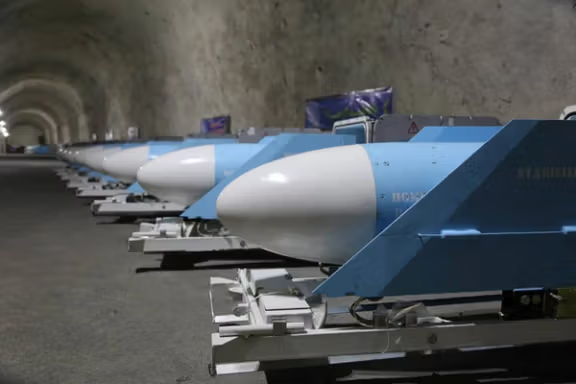
Missiles are seen at an underground missile site of Iran's Revolutionary Guards at an undisclosed location in the Persian Gulf, in this file photo from January 8, 2021

The US Treasury on Wednesday imposed sanctions on 38 individuals and companies from Iran and China it accused of advancing Iran’s military procurement including surface-to-air missiles and US-manufactured helicopter parts.

The sanctions, the Treasury said in a statement, focus on networks that facilitate the transfer of sensitive goods and technology to Iran’s Ministry of Defense and Armed Forces Logistics (MODAFL).

“Under President Trump’s leadership, we will deny the regime weapons it would use to further its malign objectives,” Treasury Secretary Scott Bessent said in a statement.

The Treasury also reminded UN member states that UN sanctions on Iran were reimposed as of September 28 and must be enforced.

These measures include restrictions on Iran’s nuclear, missile and arms programs, embargoes, export controls, travel bans, asset freezes and prohibitions on entities like banks involved in Iran’s weapons activities.

Sanctioned Iranian entities include Abzar-e Daghigh-e Taha Company, Beh Joule Pars Commercial Engineering Company and Business United Unipessoal Lda, which is tied to Pasargad Helicopter Company.

Several Chinese-based firms such as Westcom Technology Co Limited, UIY Inc, Rocket PCB Solution Ltd, and Rayming Technology were also designated.

The list further names Iranian individuals such as Mehdi Shirazi Shayesteh and Mehdi Nili Ahmadabadi, along with Chinese nationals Liu Baojuan and Sun Zhaola.

The new designations come as part of Washington’s broader effort to enforce the return of UN sanctions reactivated by European powers in response to what they say is Tehran's defiance of negotiations and nuclear inspections.

Iran denies seeking a nuclear bomb and has rejected sanctions and curbs on its conventional weapons as illegal violations of its sovereignty.

US officials argue that tightening sanctions is essential to block Tehran from acquiring advanced technologies that could bolster both its firepower and potential nuclear capabilities.

Most Viewed

US blockade enters murky phase as tankers spoof signals and buyers hesitate
1
ANALYSIS

US blockade enters murky phase as tankers spoof signals and buyers hesitate

2
INSIGHT

Ideology may be fading in Iran, but not in Kashmir's ‘Mini Iran'

3
INSIGHT

Hardliners push Hormuz ‘red line’ as US blockade tests Iran’s leverage

4
VOICES FROM IRAN

Hope and anger in Iran as fragile ceasefire persists

5

US sanctions oil network tied to Iranian tycoon Shamkhani

Banner
Banner

Spotlight

  • Hardliners push Hormuz ‘red line’ as US blockade tests Iran’s leverage
    INSIGHT

    Hardliners push Hormuz ‘red line’ as US blockade tests Iran’s leverage

  • Ideology may be fading in Iran, but not in Kashmir's ‘Mini Iran'
    INSIGHT

    Ideology may be fading in Iran, but not in Kashmir's ‘Mini Iran'

  • War damage amounts to $3,000 per Iranian, with blockade set to add to losses
    INSIGHT

    War damage amounts to $3,000 per Iranian, with blockade set to add to losses

  • Why the $100 billion Hormuz toll revenue is a myth
    ANALYSIS

    Why the $100 billion Hormuz toll revenue is a myth

  • US blockade targets Iran oil boom amid regional disruption
    ANALYSIS

    US blockade targets Iran oil boom amid regional disruption

  • Iran's digital economy battered by prolonged blackout
    INSIGHT

    Iran's digital economy battered by prolonged blackout

•
•
•

More Stories

Tehran faces worsening water shortage, official says

Oct 1, 2025, 14:18 GMT+1

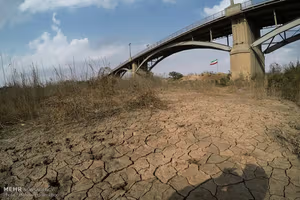
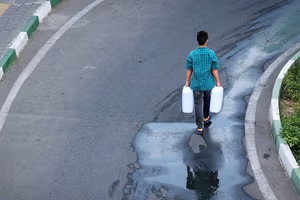
Tehran is facing an escalating water crisis as dammed reservoirs drop to critical lows, a senior sanitation official said, with rainfall and dam inflows reduced by nearly half leaving most of the capital’s reservoirs nearly depleted.

“Rainfall has dropped 40% and dam inflows 42%, leaving most of the capital’s five dams near dead storage. Only Taleghan Dam remains relatively stable,” Abbasali Mosarzadeh, CEO of Tehran’s Sewage Company cited on Tuesday as saying by official media.

“Tehran’s reserves in October fell to 258 million cubic meters, 227 million less than last year," he added. These figures were cited by Iran’s Water Resources Management Company.

The crisis extends far beyond the capital. Nationally, water reserves have fallen to alarming lows, with Iranian energy officials acknowledging that 19 of the country’s major dams are operating at below 20 percent capacity.

Independent reporting by Iran International based on satellite data showed Tehran’s Amir Kabir reservoir at roughly 6 percent of usable volume in July, with the Lar and Latyan reservoirs also at historic lows.

Groundwater depletion is worsening the picture. Research cited by Iranian geoscience institutes shows parts of Tehran sinking by more than 10 centimeters a year due to subsidence.

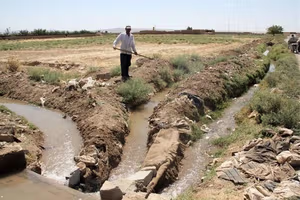
Agriculture, which consumes about 80 percent of the country’s water according to government and international environmental assessments, remains highly inefficient, further straining supplies.

Experts warn that without sweeping reforms in consumption and water management, Iran risks deeper shortages, environmental collapse, and growing public unrest.

Iran watchdog clears tougher espionage law targeting Israel, US cooperation

Oct 1, 2025, 13:27 GMT+1

Iran’s Guardian Council on Wednesday approved a bill imposing harsher penalties for espionage and collaboration with Israel, the United States and other “hostile states,” clearing the way for the law to be enacted once signed by President Masoud Pezeshkian.

The legislation, formally titled the “Intensification of Punishment for Espionage and Cooperation with the Zionist Regime and Hostile States Against National Security and Interests,” was passed by parliament in late June following the 12-day war between Iran and Israel.

The Guardian Council, a powerful 12-member body of clerics and jurists that vets legislation and elections in Iran, initially sent the bill back in July citing ambiguities, but said after revisions it no longer conflicted with Islamic law or the constitution.

  • New Iran espionage law halted for review, slowing post-war crackdown

    New Iran espionage law halted for review, slowing post-war crackdown

  • Iran's parliament approves death penalty for cooperation with Israel, US

    Iran's parliament approves death penalty for cooperation with Israel, US

The measure classifies espionage or intelligence cooperation with Israel and the US as “corruption on earth,” a charge under Iran’s penal code that can carry the death penalty.

It also criminalizes providing information, media content or assistance to groups deemed hostile, with prison sentences ranging from two to 15 years depending on the offense.

  • Iran executes man accused of spying for Israel

    Iran executes man accused of spying for Israel

  • Iran hangs nuclear scientist over alleged espionage for Israel’s Mossad

    Iran hangs nuclear scientist over alleged espionage for Israel’s Mossad

Supporters say the law is needed to counter infiltration and disinformation. “Any cooperation in media or propaganda activity, including sending videos or images to hostile channels that weaken public morale or create division, undermines national security and will face severe judicial response,” said Ebrahim Azizi, a former Revolutionary Guards commander and head of parliament’s national security committee.

  • Iran arrests over 700 accused of spying for Israel amid espionage crackdown

    Iran arrests over 700 accused of spying for Israel amid espionage crackdown

  • Iran to execute over 100 inmates over Israel spying charges - Sunday Times

    Iran to execute over 100 inmates over Israel spying charges - Sunday Times

The bill follows the June conflict in which Israeli airstrikes targeted Iranian nuclear and missile sites, prompting Tehran to retaliate with hundreds of missile and drone launches.

Iranian authorities later announced the arrest of hundreds of people accused of spying for Israel and the US.

Rights advocates have expressed concern that the law’s broad definitions, including provisions applying retroactively, could restrict free expression and be used against journalists and activists.

Jailed Georgian leaders urge UK sanctions on ruling party over Iran ties - Guardian

Oct 1, 2025, 12:21 GMT+1

Jailed Georgian opposition leaders have accused the ruling Georgian Dream party of forging closer ties with Iran and urged Britain to expand sanctions on its allies, the Guardian reported on Wednesday.

In a letter to UK Foreign Secretary Yvette Cooper from prisons in Rustavi, south-east of Tbilisi, seven politicians warned of what they called an “unprecedented expansion” of Iranian influence in Georgia.

They wrote: “We … respectfully urge you to consider extending sanctions to these individuals, their entities, and their family members, to ensure they can no longer enjoy the benefits of the UK’s democratic society while working to erode it.”

As evidence, the letter cited solidarity expressed by Deputy Foreign Minister Aleksandre Khvtisiashvili at Iran’s embassy after US strikes on nuclear facilities, and Prime Minister Irakli Kobakhidze’s recent visit to Tehran, where, they said, he “stood alongside leaders of Hamas and Hezbollah as chants of ‘Death to America’ echoed.”

The politicians -- including Zurab Japaridze, leader of the pro-EU Girchi–More Freedom party -- also accused Georgian Dream and its founder, billionaire Bidzina Ivanishvili, of “full state capture” and compared conditions to Russia, alleging more than 60 political prisoners and violent crackdowns on protests.

“More than 500 peaceful demonstrators … were brutally beaten, including many who suffered broken facial bones,” they wrote.

Imedi TV, Georgia’s most-watched broadcaster owned by London-based Hunnewell Partners and named in the letter, rejected the claims as “unfounded,” saying it was independent and allowed vigorous debate.

“Being sympathetic to Georgian Dream is not a crime,” a spokesperson said. “We strongly reject the allegation that Imedi TV is a propaganda outlet.”

Georgian Dream, which says it is pro-European, has been accused by critics of realigning the country with Moscow’s interests and eroding democratic standards.

The UK has previously sanctioned Georgian judges and politicians, as well as media figure Levan Vasadze for spreading pro-Russian disinformation. The opposition leaders said London’s measures had “real impact” but called for wider action against Ivanishvili’s network.

In July, US-based defense policy think tank Jamestown Foundation wrote of the growing ties between Tbilisi and Tehran, with trade and commerce a key incentive to the former Soviet state.

“Georgia’s Deputy Foreign Minister Alexander Khvtisiashvili expressed solidarity with Iran following the Israeli airstrikes, sparking outrage from the Israeli Embassy and raising domestic accusations of Georgian Dream acting as a regional proxy for Tehran," its author, Beka Chedia, wrote.

“Russia is intensifying efforts to pull Georgia into strategic regional frameworks, positioning Iran as a key partner, which aligns with Georgian Dream’s pivot away from the West. Iran’s connectivity and economic presence in Georgia has been rapidly growing under Georgian Dream, marked by a surge in Iranian companies, residents, and trade.”

Data from the National Statistics Office of Georgia says that over the past 10 years, 10,000 Iranian citizens have arrived in Georgia for permanent residence and following the rise to power of Georgian Dream, the number of private companies established in Georgia by Iranian citizens has increased significantly.

Jamestown Foundation research says that in 2010 there were only 84 Iranian companies registered in Georgia but between 2013 and 2024, 9,300 were registered, including 125 new companies registered in 2025.

In the wake of US sanctions against Iran, Georgia has also become a key market for Iranian goods such as food, plastic products and construction materials. Of the total trade turnover of $322 million between Georgia and Iran in 2024, $285 million was imported products from Iran to Georgia.

Georgian NGO Civic IDEA reported earlier this year that “as diplomatic ties between the Georgian Dream government and Iran have grown closer, several Georgian-registered companies have emerged with direct links to Iran’s Ministry of Defense and the Armed Forces Logistics Agency.”

The NGO said: “Iranian businessmen are using Georgia as a strategic transit point to evade international sanctions and channel funds back to the Islamic Republic of Iran.”
Iran paper says 26 students killed in decade of bus crashes

Oct 1, 2025, 11:05 GMT+1

At least 26 students have died in 13 accidents involving university buses across Iran over the past decade, the daily Ham-Mihan reported on Wednesday, reviving concerns about road safety and vehicle standards.

The paper said the latest crash occurred on the Semnan–Sorkheh road when a minibus carrying paramedical students overturned, killing two and injuring 11, three of whom remain in intensive care. Police blamed driver negligence and failure to yield by a truck driver.

Experts told the paper many of the vehicles used by universities are city buses not designed for intercity travel, and often operate without permits.

Fatal accidents in recent years include a 2018 bus crash at Islamic Azad University’s Science and Research branch in Tehran that killed nine, and a 2024 accident in Gilan province.

According to official figures, more than 19,000 people died in traffic accidents in Iran last year, with half of the fatalities recorded in just seven provinces. Health authorities say up to 800,000 people are injured annually, most under the age of 30.

Officials and transport safety experts have pointed to poorly maintained roads, broken speed cameras, low-quality vehicles and lack of oversight as key causes. “Road accidents happen every day, but when the victims are students, society takes notice,” Ham-Mihan quoted safety specialist Hormoz Zakari as saying.

Tehran dam runs dry, Lake Urmia collapse displaces residents

Oct 1, 2025, 10:44 GMT+1

Iran’s deepening water emergency is straining both cities and rural communities, with one of Tehran’s key reservoirs taken offline and the once-vast Lake Urmia reduced to a salt desert, forcing migration and sparking deadly disputes over dwindling supplies.

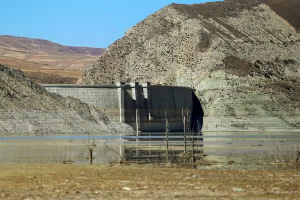
Authorities confirmed this week that the MamlouDam, one of five major reservoirs supplying the capital, has fallen below usable levels.

Only 8% of its 250 million cubic meter capacity remains, with storage at 19 million cubic meters -- below the “dead volume” threshold of 28 million.

The facility, built in 2007 east of Tehran, is officially out of operation for the first time, leaving the capital more reliant on other reservoirs already at historic lows.

  • Wells of denial: why Iran's water crisis isn't just about drought

    Wells of denial: why Iran's water crisis isn't just about drought

  • Drought and bad policy turn Iran’s largest lake into a salt desert

    Drought and bad policy turn Iran’s largest lake into a salt desert

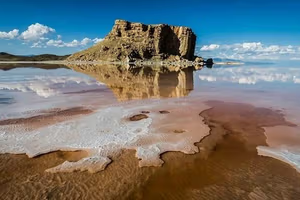
The crisis extends far beyond Tehran. In northwestern Iran, Lake Urmia, once the Middle East’s largest saltwater lake, has lost more than 90% of its volume and surface area.

Environmental experts warned on Wednesday that “salt storms” from the dried lakebed are beginning to hit surrounding provinces, damaging crops, raising health risks, and prompting what officials describe as the early stages of forced relocations from nearby towns and villages.

People walk across the dried basin of Lake Urmia.
100%
People walk across the dried basin of Lake Urmia.

Lawmakers acknowledge that years of mismanaged agriculture, unchecked groundwater pumping and weak enforcement of water-use reforms have accelerated the decline.

“The lake is like a critical patient in intensive care,” said Reza Hajikarim, head of Iran’s Water Industry Federation, warning that existing plans were not implemented to save the lake. He urged rapid cuts in water-intensive farming and enforcement of ecological water rights, saying “we do not need new solutions, only execution of the old ones.”

“Salt storms from Lake Urmia have now begun, and evacuations are starting in provinces surrounding the lake. The salt storms and rising temperatures caused by the sun’s reflection are among the consequences of Urmia’s desiccation, undermining life and habitability in the region. This is only the beginning,” he added.

  • Iran's only navigable river at risk of drought, experts warn

    Iran's only navigable river at risk of drought, experts warn

  • Iran says water crisis worsening, Tehran land subsidence looms

    Iran says water crisis worsening, Tehran land subsidence looms

Social strains are mounting. In recent weeks, a violent clash over irrigation rights near Urmia left one dead and 13 injured, highlighting how scarcity is fueling local disputes.

Similar unrest erupted earlier this year in central Iran, where farmers damaged a pipeline transferring water from Isfahan to Yazd. Rights groups say protests over blackouts and dry taps in cities such as Sabzevar were also met with arrests and tear gas.

Experts stress the problems are largely man-made. Climatologist Nasser Karami has described the situation as an “engineered drought,” arguing that mismanagement, subsidies for water-intensive crops, and expansion of militarized agriculture -- not climate alone -- lie at the root.

  • Iran’s water crisis is real but man-made, climatologist argues

    Iran’s water crisis is real but man-made, climatologist argues

  • Iran’s thirst for agricultural expansion drains water reserves

    Iran’s thirst for agricultural expansion drains water reserves

Agriculture consumes over 85% of Iran’s water while contributing less than 12% of GDP, and exports such as pistachios and melons remain state priorities despite groundwater depletion.

Other ecosystems are also under threat. Officials warn that Anzali Wetland on the Caspian coast faces collapse without $300 million in restoration funds, after decades of sewage, sediment and pollution inflows.

Iran’s Meteorological Organization says the country has endured two decades of near-continuous drought, but specialists argue that structural reforms -- diverting water from agriculture to households, modernizing irrigation, reducing waste, and enforcing groundwater limits -- could stabilize supplies.