• العربية
  • فارسی
Brand
  • Iran Insight
  • Politics
  • Economy
  • Analysis
  • Special Report
  • Opinion
  • Podcast
  • Iran Insight
  • Politics
  • Economy
  • Analysis
  • Special Report
  • Opinion
  • Podcast
  • Theme
  • Language
    • العربية
    • فارسی
  • Iran Insight
  • Politics
  • Economy
  • Analysis
  • Special Report
  • Opinion
  • Podcast
All rights reserved for Volant Media UK Limited
volant media logo

'Resistance diplomacy': Iran says both arms and dialogue guide policy

Oct 22, 2025, 12:49 GMT+1Updated: 00:08 GMT+0
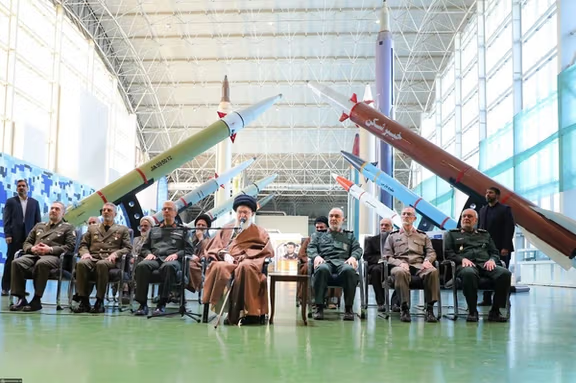
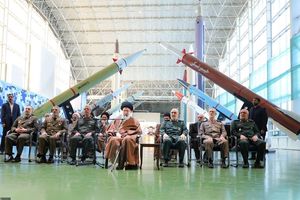
Iran's Supreme Leader Ali Khamenei during his visit to the IRGC Aerospace Force achievements exhibition in Tehran, November 19, 2023

Iran must rely on both its missile capabilities and diplomacy to safeguard national interests, the country’s foreign ministry spokesman said on Wednesday, emphasizing that resistance and engagement are complementary pillars of its foreign policy.

Iran faces stark economic and geopolitical challenges as a lingering impasse over its nuclear program led to the resumption of European-triggered international sanctions last month.

Western countries have called for Tehran to engage in renewed diplomacy with Washington and restored access to international nuclear inspectors.

Speaking at a seminar on “resistance diplomacy” at Ferdowsi University in Mashhad, Esmail Baghaei said: “We must use all tools to protect the country’s rights -- whether through missiles or diplomacy and negotiation.”

“The concept of resistance has now evolved and taken the form of resilience,” he said, adding that that Iran’s approach combines self-reliance with international engagement.

His comments appeared to strike a relatively moderate tone, two days after Iran's ultimate decision-maker Supreme Leader Ali Khamenei appeared to reject a peace overture by President Trump and deployed sharp language at his nemesis.

The 86-year-old veteran ruler called Trump's repeated assertions that US attacks on June 22 had obliterated Iran's nuclear program "nonsense" and in a rare direct address to a US President told him to "keep dreaming."

Khamenei appeared to rule out renewed talks, calling reported US demands for curbs to Iranian missile ranges and Tehran's support for regional armed groups bullying and a

Baghaei said Iran faces powerful adversaries but remains capable of shaping developments within the international system.

“Our opponents invoke international law to justify their actions, so we must also rely on the same law to prove our rights,” he said. “Resistance diplomacy must be seen as an active instrument to secure national interests.”

He defended Tehran’s stance in the wake of the UN sanctions snapback mechanism, saying that Western powers had expected immediate compliance but were surprised by global resistance to reimposing restrictions.

Support for regional groups

Addressing Iran’s backing of allied groups in the region, Baghaei rejected the notion that Tehran created “proxy” groups.

“We did not create them,” he said. “The issues of Palestine and Lebanon did not begin in 1979 (when the Islamic Republic was established). These movements existed long before, and we have supported them based on our constitutional and strategic principles.”

Baghaei added that Iran’s support is “based on a defined framework” and that “to prevent harm, we must build allies within the international system.”

He said the resilience of such movements is enduring despite repeated attempts to weaken them.

“After two years, those who claimed resistance was finished end up sitting at the same table with them,” he said. “The foundations of resistance are deeply rooted and cannot be easily destroyed.”

On diplomacy and international law

Baghaei also defended Iran’s record on diplomacy, citing past cooperation with global institutions and negotiations with Washington.

He recalled that after the US withdrawal from the 2015 nuclear deal, Iran “remained committed for months” before gradually reducing compliance.

He also noted that indirect talks with the United States had taken place under both Trump and Biden but collapsed due to continued sanctions and regional tensions.

“When one side plans an attack and then invites you to a meeting, how can you attend such a session?” he said, referring to recent incidents.

Most Viewed

US blockade enters murky phase as tankers spoof signals and buyers hesitate
1
ANALYSIS

US blockade enters murky phase as tankers spoof signals and buyers hesitate

2

US tightens financial squeeze on Iran, warns banks over oil money flows

3
INSIGHT

Ideology may be fading in Iran, but not in Kashmir's ‘Mini Iran'

4
INSIGHT

Hardliners push Hormuz ‘red line’ as US blockade tests Iran’s leverage

5
VOICES FROM IRAN

Hope and anger in Iran as fragile ceasefire persists

Banner
Banner

Spotlight

  • Hardliners push Hormuz ‘red line’ as US blockade tests Iran’s leverage
    INSIGHT

    Hardliners push Hormuz ‘red line’ as US blockade tests Iran’s leverage

  • Ideology may be fading in Iran, but not in Kashmir's ‘Mini Iran'
    INSIGHT

    Ideology may be fading in Iran, but not in Kashmir's ‘Mini Iran'

  • War damage amounts to $3,000 per Iranian, with blockade set to add to losses
    INSIGHT

    War damage amounts to $3,000 per Iranian, with blockade set to add to losses

  • Why the $100 billion Hormuz toll revenue is a myth
    ANALYSIS

    Why the $100 billion Hormuz toll revenue is a myth

  • US blockade targets Iran oil boom amid regional disruption
    ANALYSIS

    US blockade targets Iran oil boom amid regional disruption

  • Iran's digital economy battered by prolonged blackout
    INSIGHT

    Iran's digital economy battered by prolonged blackout

  • Iran debate over Russia reliance flares anew amid Putin's mediation offer

    Iran debate over Russia reliance flares anew amid Putin's mediation offer

  • Iran-Russia trade shrinks despite closer security ties

    Iran-Russia trade shrinks despite closer security ties

  • China walks tightrope as UN sanctions drive Iran deeper into its orbit

    China walks tightrope as UN sanctions drive Iran deeper into its orbit

  • Trump says strikes on Iran lifted 'dark cloud’ over Middle East

    Trump says strikes on Iran lifted 'dark cloud’ over Middle East

  • Best defense: why Tehran might go on offensive to avoid bitter concessions

    Best defense: why Tehran might go on offensive to avoid bitter concessions

  • Vance says US set on diplomacy to deprive Iran of nuclear weapon

    Vance says US set on diplomacy to deprive Iran of nuclear weapon

•
•
•

More Stories

Iran says no return to talks until US drops ‘excessive demands’

Oct 22, 2025, 12:46 GMT+1

Iran's foreign minister said on Wednesday it will not return to negotiations with the United States unless Washington abandons what it described as unreasonable and excessive demands.

Abbas Araghchi told reporters in the northeastern city of Mashhad that Iran remained committed to diplomacy but would not compromise on its national rights.

He said five rounds of indirect talks with Washington had taken place before the 12-day conflict in June that saw US and Israeli strikes on Iranian nuclear facilities and that subsequent discussions on the sidelines of the UN General Assembly also failed due to US demands.

“This year, after five rounds of negotiations, the United States joined Israel’s military attack against Iran. Later, in New York, there was also an opportunity for a reasonable, mutually beneficial agreement -- but once again, the talks failed because of America’s excessive demands,” he said.

He added, “As long as the Americans persist in their policy of overreach and continue to make unreasonable demands, we will not return to the negotiating table.”

“Iran has always shown that it believes in peace and diplomacy,” Araghchi emphasized. “Wherever the country’s interests can be secured through dialogue, we will not hesitate to act. But the other side has repeatedly proven it does not adhere to diplomacy.”

The comments came as Araghchi arrived in Mashhad to attend a two-day regional diplomacy conference alongside senior Iranian officials, business leaders, and ambassadors to neighboring and Asian countries.

  • 'Resistance diplomacy': Iran says both arms and dialogue guide policy

    'Resistance diplomacy': Iran says both arms and dialogue guide policy

Earlier in the day, the foreign ministry spokesperson said Iran must rely on both its missile capabilities and diplomacy to safeguard national interests.

Speaking earlier in the day in the same city, Esmail Baghaei said: “We must use all tools to protect the country’s rights -- whether through missiles or diplomacy and negotiation.”

The collapse of the talks followed months of rising tension over Iran’s nuclear and missile programs, compounded by the reimposition of UN sanctions under the 2015 nuclear deal’s snapback mechanism.

Hezbollah turns to Latin America networks as Iran faces pressure, US senators told

Oct 22, 2025, 12:28 GMT+1

Hezbollah is relying more on its overseas financial networks as Iran faces economic strain, US experts told a Senate hearing on Tuesday, warning that the group could deepen its activities in Venezuela and across Latin America.

“Hezbollah has a long history of turning to its diaspora networks when it’s facing financial stress,” analyst Matthew Levitt said.

He told senators that while Iran continues to support the group, “it is having a much harder time getting that money to Hezbollah in a timely manner.”

Lawmakers described Venezuela as a growing hub for Hezbollah’s drug and finance operations.

Senator Sheldon Whitehouse, the top Democrat on the Senate International Narcotics Control Caucus, said the group “is one of Iran’s tools to destabilize and terrorize,” adding that “if we target Hezbollah’s financing, we can deny them the opportunity to rebuild.”

Levitt said Hezbollah has operated in Latin America for nearly five decades, cultivating ties with traffickers and using illicit trade networks to move money.

“If you need big money real fast, you turn to illicit activities and especially to narcotics trafficking,” he said.

Several senators urged a tougher US response to Venezuela’s cooperation with Iran.

Senator Bernie Moreno said the Maduro government’s actions “meet the legal standard” to be labeled a state sponsor of terrorism and warned that “Maduro should know his days are numbered.”

Witnesses also called on Latin American governments to follow the lead of Argentina, Colombia, and Paraguay in designating Hezbollah as a terrorist organization, saying it would help disrupt its financial activity and weaken Tehran’s influence in the region.

Shamkhani urges unity after leaked wedding video draws backlash

Oct 22, 2025, 12:16 GMT+1

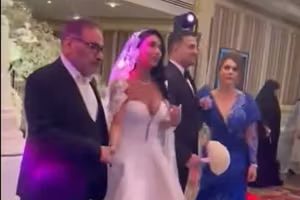
Ali Shamkhani, a senior advisor to Supreme Leader Ali Khamenei, warned on Wednesday that internal divisions could damage Iran’s stability, speaking as a leaked video of his daughter’s wedding stirred anger over Iran’s ruling establishment.

In an interview with ISNA, Shamkhani said national cohesion was vital in the face of external pressure and domestic challenges.

“We are all in the same boat shaped by the sacrifices of the martyrs of the Islamic Revolution, and it would be a shame if our differences created weaknesses,” he said.

He urged all political groups to “act together under the leadership of the Supreme Leader,” adding that adversaries were trying to exploit divisions to harm the country.

The comments came just days after footage surfaced online showing Shamkhani escorting his daughter at a wedding ceremony in a Tehran luxury hotel.

The video, shared widely on X since mid-October, appeared to show a large, Western-style celebration and drew sharp criticism from social media users accusing officials of hypocrisy amid the country’s deepening economic crisis and renewed enforcement of hijab rules.

The wedding reportedly took place in April 2024 at Tehran’s Espinas Palace Hotel. At the time, Iranian outlets estimated the cost at about 14 billion rials (over $21,000). The family did not comment on the reports, and Shamkhani has not publicly addressed the new controversy surrounding the footage.

Shamkhani, a former secretary of Iran’s Supreme National Security Council and now a member of the Expediency Council, has long been a prominent figure in Iran’s security establishment. He also serves as the Supreme Leader’s representative in the National Defense Council.

  • Naked hypocrisy: leaked wedding video sparks new scandal for Iran’s rulers

    Naked hypocrisy: leaked wedding video sparks new scandal for Iran’s rulers

  • Double standard: privacy defense over Shamkhani leak angers Iranians

    Double standard: privacy defense over Shamkhani leak angers Iranians

Leak fuels political blame game

The video has drawn reactions even from hardline circles. Some conservative commentators questioned how senior officials could call for patience under sanctions while appearing at opulent private events. Others defended Shamkhani, saying the ceremony was private and attended only by family members.

Former state broadcaster chief Ezzatollah Zarghami described the exposure as “a new method of assassination,” accusing Israel of waging psychological warfare through cyberattacks. IRGC-linked Mashregh News also said the leak aimed to “undermine an effective official,” blaming both “foreign enemies and certain domestic circles.”

The hardline daily Kayhan, which is funded by the Supreme Leader’s office, went further, accusing allies of former president Hassan Rouhani and ex-foreign minister Mohammad Javad Zarif of involvement. The paper called the release of the footage a “proxy character assassination,” saying that Shamkhani’s past criticism of Rouhani’s handling of nuclear policy had fueled political resentment.

Pro-hardline activists echoed that view online, arguing that the leak followed Shamkhani’s recent comments implicating the previous administration in the delayed acknowledgment of the 2020 downing of a Ukrainian airliner by the Revolutionary Guards.

Figures close to Rouhani have denied any connection to the leak. A source told the news outlet Khabar Online that the act was “unethical and contrary to Islamic norms.”

Iran’s president signs law joining UN anti-terror finance convention with conditions

Oct 22, 2025, 10:48 GMT+1

Iranian President Masoud Pezeshkian has signed into law the country’s conditional accession to the United Nations Convention for the Suppression of the Financing of Terrorism (CFT), approving it only within the limits of Iran’s constitution and domestic legislation.

In a formal decree on Tuesday, Pezeshkian instructed the judiciary, the ministries of interior, intelligence, justice, foreign affairs, and economy, as well as the Central Bank, to implement the law in accordance with national regulations -- a condition that could limit its impact even as Tehran seeks to ease its isolation from the global financial system.

Under conditions set by parliament and endorsed by the Expediency Council, Iran will act “within the framework of the constitution,” and in cases where any provision of the convention conflicts with national laws, “domestic legislation will take precedence,” council spokesman Mohsen Dehnavi said.

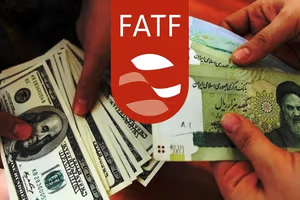
The move, which follows years of political wrangling, comes just a day before the Financial Action Task Force (FATF) plenary in Paris on October 22–24, where delegates from over 200 jurisdictions will discuss mutual evaluations and global efforts to combat money laundering and terror financing.

Iran’s Financial Intelligence Unit chief, Hadi Khani, has traveled to Paris to attend FATF plenary for the first time in six years at the group’s official invitation, according to state media.

Khani, who also serves as deputy economy minister and secretary of Iran’s Anti–Money Laundering and Counter-Terrorist Financing Council, is expected to outline Iran’s progress on its action plan, focusing on the recent approval of its accession to the UN Palermo Convention against transnational organized crime.

The Iranian delegation will brief FATF members on legislative and implementation steps and coordinate future meetings to address questions and clarify outstanding issues, IRNA reported.

In May, Iran’s Expediency Council, conditionally approved the country’s accession to the Palermo Convention, one of the two key legislative items tied to the FATF standards, alongside the CFT.

The Expediency Council, overseen by Supreme Leader Ali Khamenei, mediates disputes between parliament and the Guardian Council, a body that vets laws and candidates.

  • Q&A: All you need to know about Iran's FATF problem

    Q&A: All you need to know about Iran's FATF problem

  • Iran parliament speaker sends anti-terror finance law for implementation

    Iran parliament speaker sends anti-terror finance law for implementation

  • Iran agrees to conditionally join UN convention against terror financing

    Iran agrees to conditionally join UN convention against terror financing

Supporters say joining the UN convention could help Iran align with FATF standards, reconnect with global banking systems, and attract investment, while hardliners warn it risks exposing financial channels used to evade US sanctions and fund regional allies.

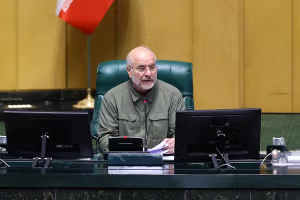
Parliament Speaker Mohammad Bagher Ghalibaf sent the bill to Pezeshkian for implementation under Article 123 of the constitution last week after lawmakers rejected a conservative-backed motion to block the move, clearing the way for Iran to finalize its accession.

Iran and North Korea remain the only two countries still outside the FATF framework.

Best defense: why Tehran might go on offensive to avoid bitter concessions

Oct 21, 2025, 21:11 GMT+1
•
Jamshid Barzegar

Tehran may be preparing for confrontation rather than calm, if the recent remarks of Supreme Leader Ali Khamenei are any indication, preferring the uncertainties of further conflict over meeting US peace demands seen as humiliating.

In a speech on Monday, Khamenei dismissed any Mideast-wide peace deal, threatened renewed missile attacks and derided Donald Trump—all at a moment when the US president was taking credit for brokering the Gaza ceasefire.

Despite visible fatigue within the political establishment and the military setbacks that followed the June war, 86-year-old Khamenei continues to project defiance. His choice of language suggests a leader who sees few acceptable alternatives.

Even amid widening divisions, those around him seem to recognize that Iran faces two narrow paths—negotiation on terms seen as humiliating, or confrontation whose outcome remains uncertain.

For now, the veteran leader appears inclined toward the latter. Negotiations, in his view, offer neither leverage nor time.

Hardball in Washington

Trump has made clear he would accept nothing short of dismantling Iran’s nuclear program, curbing its missile capabilities, and ending support for armed allies in the region—conditions that Tehran reads as surrender.

The most recent talks, which were cut short by US-Israeli strikes, appear to have convinced the decision-makers in Tehran that diplomacy to buy time may no longer be viable.

Still, for Khamenei and his closest advisers, war may appear the less constraining option—one that carries risks but also the potential for unexpected outcomes that preserve or even strengthen their rule.

One factor shaping this outlook is a belief that Washington and its allies are reluctant to open another front. With strategic focus fixed on China and Russia, the West appears more interested in containing instability than deepening it.

From Tehran’s perspective, that caution could reduce the likelihood of sustained military engagement and therefore make confrontation a manageable gamble.

Diplomacy with predetermined outcomes, in that calculation, holds little appeal.

The succession factor

Since the June ceasefire, speculation about life after Khamenei has become more open.

With power struggles simmering, no faction wishes to inherit leadership while Iran’s confrontation with Israel and the West remains unresolved. Any successor would bear the stigma of defeat.

Some insiders therefore appear willing to let Khamenei shoulder responsibility for the current standoff, expecting that his eventual departure could clear the way for a recalibration of policy.

Events since Hamas’s October 7 attack on Israel have highlighted Iran’s limited capacity to protect its regional allies and assets. Yet Khamenei’s rhetoric continues to emphasize endurance and faith in ultimate victory.

A parallel pattern is evident at home, where intensified repression and executions signal an attempt to assert authority and restore control in the face of uncertainty.

Khamenei’s current stance seems driven less by confidence than by constraint—a conviction that confrontation, though perilous, still allows the system to act rather than be acted upon.

Whether that belief prolongs the system’s survival or deepens its vulnerabilities remains unclear.

For now, Iran’s leadership appears to have chosen uncertainty over surrender—a gamble that may define the final phase of Khamenei’s rule.