• العربية
  • فارسی
Brand
  • Iran Insight
  • Politics
  • Economy
  • Analysis
  • Special Report
  • Opinion
  • Podcast
  • Iran Insight
  • Politics
  • Economy
  • Analysis
  • Special Report
  • Opinion
  • Podcast
  • Theme
  • Language
    • العربية
    • فارسی
  • Iran Insight
  • Politics
  • Economy
  • Analysis
  • Special Report
  • Opinion
  • Podcast
All rights reserved for Volant Media UK Limited
volant media logo

Tehran faces nightly water cuts as rationing begins without notice

Nov 8, 2025, 08:05 GMT+0Updated: 23:59 GMT+0

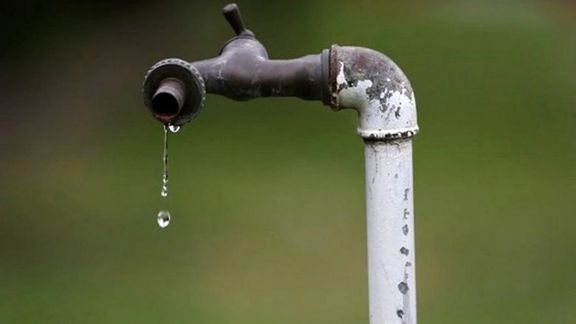
Water rationing has quietly begun in Tehran, with several neighborhoods facing nightly supply cuts without official announcement or public warning, Iranian media reported on Saturday.

Residents say water has been shut off from midnight until around 5 a.m. in recent nights.

“Despite repeated denials by officials, it appears the process of rationing has started” and citizens in parts of the capital “are deprived of water during the night,” Mizan News Agency, affiliated with the judiciary, wrote.

The daily Haft-e Sobh likewise reported sudden five-to-six-hour overnight cuts in drinking water across several districts, all without prior notice.

Reduced pressure across the city, the paper said, and declining surface and groundwater reserves had led to “serious instability” in Tehran’s water network.

The outages have lasted long enough to affect even households with backup storage tanks, according to the report.

Rising frustration

Haft-e Sobh quoted residents as saying the sudden shutdowns disrupted daily life. “When the water is cut off at night, we don’t know when it will return, so we can’t plan our use. Even tanks empty quickly,” one resident said.

President Masoud Pezeshkian warned on November 6 that if rain does not arrive by December, water will have to be rationed across Tehran, adding that prolonged drought could even force evacuation of the city.

The head of Tehran’s provincial water company recently described the capital’s situation as “red and concerning.”

Health and cost concerns

Unannounced rationing, Haft-e Sobh warned, could hinder hygiene and household routines dependent on steady water access. Unreliable supply may increase health risks in residential buildings and impose higher costs on families forced to rely on water tanks or delivery services, it added.

Meteorological data show 20 provinces have gone more than six weeks without measurable rainfall.

100%

No precipitation has fallen in Tehran since the start of autumn, Mohammadreza Kavianpour, head of Iran’s Water Research Institute, said on Thursday warning that forecasts show the drought is likely to persist through the season.

“The risk of water scarcity in the capital must be taken very seriously,” Kavianpour said.

Tehran’s supply depends heavily on the Karaj Dam, whose remaining reserves are sufficient for only two weeks of drinking water.

Environmental experts say years of over-extraction, unscientific dam-building and poor management have pushed the country toward what some describe as “water bankruptcy.”

Most Viewed

US blockade enters murky phase as tankers spoof signals and buyers hesitate
1
ANALYSIS

US blockade enters murky phase as tankers spoof signals and buyers hesitate

2

US tightens financial squeeze on Iran, warns banks over oil money flows

3
INSIGHT

Ideology may be fading in Iran, but not in Kashmir's ‘Mini Iran'

4
INSIGHT

Hardliners push Hormuz ‘red line’ as US blockade tests Iran’s leverage

5
VOICES FROM IRAN

Hope and anger in Iran as fragile ceasefire persists

Banner
Banner

Spotlight

  • Hardliners push Hormuz ‘red line’ as US blockade tests Iran’s leverage
    INSIGHT

    Hardliners push Hormuz ‘red line’ as US blockade tests Iran’s leverage

  • Ideology may be fading in Iran, but not in Kashmir's ‘Mini Iran'
    INSIGHT

    Ideology may be fading in Iran, but not in Kashmir's ‘Mini Iran'

  • War damage amounts to $3,000 per Iranian, with blockade set to add to losses
    INSIGHT

    War damage amounts to $3,000 per Iranian, with blockade set to add to losses

  • Why the $100 billion Hormuz toll revenue is a myth
    ANALYSIS

    Why the $100 billion Hormuz toll revenue is a myth

  • US blockade targets Iran oil boom amid regional disruption
    ANALYSIS

    US blockade targets Iran oil boom amid regional disruption

  • Iran's digital economy battered by prolonged blackout
    INSIGHT

    Iran's digital economy battered by prolonged blackout

•
•
•

More Stories

Broken machine: why Tehran’s food distribution plan won’t move the needle

Nov 8, 2025, 04:00 GMT+0
•
Behrouz Turani

Iran’s latest attempt to curb soaring food prices—delegating the distribution of staple goods in Tehran to the city’s municipality—has again exposed a deeper truth about the country’s economic crisis: quick fixes rarely work when the foundations are broken.

The proposal, reported Thursday by the IRGC-linked daily Javan, would put Mayor Alireza Zakani in charge of supplying essential goods to households in the capital.

Zakani claims the plan, approved by President Masoud Pezeshkian, could reduce prices by up to 40 percent. Residents quoted by Javan said municipal-run markets already sell cheaper goods than elsewhere in the city.

But even at face value, the initiative seems to be yet another reactive measure in a system afflicted by deep structural problems. The question is less whether this plan can work and more why such plans keep reappearing.

Moderate outlet Fararu this week laid out the structural flaws driving Iran’s crisis: contradictory decision-making by overlapping institutions, a budget tied to unstable oil revenues, and an absence of dependable data that leaves officials governing by instinct rather than information.

Economic policy, the outlet said, is shaped by ministries, the Central Bank, the Planning and Budget Organization, and an array of parallel bodies that often work at cross-purposes.

“Most economic decisions in Iran are made overnight,” it wrote, warning that real change requires slow, coordinated reform across government—something the Islamic Republic has resisted for decades.

‘Bipolar economy’

The centrist daily Sazandegi pointed to another symptom of this dysfunction: chaotic decision-making that thrives in the grey zones created by sanctions.

The paper highlighted the clash between hardline MP Amir Hossein Sabeti and Babak Zanjani—the ‘sanctions-fixer’ once sentenced to death but pardoned and now tapped again to recover Iran’s oil revenues.

“Iran’s economy exists in a bipolar state,” Sazandegi wrote, “caught between a revolutionary pursuit of social justice that resists globalization and a rentier capitalism that thrives on sanctions.”

The public spat between two privileged insiders, Sazandegi argued, is evidence of an economy pulled between ideological theatrics and rent-seeking networks—a system that’s neither competitive nor transparent.

Bleak outlook

Despite their scathing critiques, both outlets chose to not mention the elephant in the room—as is almost always the case in Iran: a foreign policy that has produced decades of isolation and tightening sanctions.

With the return of UN sanctions in late September—and Tehran’s continued combative stance—the situation is likely to deteriorate further before any improvement is possible.

Seen through that lens, Zakani’s food-distribution proposal is less a solution than another reflex: an attempt to patch symptoms without addressing the machinery underneath.

From guns to votes: Iran-backed Iraqi militias may be about to transform

Nov 7, 2025, 21:48 GMT+0
•
Negar Mojtahedi

Iran-backed militias in Iraq are looking to consolidate the grip they won by force of arms on the fragile country's politics with gains in parliamentary elections next month, experts told Eye for Iran podcast.

After a series of military and diplomatic setbacks, Tehran may hope their allies next door can preserve its influence via the ballotbox and protect a decades-old Iranian political investment in its neighbor.

Confident that US attacks "obliterated" Iranian nuclear sites in June amidst an Israeli military campaign, US President Donald Trump may be ignoring the potential threat Iran poses in Iraq according to historian Dr Shahram Kholdi.

“Iraq may become, in a very odd way, the Achilles heel of the Trump administration,” he told Eye for Iran.

Kholdi warned Tehran’s reconfigured influence could quietly undermine US gains against Iran in the region, adding that steering its militias into politics risks “recreating the Islamic Republic light version in Iraq, 2.0, that operates through bureaucracy rather than arms.”

The shift comes as Washington issues one of its strongest warnings yet, saying it will not recognize Iraq’s next government if any ministries are handed to armed factions linked to the Islamic Republic, a source in Iraq’s Kurdistan region told Iran International on Friday.

In a recent call with Iraq’s defense minister reported by Saudi daily Al-Sharq al-Awsat, US Secretary of War Pete Hegseth cautioned any interference by armed factions to unspecified future US military operations would provoke a sharp American response.

The minister, according to the report, described it as “a final notice,” reflecting US concern that Iran’s allies could use Iraq’s elections to entrench themselves in state institutions.

For Tehran, encouraging its proxies to enter politics provides a way to adapt without relinquishing its arms.

The Popular Mobilization Forces, an umbrella of Shi'ite militias funded through Iraq’s state budget, command vast patronage networks that already blur the line between governance and coercion. Bringing those networks formally into Iraq’s political system could allow Iran to project stability while maintaining influence behind the scenes.

“Iran has been severely weakened in the wake of the 12-day war,” said Jay Solomon, a journalist and author of The Iran Wars.

“What we see is an effort to maintain their proxies and stay below the radar but rebuild.” The approach, described by Solomon, reflects a shift from confrontation to consolidation, using political channels to preserve influence while avoiding direct conflict with the United States.

That calculation, according to Alex Vatanka, Director of the Iran Program at the Middle East Institute, shows how Iran’s leadership has learned to work within new limits.

“They want to rebuild as much as they can within limits. They probably have a much better sense of their limitations today than they did before this summer. But again, they do not want to have that open fight, certainly not on Iraqi soil.”

Two decades after the US invasion of Iraq, Washington faces a familiar dilemma: whether to tolerate a fragile partner shaped by Tehran’s influence or confront a more sophisticated phase of Iranian power consolidation.

Iran’s recalibration in Iraq, analysts on Eye for Iran said, is less a retreat than a pause for recovery, a reminder that even under pressure its power lies not in confrontation but in adaptation.

You can watch the full episode of Eye for Iran on YouTube or listen on a podcast platform of your choosing.

Former top US officials on Mideast doubt imminent Iran-Israel war

Nov 7, 2025, 19:13 GMT+0

Two former senior US Mideast policy officials said a renewed conflict between Israel and Iran appeared remote after the arch-foes clashed in June, but described Tehran in a roundtable discussion hosted by Iran International TV as a lingering threat.

Iran envoy for President Donald Trump from 2020 to 2021 Elliott Abrams and Ambassador Dennis Ross, a former Middle East adviser to Republican and Democratic administrations, are veterans of decades of US diplomacy with long records in the fraught region.

Both see the Islamic Republic as threat to US national security, the country's military presence in the Middle East and the security of its Arab partners and Israel.

The first direct blows between Israel and Iran last year transformed their fight from one in the shadows and via Iran's armed allies like Hezbollah, they said, into a face-to-face showdown culminating in a June war which dealt Tehran punishing blows.

A ceasefire enforced by Trump after US strikes hit three key Iranian nuclear sites is likely to hold for the foreseeable future, they predicted.

In a panel moderated by Bozorgmehr Sharafedin, Iran International's head of Digital, they said a weakened Tehran is salving its wounds and focusing on its internal grip while Israel relishes calm after a Gaza ceasefire mediated by President Trump.

"Lacking air defenses, (the Iranians) know that a great deal more damage can be done by Israel, and I don't think the Israelis are looking for it right now either," Abrams said. "They've having gotten the hostages back from Gaza. They need to let their military rest, rebuild, rearm."

Israeli strikes likely damaged Iran's air defense infrastructure. Iran's foreign minister Abbas Araghchi said this week Tehran had rebuilt its missile power beyond pre-war levels and that it seeks peace through diplomacy, but Iranians must not fear war.

"I would be quite surprised actually to see war with one exception, Abrams added. "If the regime in Tehran decides we must quickly, as quickly as possible, rebuild the nuclear program, then they're going to get hit again."

Iran denies seeking nuclear weapons but Israel and Western countries doubt its intentions. Trump seeks to resume talks halted by the June conflict but Tehran rejects US demands it negotiate over its missiles or support for armed regional allies.

"The fact is, Iran has no air defense today," Ross said. "If they were to rush for a nuclear weapon right now, that would invite either an Israeli response or an American one, and I'm quite certain that the Iranian leadership knows better than that."

Ross served as director of the policy planning staff of the US State Department under President George H.W. Bush, helping guide diplomacy as perennial US adversary the Soviet Union unraveled and toward Saddam Hussein's Iraq in the 1991 Gulf War.

"Right now where we are with the regime, talk tough, talk bravely, but recognize the reality is," he added. "The last thing you need is another fight with the Israelis, and you need even less of one with the United States."

Obliterated, exaggerated

US attacks on June 22 hit the Fordow, Natanz and Esfahan nuclear sites in raids Trump has repeatedly said "obliterated" Iran's nuclear program.

While he asserted Tehran is now focused on survival and not resuming its activities, Trump has pledged to attack again if it does.

Iranian officials this week vowed to build the program back stronger than before.

The head of UN nuclear watchdog Rafael Grossi said on Friday that Tehran still possesses enriched uranium sufficient, should Iran choose and be able to enrich it further, to make several nuclear weapons.

Both former senior officials said that while the US and Israelis strikes had dealt Iran significant setbacks, Trump was dealing in hyperbole.

"It's premature. It's exaggerated," Abrams said. "Meaning, there is something there. He's just making too much of it."

"It's a real change. And I think Trump is right to draw attention to that," Abrams said. "To go further and say, you know, it's the end of conflict and peace in our time, no that goes too far. The regime is still there. Their military is still powerful. They have a dangerous ballistic missile program."

Abrams, a fellow for Middle Eastern studies at the Council on Foreign Relations (CFR) in Washington, supports robust US engagement in the region and the encouragement of democratic transitions.

A neoconservative, he was a prominent advocate of preemptive military action against Iraq during George W. Bush’s presidency.

Ross said Trump's military intervention marked an important paradigm shift, transmitting to the region that the United States would check Iranian influence.

"What he did is he signaled, 'you don't have impunity any longer.' Now that was really important for the region, because it said, okay, we really don't have to be so afraid of the Iranians anymore."

Ross is fellow at Washington DC thinktank the Washington Institute and served as a presidential aide in unsuccessful bids by Barack Obama to resolve the Israeli-Palestinian conflict.

He has advocated an active and multi-pronged US engagement in the Mideast and the world not limited to ideological or military approaches and co-founded the advocacy group United Against a Nuclear Iran in 2008.

"This is a regime that is focused on survival," Ross asserted. "It always has been, but that's the first priority. It feels it can manage and sustain control, which is another reason why they're not looking for trouble on the outside right now, because that could actually endanger them more on the inside."
In nationalist push, Iran unveils statue of kneeling Roman emperor

Nov 7, 2025, 18:00 GMT+0

Iran on Friday unveiled a statue of Roman Emperor Valerian kneeling in submission before ancient Persian King Shapur after a third century military victory, as Islamic authorities pivot toward nationalism to boost support following a June war.

Videos show the ceremony in Tehran’s Revolution (Enghelab) square, where the statue group was unveiled as part of campaign dubbed by officials “Kneel before Iran."

"The Valerian statue reflects a historical truth that Iran has been a land of resistance throughout history," said Mehdi Mazhabi, head of Tehran's Municipal Beautification Organization. "By implementing this plan in Enghelab Square, we aim to forge a bond between this land's glorious past and its hopeful present."

Following a ceasefire which ended a punishing 12-day war with Israel in June, Iranian officials moved to invoke nationalism and glorifying ancient history of Iran to promote unity. Symbols of the pre-Islamic past had previously been shunned by the theocracy.

Days after the conflict, a mural set up in Vanak square in Tehran depicting Arash the archer firing arrows alongside modern ballistic missiles shot at Israel.

The new statue immortalizes the 260 AD Battle of Edessa, where the second king of the Sassanid Empire Shapur I, 240–270 AD, decisively defeated Roman forces and captured Valerian. The defeat was an unprecedented catastrophe for Rome.

Shapur, son of Ardashir I, expanded Persian territory and clashing repeatedly with the empire that spanned Europe, North Africa and parts of the Middle East. Ancient reliefs at Naqsh-e Rostam show him on horseback, Valerian humbled beneath.

Valerian, 253–260 AD, co-emperor with his son Gallienus, sought to stabilize Rome's eastern frontier.

From murals of Cyrus the Great to patriotic songs at Shi'ite mourning ceremonies, Tehran is now leaning into pre-Islamic imagery it once viewed as anathema.

Iran plotted to kill Israeli envoy to Mexico - Axios

Nov 7, 2025, 15:09 GMT+0

Iran's Islamic Revolutionary Guard Corps sought to kill the Israeli ambassador to Mexico but the plot was thwarted over the summer by Mexican security forces according to US and Israeli officials cited by Axios on Friday.

The plot to assassinate ambassador Einat Kranz-Neiger began at the end of 2024, Axios cited a source with knowledge of the matter as saying, and was led by a member of the IRGC Quds Force's secretive Unit 11000.

The operative, according to the source, spent several years overseeing agents from Iran's embassy in Venezuela.

"The plot was contained and does not pose a current threat," the outlet quoted a US official as saying.

"This is just the latest in a long history of assassination attempts by Iran around the world targeting diplomats, journalists, dissidents, and anyone who disagrees with them — something that should deeply concern every country where there is an Iranian presence," the US official added, according to Axios.

Israel and Iran have been arch-enemies since the 1979 Islamic Revolution made enmity to the Jewish State a key element of state ideology.

Their confrontation had mostly been contained to indirect fighting between Israel and Iran-backed Islamist armed groups in the Middle East including Hezbollah in Lebanon and Hamas in the occupied Palestinian territories.

The October 7, 2023 attacks on Israel led by Hamas helped propel the conflict into a direct showdown which culminated in a 12-day war in June.

Israel launched an air strike on Iran's embassy in Damascus in April 2024 killing several senior IRGC personnel and was widely believed to have carried out the assassination of Hamas senior official Ismail Haniyeh in Tehran in July last year.

A US federal court last week handed out lengthy sentences to two men convicted of seeking to kill US-based Iranian dissident Masih Alinejad in a plot prosecutors said was orchestrated by the IRGC.

Israel, Axios added, thanked Mexico for foiling the plot.

"The Israeli intelligence and security community will continue to work tirelessly, in full cooperation with security and intelligence agencies around the world, to thwart terror threats from Iran and its proxies against Israeli and Jewish targets worldwide," Axios quoted Israeli Foreign Ministry spokesperson Oren Marmorstein as saying.