• العربية
  • فارسی
Brand
  • Iran Insight
  • Politics
  • Economy
  • Analysis
  • Special Report
  • Opinion
  • Podcast
  • Iran Insight
  • Politics
  • Economy
  • Analysis
  • Special Report
  • Opinion
  • Podcast
  • Theme
  • Language
    • العربية
    • فارسی
  • Iran Insight
  • Politics
  • Economy
  • Analysis
  • Special Report
  • Opinion
  • Podcast
All rights reserved for Volant Media UK Limited
volant media logo

IAEA urges Iran to restore full access to nuclear sites hit in June strikes

Nov 19, 2025, 11:18 GMT+0Updated: 12:51 GMT+0
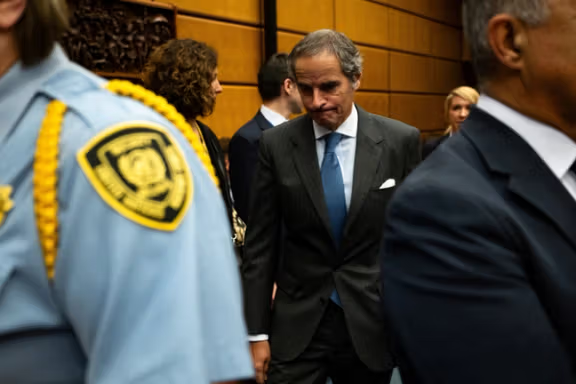
International Atomic Energy Agency (IAEA) Director General Rafael Grossi arrives for the quarterly board of governors meeting at the IAEA headquarters in Vienna, Austria, November 19, 2025.

The UN nuclear watchdog said on Wednesday it needs more Iranian cooperation to restore full inspections at sites hit in June’s strikes, warning that verification of enriched uranium stocks is “long overdue.”

In his opening statement to the IAEA Board of Governors, UN nuclear chief Rafael Grossi said the agency urgently needs access to Iran’s inventories of low-enriched and high-enriched uranium, which have not been checked for five months.

Grossi said he is in regular contact with Iranian officials following a September agreement in Cairo that set inspection procedures after the attacks, but added that “further constructive engagement is needed” to implement the deal in full.

The remarks come as the United States and three European allies have submitted a draft resolution demanding that Iran promptly restore cooperation and provide comprehensive nuclear-material accountancy.

Diplomats told Reuters on Tuesday that the measure is expected to pass at the board meeting later this week. 

The text calls on Iran to grant the agency “all access it requires” and to fully implement the Additional Protocol without delay.

Tehran has warned that such a resolution could undermine the September understanding reached with Grossi. 

Earlier this week, Iran’s Deputy Foreign Minister Kazem Gharibabadi said the Western push would compromise the agreement, while Iranian officials have linked stalled access to the reimposition of UN sanctions in late September under the snapback mechanism.

Iran has yet to allow inspectors to visit the facilities damaged during Israeli and US strikes in June, according to a confidential IAEA report seen by Reuters earlier this month. 

The report said the agency has not been able to verify Iran’s enriched-uranium stockpile since the attacks, when inspectors last confirmed about 440 kg of uranium enriched to 60% purity.

Access granted to unaffected sites 

Grossi told the board on Wednesday that establishing the status of Iran’s enriched material “needs to be addressed urgently,” warning that extended gaps in verification increase risks to the safeguards system. 

“It is critical the agency be able to verify this material as soon as possible,” he said.

The IAEA chief added that Iran has facilitated access with advanced notice to “almost all unaffected facilities,” calling this step welcome but insufficient.

The renewed push for cooperation follows a turbulent year in which Israeli and US attacks on Iranian nuclear facilities during the 12-day war in June left parts of the program damaged.

Iranian officials say the strikes undermined the credibility of the IAEA and have accused the agency of failing to condemn the attacks.

The IAEA board will continue discussions this week as Western governments seek to pressure Tehran back into full compliance, while Iran argues that sanctions and security concerns must also be addressed.

Most Viewed

US blockade enters murky phase as tankers spoof signals and buyers hesitate
1
ANALYSIS

US blockade enters murky phase as tankers spoof signals and buyers hesitate

2
INSIGHT

Ideology may be fading in Iran, but not in Kashmir's ‘Mini Iran'

3
INSIGHT

Hardliners push Hormuz ‘red line’ as US blockade tests Iran’s leverage

4
VOICES FROM IRAN

Hope and anger in Iran as fragile ceasefire persists

5

US sanctions oil network tied to Iranian tycoon Shamkhani

Banner
Banner

Spotlight

  • Hardliners push Hormuz ‘red line’ as US blockade tests Iran’s leverage
    INSIGHT

    Hardliners push Hormuz ‘red line’ as US blockade tests Iran’s leverage

  • Ideology may be fading in Iran, but not in Kashmir's ‘Mini Iran'
    INSIGHT

    Ideology may be fading in Iran, but not in Kashmir's ‘Mini Iran'

  • War damage amounts to $3,000 per Iranian, with blockade set to add to losses
    INSIGHT

    War damage amounts to $3,000 per Iranian, with blockade set to add to losses

  • Why the $100 billion Hormuz toll revenue is a myth
    ANALYSIS

    Why the $100 billion Hormuz toll revenue is a myth

  • US blockade targets Iran oil boom amid regional disruption
    ANALYSIS

    US blockade targets Iran oil boom amid regional disruption

  • Iran's digital economy battered by prolonged blackout
    INSIGHT

    Iran's digital economy battered by prolonged blackout

  • Iran says only level of uranium enrichment open for talks with US

    Iran says only level of uranium enrichment open for talks with US

  • US, European allies submit IAEA resolution urging Iran's swift cooperation

    US, European allies submit IAEA resolution urging Iran's swift cooperation

•
•
•

More Stories

Tehran denies any talks with Washington despite Trump comment

Nov 19, 2025, 10:45 GMT+0

Iran said on Wednesday that no negotiation process is underway with the United States, rejecting President Donald Trump’s claim a day earlier that the two sides had begun talks.

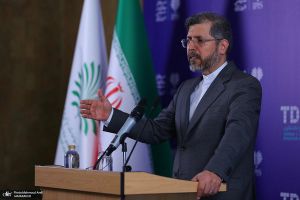
“There is no process of negotiation between Iran and the United States,” Foreign Ministry spokesman Esmail Baghaei told reporters in Tehran.

“As the foreign minister has said many times, talking to a side that does not believe in mutual respect and takes pride in military aggression against Iran has no logical justification.”

Trump said on Tuesday that the United States was talking with Iran and that he believed Tehran wanted a deal “very badly.”

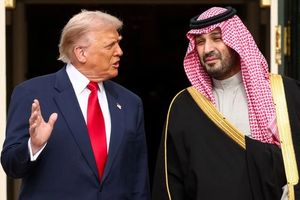
Speaking at the White House alongside Saudi Crown Prince Mohammed bin Salman, he said, “I am totally open to it, and we’re talking to them, and we start a process.”

The US president added that “it would be a nice thing to have a deal with Iran,” saying he thought the two sides could reach one with Saudi support.

Washington and Tehran held indirect contacts earlier this year over Iran’s nuclear program and regional issues, but the talks stopped after Israel launched a 12-day military campaign in June, followed by US strikes on key Iranian nuclear sites.

No message to US via Riyadh

Baghaei also addressed reports about a recent message from Iranian President Masoud Pezeshkian to the Saudi crown prince, saying it had only bilateral content.

He said the message, delivered by the new head of Iran’s Hajj and Pilgrimage Organization, expressed Iran’s gratitude for Saudi Arabia’s assistance to Iranian pilgrims last year and stressed the need for continued cooperation for this year’s pilgrimage.

Iran says only level of uranium enrichment open for talks with US

Nov 19, 2025, 08:14 GMT+0

Iran would consider resuming nuclear talks with the United States but will only discuss limits on the degree of uranium enrichment, not the continuation of enrichment itself, a senior adviser to Supreme Leader Ali Khamenei told CNN.

Kamal Kharrazi said Tehran’s conditions for returning to the table remain unchanged since US and Israeli strikes on Iranian nuclear sites in June.

Any renewed dialogue must be conducted on equal footing and mutual respect, he said, adding that Washington must show it is ready “to engage with us on the conditions that we put.” 

An agenda would need to be prepared in advance to avoid ambiguity, Kharrazi continued, arguing that President Donald Trump “does not believe in diplomatic engagement but rather prefers to use force to achieve his objectives,” and insisted that enrichment would continue because Iran requires nuclear fuel for power and medical use. 

Tehran’s expanding ballistic missile program, he added, will not be included in talks. “It is only the nuclear issue we will discuss with the United States,” he said.

  • Trump must accept peace is not achieved by force, Khamenei advisor says

    Trump must accept peace is not achieved by force, Khamenei advisor says

  • Trump says Iran wants a deal 'very badly', US is talking to Iran

    Trump says Iran wants a deal 'very badly', US is talking to Iran

Talks derailed by June strikes

The United States and Iran had been engaged in indirect discussions earlier this year when Israel launched a surprise attack in mid-June, prompting US airstrikes on three Iranian nuclear facilities. 

Kharrazi said the extent of the damage has still not been fully assessed and cautioned that further confrontation remained possible. “Everything is possible. But we are ready for that,” he said.

Iranian officials told CNN this week that despite “serious damage to infrastructure, machineries and buildings,” the program remains “intact,” even though enrichment is not currently taking place due to the attacks.

During the summer contacts, Washington insisted Tehran halt all enrichment, while Iran maintained it would continue low-purity domestic production. 

Kharrazi said limits on enrichment levels, rather than the activity itself, could form the basis of future negotiations. He added that a structured arrangement could allow Iran to continue enrichment while providing assurances it is not pursuing weapons.

  • Iran no longer enriching uranium after US, Israeli strikes, Araghchi says

    Iran no longer enriching uranium after US, Israeli strikes, Araghchi says

  • Channels with US exist but few messages worth pursuing, Iran says

    Channels with US exist but few messages worth pursuing, Iran says

Possible pathway via an enrichment consortium

According to a CNN report in June, the US had proposed joining a multinational consortium to oversee low-level enrichment inside Iran. Kharrazi said he believed an understanding could be reached on such a framework as long as Iran retains control over its fuel cycle. 

“If there would be genuine negotiations,” he said, “there are ways and means how to ensure that Iran can continue its enrichment and at the same time assure the others that it's not going to look for nuclear weapons.”

He also urged Trump to shift tone: “Start with a positive approach with Iran. If it will be positive, certainly it will be reciprocated. But they have to refrain from any force against Iran.”

Trump told reporters on Tuesday that Iran “very badly” wants a deal and that talks were already underway. 

Standing beside Saudi Crown Prince Mohammed bin Salman, he said: “I am totally open to it, and we're talking to them, and we start a process.”

He said his administration could have reached an agreement before the June war, “but that didn't work out,” while the crown prince said Riyadh would “do our best to help” Washington and Tehran reach a settlement.
Iranian nuclear scientists made covert visit to Russia for laser tech - FT

Nov 19, 2025, 07:29 GMT+0

Iranian scientists linked to its defense establishment made a second covert trip to Russia last year as part of what the United States says is an effort to obtain dual-use technologies with potential nuclear weapons applications, the Financial Times reported on Tuesday.

The previously undisclosed visit, held between November 7 and 11, 2024, involved physicists and engineers travelling on consecutively numbered diplomatic passports and meeting Russian institutes connected to military research, the report said, citing documents it obtained and corroborated through corporate filings, sanctions records, leaked travel data and other correspondence.

According to the report, the exchanges form part of a broader pattern of contact between Russian military-linked research centers and Iran’s Organization of Defensive Innovation and Research (SPND), a Defense Ministry body long sanctioned by Washington for alleged work on nuclear weapons design.

Jim Lamson, a senior research associate at the James Martin Center for Nonproliferation Studies and a former CIA analyst, told the FT the evidence indicated that Iran’s defense-linked scientists were “seeking laser technology and expertise that could help them validate a nuclear weapon design without conducting a nuclear explosive test.”

Tehran maintains its nuclear program is entirely peaceful, and Moscow has publicly opposed the Islamic Republic obtaining a nuclear weapon.

  • Iran runs covert nuclear procurement network with Vienna-based front firms

    Iran runs covert nuclear procurement network with Vienna-based front firms

  • Iranian nuclear experts visited Russian labs with dual-use tech - FT

    Iranian nuclear experts visited Russian labs with dual-use tech - FT

  • 700 Russians working on Iran's Bushehr nuclear facility, Rosatom says

    700 Russians working on Iran's Bushehr nuclear facility, Rosatom says

The delegation met Laser Systems, a Russian company under US sanctions that develops equipment for both civilian and classified military use. 

The November 2024 mission followed an earlier set of meetings revealed in August, which showed that a Vienna-linked procurement network involving DamavandTec – and using diplomatic passports issued by Iran’s foreign ministry – had arranged introductions between Iranian nuclear scientists and Russian companies with defense and intelligence ties.

Academic and institutional records reviewed by the FT showed the men who travelled were not DamavandTec employees but researchers from Shahid Beheshti University, Islamic Azad University of Kashan and Malek Ashtar University of Technology, an institution under US and EU sanctions for its role in nuclear-related activity.

The FT said the visit had been framed in invitations as an opportunity for technological collaboration, though the scope of any technology transfer between the two sides remains unclear.

The findings come against the backdrop of years of Western allegations that SPND operates covert procurement networks in Europe and Asia to source dual-use equipment. 

An investigation by Iran International in 2025 documented a Vienna-based hub tied to SPND-linked front firms purchasing neutronics-related and other sensitive components with potential applications in nuclear weapons design.

Washington has sanctioned more than 30 SPND scientists and multiple affiliated entities, saying the organization oversees “dual-use research and development activities applicable to nuclear weapons and nuclear weapons delivery systems.”

In 2024, Iran’s parliament formally recognized SPND under Iranian law, placed it under the authority of the Supreme Leader and exempted its budget from parliamentary oversight.

US, European allies submit IAEA resolution urging Iran's swift cooperation

Nov 18, 2025, 20:55 GMT+0

The United States and three European allies urged Tehran to immediately restore its cooperation with the UN nuclear watchdog in a draft resolution they submitted to the IAEA Board of Governors which will meet later this week in Vienna.

"Iran must ... provide the (International Atomic Energy) Agency without delay with precise information on nuclear material accountancy and safeguarded nuclear facilities in Iran," they wrote in the draft submitted on Tuesday.

The United States and its allies also demanded Tehran grant the Agency "all access it requires to verify this information," according to the draft resolution which diplomats cited by Reuters said is highly likely to be passed.

The IAEA board "calls upon Iran to act strictly in accordance with" the IAEA Additional Protocol "and to fully implement this measure without delay", the resolution added.

Iran's deputy foreign minister Kazem Gharibabadi warned earlier on Tuesday that an agreement Tehran signed with the UN nuclear watchdog in September would be compromised by the US-European IAEA resolution.

The Cairo deal allowed the IAEA to resume inspections at all declared Iranian nuclear facilities including those damaged in Israeli and US strikes in June.

But after the three European powers restored UN sanctions on Iran in late September through the so-called snapback mechanism, Iranian officials said the reimposed sanctions would “certainly halt” the deal.

Iran’s nuclear chief Mohammed Eslami said on Sunday that US and Israeli strikes on its civilian nuclear facilities during the June conflict had damaged the credibility of the UN nuclear watchdog, accusing the IAEA of failing to condemn the attacks.

Iran has yet to allow UN inspectors to visit nuclear sites hit by the Israeli and US airstrikes, the IAEA said in a confidential report last Wednesday, saying verification of Tehran’s enriched uranium “long overdue.”

“The Agency’s lack of access to this nuclear material in Iran for five months means that its verification is long overdue,” the IAEA said in a report to member states seen by Reuters.

"It is critical that the Agency is able to verify the inventories of previously declared nuclear material in Iran as soon as possible in order to allay its concerns ... regarding the possible diversion of declared nuclear material from peaceful use," the agency quoted the IAEA report as saying.

The Vienna-based nuclear watchdog has not been able to confirm the amount of enriched uranium in Iran’s possession since June, when Israeli and US strikes hit its main enrichment sites at Natanz, Isfahan and Fordow during the 12-day conflict.

Before the attacks, inspectors had verified about 440 kilograms of uranium enriched to 60 percent purity—enough, if further refined, for roughly 10 nuclear weapons under IAEA criteria.

Germany says Iran’s nuclear breaches will be on IAEA meeting agenda

Nov 18, 2025, 16:40 GMT+0

Iran’s continued breaches of its nuclear obligations will remain on the agenda at the upcoming quarterly meeting of the International Atomic Energy Agency Board of Governors, a German foreign ministry spokesperson told Iran International.

"The reports of the IAEA Director General speak for themselves, as they highlight Iran’s ongoing violations of its key obligations. This particularly concerns the still-unclarified whereabouts of the stocks of highly enriched uranium," the spokesperson said.

Last week, in a confidential report cited by Reuters, the IAEA said Iran has yet to allow UN inspectors to visit nuclear sites hit by Israeli and US airstrikes in June, adding that the verification of Tehran’s enriched uranium is “long overdue.”

“The Agency’s lack of access to this nuclear material in Iran for five months means that its verification is long overdue,” the IAEA said in the report to member states.

Under its obligations as a party to the Nuclear Non-Proliferation Treaty, Iran must submit a detailed report on the status of the bombed facilities “without delay,” but has yet to do so, the IAEA added. Only after such a report is received can inspectors return to the damaged sites.

The spokesperson added that the E3 — Germany, France and the United Kingdom — have repeatedly raised their concerns on Iran's violations publicly and they were the reason the troika triggered the so-called snapback of sanctions.

The E3 triggered the snapback mechanism under the UN Security Council Resolution 2231 which led to the restoration of UN sanctions on Iran in late September.

European states are expected to discuss a draft resolution critical of Iran at the IAEA Board of Governors meeting later this week.

According to the spokesperson, no specific agenda item is planned on the implementation of UN Security Council Resolution 2231, but Berlin said the issue will still be addressed based on reporting from the IAEA director general and the UN resolutions that re-entered into force following the snapback mechanism.

European countries and the United States have called for renewed talks between Washington and Tehran, but Iran says it will not renounce domestic uranium enrichment or discuss its missile program and its support for regional armed groups.

"Germany, together with its E3 partners France and the United Kingdom, continues to advocate for a diplomatic solution to the Iranian nuclear program," the spokesperson added.

Earlier this month, IAEA chief Rafael Grossi said although the June attacks on Iran's Natanz, Isfahan and Fordow nuclear sites “severely damaged” the country's nuclear program, the country retains the knowledge and material “to manufacture a few nuclear weapons."

Before the attacks, inspectors had verified about 440 kilograms of uranium enriched to 60 percent purity—enough, if further refined, for roughly 10 nuclear weapons under IAEA criteria.

Iranian officials, including Iran's foreign minister Abbas Araghchi, have repeatedly said the enriched uranium is buried "under rubble" left from the June strikes.

Tehran denies seeking a bomb but Western powers and Israel doubt its intentions.