• العربية
  • فارسی
Brand
  • Iran Insight
  • Politics
  • Economy
  • Analysis
  • Special Report
  • Opinion
  • Podcast
  • Iran Insight
  • Politics
  • Economy
  • Analysis
  • Special Report
  • Opinion
  • Podcast
  • Theme
  • Language
    • العربية
    • فارسی
  • Iran Insight
  • Politics
  • Economy
  • Analysis
  • Special Report
  • Opinion
  • Podcast
All rights reserved for Volant Media UK Limited
volant media logo

Iran's Police Sends ‘Hijab Warning’ Text Messages To Men

Maryam Sinaiee
Maryam Sinaiee

Iran International

Apr 19, 2023, 20:15 GMT+1Updated: 17:42 GMT+1
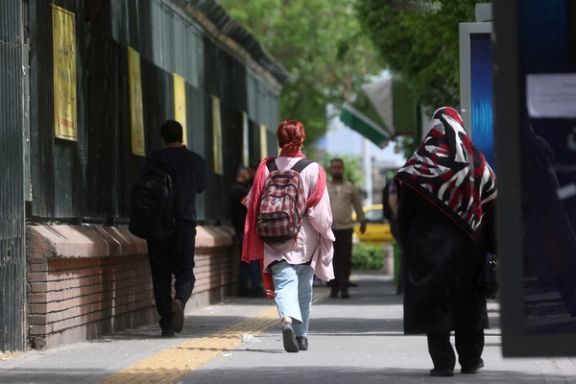
An Iranian woman without mandatory hijab in public

Some men have said on social media that they received the police hijab warning text messages meant for women driving without a veil, for no reason.

“I received a hijab warning text message! I swear by God that I was alone in the car!” former reformist vice-president Mohammad-Ali Abtahi tweeted Tuesday.

Abtahi who is a cleric jokingly said the police surveillance cameras had warned him for not donning his turban, but he didn’t know what to do because people try to toss his turban when he wears it.

“I got a text message warning me to abide by hijab rules. I think the surveillance cameras are unable to distinguish between men and women. The Chinese [surveillance equipment and software] are apparently the reason for that. They are too modern!” a male tweeter user said Tuesday with the hashtag NoToCompulsoryHijab and an image of the text message he had received.

“Dear citizen, respecting the hijab law and abidance by it is necessary as any other law,” a text message sent en masse to cell phone holders by the police in the past few days reads.

A text message warning about the observance of hijab  (file photo)
100%
A text message warning about the observance of hijab

Khabar Online said official statistics indicate that there are over 141m sim cards in active use in the country. Iranian media say sending the said text messages has entailed a cost around 2 trillion rials ($40,000) to the police.

In the past few weeks, hardliner government officials, lawmakers, and clerics have also demanded that businesses refuse serving hijab-less women.

Opposition to compulsory hijab has grown hugely in the past few years. Apparently in a bid to lessen the direct engagement of the police against women and to avoid escalating the situation to protests as in September last year, authorities have been trying to shift the responsibility of enforcing hijab rules to businesses.

Punishment of businesses, including cash fines and closure, for hijab infringements by their customers has a long history in the Islamic Republic but this level of strict warnings and threats which puts great pressure on the retail and hospitality sectors at a time of economic hardship is unprecedented.

Some legal and Sharia experts say measures making businesses responsible for enforcement of hijab rules are not justified, even according to Sharia.

Mohsen Borhani, a professor of criminal law at Tehran university (undated)
100%
Mohsen Borhani, a professor of criminal law at Tehran university

Mohsen Borhani, an Islamic law expert and lawyer, argued in a tweet that nowhere in Sharia one can find reasons to justify the ban on selling commodities to hijab-less women or to shut down a shop if a hijab-less woman is spotted there. “You neither abide by the law, nor the Sharia. It’s flustering!” he tweeted Tuesday.

Some Iranian politicians including former President Hassan Rouhani have repeatedly suggested holding referendums on “important issues”, which may include hijab in the current circumstances, to give the power of decision to the people. Supreme Leader Ali Khamenei, however, has ruled out the possibility of referendums despite the Islamic Republic’s own constitution.

“[Who says] the country’s various issues can be put to referendum? Where in the world do they do that? [Who says] all the people participating in a referendum have the faculty of analyzing that matter? What kind of demand is that?” he said Tuesday at a meeting with some students.

Defying hijab rules has turned into a form of civil disobedience. Many women have been sharing their photos taken in public places without hijab to prove that they have not given up despite the threats and harsher measures adopted recently.

The ultra-hardline Kayhan newspaper whose chief editor, Hossein Shariatmadari, is appointed by Khamenei claimed Monday that these images were “forged”.
Most Viewed

US blockade enters murky phase as tankers spoof signals and buyers hesitate
1
ANALYSIS

US blockade enters murky phase as tankers spoof signals and buyers hesitate

2
INSIGHT

Ideology may be fading in Iran, but not in Kashmir's ‘Mini Iran'

3
INSIGHT

Hardliners push Hormuz ‘red line’ as US blockade tests Iran’s leverage

4
VOICES FROM IRAN

Hope and anger in Iran as fragile ceasefire persists

5

US sanctions oil network tied to Iranian tycoon Shamkhani

Banner
Banner

Spotlight

  • Hardliners push Hormuz ‘red line’ as US blockade tests Iran’s leverage
    INSIGHT

    Hardliners push Hormuz ‘red line’ as US blockade tests Iran’s leverage

  • Ideology may be fading in Iran, but not in Kashmir's ‘Mini Iran'
    INSIGHT

    Ideology may be fading in Iran, but not in Kashmir's ‘Mini Iran'

  • War damage amounts to $3,000 per Iranian, with blockade set to add to losses
    INSIGHT

    War damage amounts to $3,000 per Iranian, with blockade set to add to losses

  • Why the $100 billion Hormuz toll revenue is a myth
    ANALYSIS

    Why the $100 billion Hormuz toll revenue is a myth

  • US blockade targets Iran oil boom amid regional disruption
    ANALYSIS

    US blockade targets Iran oil boom amid regional disruption

  • Iran's digital economy battered by prolonged blackout
    INSIGHT

    Iran's digital economy battered by prolonged blackout

•
•
•

More Stories

Imagine Ties With Secular, Democratic Iran, Pahlavi Tells Israelis

Apr 19, 2023, 16:36 GMT+1
•
Iran International Newsroom

Iran’s exiled prince Reza Pahlavi, who is on a historic visit to Israel, expressed hope for amicable relations once Iran becomes a secular and democratic country.

During a joint press conference with Israel’s Intelligence Minister Gila Gamliel, who is hosting Pahlavi, in Tel Aviv on Wednesday, Pahlavi said that Iranians are the extreme opposite of the country’s current rulers, and that the regime does not represent the Iranian nation. 

He added that Iranians are thrilled to see the son of their last shah is spreading the message of peace with Israelis on their behalf. “They have no antagonism to any nation or any faith,” Pahlavi said. 

“I know that Iranians and Israelis see how important it would be for our future to be strategic partners, to work together, to address many issues. I come here to convey this message to Israeli citizens,” he said.

Iran’s exiled prince Reza Pahlavi during a press conference in Tel Aviv on April 19, 2023
100%
Iran’s exiled prince Reza Pahlavi during a press conference in Tel Aviv on April 19, 2023

As he was welling up and holding back tears, Pahlavi said, "The amount of affection and emotions demonstrated by the Iranian Israeli community, but also regular Israeli citizens, has been overwhelmingly warm and welcoming, and it has affected myself and my wife very much... What you see in me is not just me, it’s millions of voiceless Iranians who feel the same emotions being in captivity, in repression.”

He noted that the Islamic Republic brought the situation to the point “when once a proud nation has been faced with the designation as a terrorist nation.”

Pahlavi then talked about the prospects of peace and calm in the region when the Islamic Republic collapses. “Imagine a different Iran, not ruled by a religious dictatorship, but [what] a secular democratic Iran could mean for our region, for stability and how it would impact the world positively,” he said.

He also enumerated some of the negative impacts of the Islamic Republic on the globe “from the nuclear threat, to spread of Islamic radicalism, and support for terrorism.” 

He said he is in Israel “to explore how we can cooperate in helping the Iranian people in their campaign for freedom,” referring to the “Women, life, liberty” movement. He described the uprising as “the first modern day – or all time perhaps" women-led revolution. 

He also reiterated that he is not seeking the throne in the future of Iran but only wants to help the people of the country to establish a constituent assembly and hold a referendum. 

Referring to the 2020 US-brokered Abraham Accords aimed at normalizing relations between Israel, the United Arab Emirates and Bahrain, Pahlavi also expressed hope for a “Cyrus Accord” for peace between Tehran and Jerusalem.

While Pahlavi was promoting peace with the Israelis, Islamic Republic’s President Ebrahim Raisi threatened to destroy the Israeli cities of Tel Aviv and Haifa in an inflammatory speech in Tehran on Tuesday. 

During his stay, Pahlavi visited the Wailing Wall and attended the ceremony to mark Israel's Holocaust Remembrance Day at the Yad Vashem memorial in Jerusalem. He also met with Prime Minister Benjamin Netanyahu and President Isaac Herzog in the past two days.

Netanyahu, in his opening remarks at the Remembrance Day event, pointed to the similarities between the Islamic Republic and the Nazis, saying that Israel’s victory in the future requires constant determination and fight against those who seek to kill Israelis. 

“That is why we firmly fight any nuclear agreement with Iran, which would pave its way to nuclear weapons,” he said, adding that “Those who seek to wrap us in a stranglehold of terror will encounter an overwhelming response.” 

The prince and Minister Gamliel also visited Sorek desalination plant Wednesday evening, as part of Pahlavi's intention to learn about how Israel is coping with the challenge of water, given a crisis in Iran.

In 2021, large-scale water protests took place in Iran, with several people killed and hundreds injured by security forces. Water reservoirs are at an all-time low, threatening nationwide rationing soon, local media and officials say.

Amnesty Int. Calls For Independent Probe Into School Chemical Attacks In Iran

Apr 19, 2023, 13:08 GMT+1

Amnesty International has called for an “independent, thorough and effective” investigation into the poisoning of schoolgirls across Iran.

In a letter to Iran’s Prosecutor General Mohammad Javad Montazeri on Tuesday, the human rights group said the authorities must ensure girls have equal and safe access to education and are protected from any form of violence.

Amnesty warned that the rights to education, health and life of millions of schoolgirls are at risk amid ongoing chemical gas attacks deliberately targeting girls’ schools in Iran.

According to the letter, more than 100 schools have been targeted since November, some more than once.

Amnesty says the poisonings appear to be a coordinated campaign to punish schoolgirls for their peaceful participation in nationwide protests that erupted in mid-September 2022, including through acts of resistance such as removing their mandatory hijabs and showing their hair in public while in school uniform.

Amnesty wrote: “An independent international delegation to investigate the attacks, including UN Special Rapporteur on the situation of human rights in Iran, UN Special Rapporteur on the right to education, UN Special Rapporteur on violence against women and girls, UN Special Rapporteur on the right to health, and Committee on the Rights of the Child, must also be granted access to the country.”

The letter adds: “Many people in Iran suspect actors tied to the state or pro-government vigilantes, who have been empowered by Iran’s discriminatory and degrading laws and policies that perpetuate violence against women and girls, of being involved in the attacks, especially given the authorities’ failure to take meaningful action and their attempts to silence public criticism.

“The attacks were first reported in Qom province and have since spread to other provinces and become more frequent with multiple schools attacked daily. These attacks have left schoolgirls hospitalized with symptoms including coughing, difficulty in breathing, nose and throat irritation, heart palpitation, headache, nausea, vomiting and numbness in limbs.”

Some of the schoolgirls hospitalized with symptoms of poisoning (February 2023)
100%

Amnesty also noted that the authorities have tried to silence public calls for accountability by subjecting distressed parents, schoolgirls, teachers, journalists and others to violence, intimidation and arrest for peacefully protesting or reporting on the authorities’ failure to stop the poisonings.

Meanwhile, the deposed Sunni Imam of Azadshahr Mowlavi Hossein Gorgij on Monday wished for the death of those who poison children.

He said the world earlier witnessed such chemical attacks on children in Syria.

Chemical attacks on girl's schools in Iran continued on Tuesday with students in at least 26 elementary and high schools poisoned according to reports.

A large number of students were taken to hospital in the cities of Kermanshah, Urmia, Eslamshahr, Tehran, Karaj, Ardebil, Saqqez and Ahvaz.

Videos published on social media show families gathered in front of the schools to vent anger at the regime’s indifference to the attacks.

The serial poisoning of students has been ongoing for over four months. The perpetrators have not been identified, while the attacks have spread to more and more cities.

Amid an international outcry over the attacks, the UN Human Rights Council in Geneva has called for a transparent investigation, while the White House has demanded that those responsible are held accountable.

Iran’s Culture Minister Tells Protesting Artists: 'Repent Or Be Jobless!'

Apr 19, 2023, 10:55 GMT+1
•
Iran International Newsroom

Iran's Culture Minister Mohammad Mehdi Esmaili says dissident artists may be allowed to work if they express regret for supporting popular protests.

Relations between the government and Iranian artists have been strained since last September when anti-regime protests began and hurt the official propaganda plans for the anniversary of the Islamic revolution in February.

As musicians, film and theater artists refused to take part in the Fajr Festivals that mark the anniversary, the regime's image was badly damaged particularly in front of the foreign guests the government had invited to Tehran.

Esmaili said that the Culture Ministry can arrange jobs for the artists on the condition that they repent. Some observers have charged that what the Culture Ministry is doing with the artists is like what the government did to political prisoners in the 1980s by forcing them to incriminate themselves and their colleagues.

Esmaili denied that the Ministry has a list of artists who are not allowed to work in Iran because of their support for the protest. However, he acknowledged that the Iranian Judiciary does has such a list.

Tens of Iranian journalists, musicians, as well as film and stage actors were arrested and jailed either for supporting the protesters or for taking part in acts of protest. This included female artists who took off their compulsory hijab in public.

Iranian actresses Khazar Ma'soomi (left) Donya Madani (center) and Taraneh Alidoosti
100%
Iranian actresses Khazar Ma'soomi (left) Donya Madani (center) and Taraneh Alidoosti

Most of the actors, including the highly prominent actress Katayoun Riahi have been released from jail but judicial cases have been fabricated so that they would fear arrest any moment. The government uses looming jail sentences to keep the artists under control. Some artists including rap singer Toomaj Salehi are still in jail after several months.

Esmaili claimed: "We will do our best to return the repenting artists to the arms of the nation and resume working." However, similar experiences following unrest in the aftermath of the 2009 disputed presidential election showed that artists who bow to the regime would not be welcome by the society.

Esmaili also threatened artists by saying, "Those who are not compliant with the ideals of the Iranian nation will be treated differently." It is obvious that by "the Iranian nation" he meant the regime.

The Trade Union of Iranian Film Artists (The House of Cinema) had announced earlier that some 100 figures are facing restrictions imposed by the government. Many of those artists are barred from travelling abroad. The travel bans have been intensified after Iranian actor and TV celebrities including Hamid Farrokh Nejad, Ehsan Karami and Borzou Arjmand joined the foreign-based opposition after leaving the country.

The government was forced to release actresses under international pressure, as nearly all major film festivals in Europe condemned the arrests. The culture minister said late last year that they can engage in businesses other than acting in the movies, which meant that the actresses are barred from working.

The minister further said that actresses who have removed their hijab have in fact chosen not to obey the laws.

The head of Iran's state television Payman Jebelli (undated)
100%
The head of Iran's state television Payman Jebelli

Stage director Qotbeddin Sadeqi told reporters in Tehran that the situation of stage artists is catastrophic. He said, "None of them has a job. The plays that are allowed to go on stage are not popular and most of those who go to theaters are friends and colleagues invited by artists to watch the show for free."

Film Critic Ali Mosleh told Iran International TV that during the protests, the minister used to beg the actresses to return to work, but he is now threatening them as the government believes the protests have ended. He added that none of the protesting artists have retreated from their positions during the past months.

Meanwhile, the head of Iran's state television Payman Jebelli has said that some artists and TV personalities are no longer interested in working with the state television.

Four Countries Slam Iran’s ‘Sham’ Trials Over Downed Airliner

Apr 18, 2023, 18:37 GMT+1
•
Iran International Newsroom

The International Coordination and Response Group for the victims of Flight PS752, shot down by the IRGC in 2020, denounces Iran’s “sham” trial for alleged culprits.

In a Tuesday statement, the response group -- which represents Canada, Sweden, the United Kingdom, and Ukraine – said, “The sham trials that took place in Tehran must not distract the world from Iran’s failure to meet its international obligations and take responsibility for its actions.”

On Sunday, a court in Iran issued sentences for 10 low-ranking military personnel in connection with the incident, sentencing a commander to 10 years in prison, while nine others were sentenced to between one and three years. The names of none of the senior military and government officials could be seen in the list, while families of victims demand to know which senior officers issued the order to fire at the plane.

In the statement, the response group said that the Islamic Republic “callously shot down Flight PS752 over Tehran," denouncing the verdicts in the criminal trials against the alleged perpetrators.

“Neither the trials nor the verdicts announced this week brings truth or justice to the families of the victims, as the entire process—starting with Iran’s biased investigation into the downing—lacked the necessary impartiality and transparency,” read the statement.

Flight PS752 of the Ukrainian International Airlines was shot down by two air-defense missiles fired by the IRGC as it took off from Tehran’s Imam Khomeini International Airport on January 8, 2020. Hours earlier, the IRGC had fired more than a dozen missiles at Iraqi bases hosting US troops in retaliation for the killing of its Quds Force Commander Qassem Soleimani in a US airstrike in Baghdad just five days earlier.

All 176 passengers and crew, including 63 Canadians as well as 82 Iranian citizens died in the disaster.

Iran first tried to deny it had shot down the plane, but when video evidence emerged, it acknowledged the incident but attributed it to human error. However, it never allowed an independent investigation and did not explain why the order was issued to shoot at a plane taking off from Tehran, or if Iran was concerned about a US retaliation, why it did not close its airspace following the attack on US bases in Iraq.

On December 28, 2022, the Coordination Group urged Iran to agree to arbitration as Tehran stonewalled over an independent investigation and proper compensation.

The statement Tuesday added, “The families of the 176 innocent victims are still waiting for the justice they deserve. We continue to stand in solidarity with the families and loved ones of the victims of the downing of Flight PS752 and will not rest until justice has been served.”

Head of the Judiciary Organization of the Armed Forces of the Islamic Republic Ali Eftekhari (April 2023)
100%
Head of the Judiciary Organization of the Armed Forces of the Islamic Republic Ali Eftekhari

On Monday, head of the Judiciary Organization of the Armed Forces of the Islamic Republic, Ali Eftekhari, made paradoxical remarks about the case. Claiming that "the air defense system of the country was not defective" at the night of the accident, he said that "it was not possible to determine whether it was a passenger plane or a missile in the radar system at night."

Although it is common knowledge that radar is a radiolocation system that uses radio waves to detect and track objects and there is no difference in their performance between night and day. In addition, speed and trajectory of an object should clearly distinguish between a missile and a passenger plane.

Eftekhari also claimed that the IRGC did not shoot a second rocket at the plane, despite videos of the night of the incident clearly showing the second projectile.

Following the trials, families of the victims are outragedby light sentences issued for a few low-ranking military men.

Responding to the criticism about the light sentences for the alleged culprits in comparison to the harsh sentences for antigovernment protesters, Eftekhari said that those who go to the streets seek to "disrupt security" and "must" be punished but the operator behind the attack on the passenger plane meant to preserve the country’s security.

Iran Issues Heavy Sentences To Protesters Accused Of Killing Agent

Apr 18, 2023, 14:12 GMT+1

Fourteen protestors have been jailed in Iran for up to 15 years for the death of a Basij agent in a trial branded a travesty of justice by human rights activists.

Ruhollah Ajamian was killed in Karaj, near Tehran, in November by a group of men the regime called “rioters”.

The member of the Basij militia of the Revolutionary Guards (IRGC) was stabbed, beaten, and stripped naked by a group of men and died of his injuries later.

The Islamic Republic has already executed Mohammad Mehdi Karami and Mohammad Hossein over Ajamian’s death.

On Tuesday in Alborz, 14 protesters were jailed in connection with the killing, with five of them receiving long-term prison terms of 10 and 15 years.

The two executions came after a hasty trial and without their right to choose a lawyer.

Jurists and human rights activists have described the trials as “unfair” and questioned the verdicts.

The judiciary of Alborz province claimed on Tuesday that the charges leading to the verdict were not "intentional murder" but "corruption of the earth" and "moharebeh", or “waging war against God”.

Among the defendants, Hamid Qarahasanlou, who was previously sentenced to death, received the longest prison term and was given 15 years in prison. He is set to serve his sentence in Yazd province in central Iran.

These are only the latest lengthy sentences to be handed down by the Iranian regime to countless protesters in the widespread demonstrations that followed the death in custody of 22-year-old Mahsa Amini last September.

Protests broke out in scores of cities across Iran, with crowds demanding justice for Mahsa and calling for an end to the regime’s oppressive policies.

The brutal crackdown in response to the demonstrations and heavy sentences handed out by the courts have signaled the regime’s refusal to change and determination to silence dissent.