• العربية
  • فارسی
Brand
  • Iran Insight
  • Politics
  • Economy
  • Analysis
  • Special Report
  • Opinion
  • Podcast
  • Iran Insight
  • Politics
  • Economy
  • Analysis
  • Special Report
  • Opinion
  • Podcast
  • Theme
  • Language
    • العربية
    • فارسی
  • Iran Insight
  • Politics
  • Economy
  • Analysis
  • Special Report
  • Opinion
  • Podcast
All rights reserved for Volant Media UK Limited
volant media logo

Congestion At Gas Stations As Iran's Fuel Crisis Deepens
Iran International Newsroom
Aug 15, 2023, 20:51 GMT+1Updated: 17:52 GMT+1
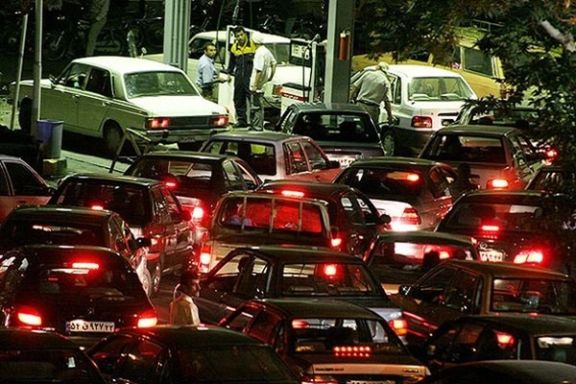
Congestion at an Iranian gas station  (file photo)
Congestion at an Iranian gas station (file photo)

Shortages of gasoline in Iran and refueling limits, as well as rumors of an impending price hike have led to long queues at gas stations across the country. 

Despite repeated denials of a fuel crisis by government media -- which blame the disruption in the supply chain on summer travels -- Iranians see the long lines of cars as a prelude to protests that may engulf the country even before the anniversary of last year’s protests in mid-September. 

The congestion at gas stations started in small towns and cities earlier in the month but as of Tuesday, numerous videos have emerged on social media showing long queues of vehicles waiting to fill up in the capital Tehran, Kerman, Karaj, Kermanshah, as well as several cities in border provinces.

Media outlets affiliated with the government and the Revolutionary Guard have published several reports in the past few days claiming that technical issues such as out of order fuel pumps and nozzles have caused the problem. Jam-e Jam newspaper, owned by Iran's state broadcaster, claimed that delays to get fuel to the stations and problems with smart cards that keep tabs on the customers' rations have caused the crisis. 

Meanwhile, there are reports that fuel black markets have formed in several cities, with prices closer to international levels. The government, which controls one of the world's largest oil and gas reserves, sells gasoline at extremely low, subsidized prices, charging less than 10 US cents per gallon, or less than 3 cents per liter, while neighboring oil-producers have much higher prices, in line with international market rates. Second only to Venezuela, Iran has the world’s cheapest gasoline price. 

According to the reformist Ham-Mihan newspaper, in several cities in Sistan-Baluchistan province, a 20-liter can of gasoline is being sold for 4,000,000 rials or $8, about seven to eight times higher than the highest government price. 

One of the main reasons that the Islamic Republic has not managed to increase prices in the midst of the current economic crisis is because it faced the worst wave of unrest in years since September 2022. A fuel price hike would risk fanning the flames of unrest further. 

For years there has been talk of adjusting prices, but since 2018 Iran’s currency has dropped 12-fold and any increase needs to be huge to be meaningful in US dollars. In November 2019, a government decision to increase fuel prices by 50–200 percent triggered nationwide unrest that lasted for two weeks. Regime forces killed at least 1,500 civilians, in the worst such crackdown in Iran.

Riot police against protesters in Tehran during 2019 protests
100%
Riot police against protesters in Tehran during 2019 protests

Iran has been struggling with gasoline shortages since at least the beginning of the summer of 2022 and was forced to release one-third of its strategic reserves by the end of the same year. A source at the oil ministry told Iran International that the National Iranian Oil Refining and Distribution Company (NIORDC), a department within the ministry, has released around 900 million liters of strategic gasoline reserves into the market.

Adding to the misery, an informed Iranian oil ministry official told Iran International on Monday that Russia has ceased its gasoline exports to Iran for the past few months. 

Most Viewed

US blockade enters murky phase as tankers spoof signals and buyers hesitate
1
ANALYSIS

US blockade enters murky phase as tankers spoof signals and buyers hesitate

2
INSIGHT

Ideology may be fading in Iran, but not in Kashmir's ‘Mini Iran'

3
INSIGHT

Hardliners push Hormuz ‘red line’ as US blockade tests Iran’s leverage

4
VOICES FROM IRAN

Hope and anger in Iran as fragile ceasefire persists

5

US sanctions oil network tied to Iranian tycoon Shamkhani

Banner
Banner

Spotlight

  • Hardliners push Hormuz ‘red line’ as US blockade tests Iran’s leverage
    INSIGHT

    Hardliners push Hormuz ‘red line’ as US blockade tests Iran’s leverage

  • Ideology may be fading in Iran, but not in Kashmir's ‘Mini Iran'
    INSIGHT

    Ideology may be fading in Iran, but not in Kashmir's ‘Mini Iran'

  • War damage amounts to $3,000 per Iranian, with blockade set to add to losses
    INSIGHT

    War damage amounts to $3,000 per Iranian, with blockade set to add to losses

  • Why the $100 billion Hormuz toll revenue is a myth
    ANALYSIS

    Why the $100 billion Hormuz toll revenue is a myth

  • US blockade targets Iran oil boom amid regional disruption
    ANALYSIS

    US blockade targets Iran oil boom amid regional disruption

  • Iran's digital economy battered by prolonged blackout
    INSIGHT

    Iran's digital economy battered by prolonged blackout

•
•
•

More Stories

Water Scarcity Grips Iran As Over 260 Cities Face Deficit

Aug 15, 2023, 20:13 GMT+1

Over 260 cities are facing severe water shortages across Iran, says a leading official in Iran’s water industry.

Addressing inquiries during a session focused on the nation's water industry, Hashem Amini, the deputy head of National Water and Wastewater Company, said that the situation had reached national crisis level in various regions. A particular concern, he highlighted, is drinking water shortages from the Dousti Dam in Mashhad and the Nahand Dam in the northwestern city of Tabriz.

He further cautioned about the precarious state of groundwater in Zanjan, Tabas, and cities in Sistan and Baluchestan province, saying that these vital water sources were also in significant decline over the past two years.

However, during the session, Amini countered his claims, saying that new water supply projects across the country would address the issue.

Adel Peyghami, the CEO of the Qeshm Free Zone, also stressed the need to address water security, saying that "people do not have water" on Qeshm Island. He also said that Islamic regime authorities had urged him not to overstate the situation.

While drought contributes significantly to Iran's water stress, inefficiency in water management has compounded the crisis. It is estimated that a quarter of the country's treated water is wasted, further highlighting the need for improved water management practices.

Iran Says Britain Restricts Freedom Of Speech For UK Journalists

Aug 15, 2023, 17:06 GMT+1

Masoud Setayeshi, spokesman for Iran's Judiciary has slammed the United Kingdom for restricting freedom of speech and the violation of journalists' rights.

Despite being blasted by human rights organizations all over the world for consistently violating human rights, detaining journalists for speaking out against the regime and threatening journalists from Farsi-language media including Iran International reporters on British soil, Setayeshi said that that the government in the UK did not “prioritize the fundamental rights of its citizens.”

"It is imperative for me to express my regret over the repeated violations of human rights, minority rights, women's and children's rights, and the lamentable state of freedom of expression in the UK,” he said during a weekly press briefing on Tuesday.

“I hereby admonish this government to prioritize the fundamental rights of its citizens, including the rights of prisoners and the rights of journalists, and to responsibly prevent the infringement of these individuals' rights."

Setayeshi's remarks were prompted by a recent tweet from the British Ambassador in Iran, Simon Shercliff, which called for the release of detained journalists and resulted in him being summoned by Iran's foreign ministry.

Setayeshi criticized these kinds of comments as impertinent and audacious. "It should be acknowledged that Iran's response to the impertinence and historical interference of British government entities in our internal affairs has consistently been firm,” he said.

"It is prudent for the representative of the British monarchy's government, before rushing to his computer to tweet on social media, to first present a comprehensive dossier outlining how his predecessors' interventions have brought shame and humiliation upon themselves in the eyes of the Iranian nation. By doing so, he will restrain himself from committing such audacity again."

Last week, the Revolutionary Guards (IRGC) spokesman warned Iranian journalists to avoid critical reporting, which they said would aid the enemies.


Iranians Push For Regime-Linked Center In Frankfurt To Be Banned

Aug 15, 2023, 17:02 GMT+1
•
Benjamin Weinthal

German Iranians are demanding the state government of Hesse shut down the pro-Iran regime Center for Islamic Culture in Frankfurt that honored Qasem Soleimani.

A Frankfurt Social Democrat Party politician Turgut Yüksel has shared information about the strong ties between the Center for Islamic Culture and Iran’s regime.

Iran International reviewed state of Hesse’s response to Yüksel’s “minor interpellation”—a formal written request by a member of the state parliament seeking concrete information about government conduct.

According to answers with respect to Yüksel’s request, the state’s ministry of interior and sport wrote, “The Center for Islamic Culture Frankfurt (ZIK) was influenced by the Islamic Center of Hamburg (IZH). The ZIK property was acquired by the IZH in 2012 and was still owned by the IZH in 2022. Until November 2020, the long-time head of the ZIK was also chairman of the Shiite umbrella organization ‘Islamic Community of Shiite Communities in Germany’ (IGS), which in turn sees the IZH as a reference organization for itself and its member associations.”

When asked by Yüksel “What options does the state government see for restricting the activities of the associations that support the Iranian regime,” state secretary, Stefan Sauer, for the interior ministry, wrote “should an examination show that the goals or activities of the associations run contrary to criminal law or against the constitutional order or international understanding, ban could be come into consideration.”

Frankfurt Social Democrat Party politician Turgut Yüksel (undated)
100%
Frankfurt Social Democrat Party politician Turgut Yüksel

German governments in Hamburg and Hesse have showed great tolerance and leniency toward Iranian regime-controlled mosques and centers, according to critics.

The German daily paper Die Welt termed the Islamic Center of Hamburg “Iran’s long arm in Europe” and has reported it has “links to a terrorist organization, “including being controlled by Iran’s Supreme Leader Ali Khamenei.

The domestic intelligence agency for Hesse wrote, in 2021, “The extent to which the ZIK acted in accordance with Iranian state doctrine was shown, for example, by the fact that it -- like the IZH -- held a commemoration event in 2020 for Qasem Soleimani, the leader of the Iranian Revolutionary Guards who was killed by the American military."

Friday prayers at the Center for Islamic Culture Frankfurt's mosque  (August 2023)
100%
Friday prayers at the Center for Islamic Culture Frankfurt's mosque (August 2023)

The intelligence report added, “Events with a positive connection to the Iranian regime were regularly held in the ZIK, especially on the anniversary of the death of Ayatollah Khomeini, the founder of the Islamic Republic of Iran."

The ZIK does not receive public funds, according to the Hesse government’s response. 

Dr. Kazem Moussavi, a German-Iranian dissident who has campaigned for years against the ZIK, told Iran International, “The fact that the state of Hesse has not yet closed the ZIK is due to Germany’s policy of appeasement towards Iran. In 2018, federal president Frank-Walter Steinmeier received the former chairman of the IGS and the head of the Center for Islamic Culture in Frankfurt, Mahmoud Khalizadeh, at Bellevue Palace. This signaled the green light for the German-based institutions of the terror regime.”

Moussavi is the spokesman for the exiled Green Party of Iran in Germany.

Sheina Vojoudi, an Iranian refugee who lives in Germany, urged the state of Hesse to launch an intensive investigation of the ZIK. She told Iran International, “It almost impossible to consider an Islamic Center related to the Islamic Republic as non-political. The Islamic Republic mostly uses these centers as its source of money to lobby on a foreign soil like it does in the African countries recently.”

Vojoudi, who is an associate fellow for the Gold Institute for International Strategy, added “As an Iranian dissident deprived of my right to live in my own country, I would love to know every detail of the expenses related to all the Islamic Centers on German soil, which are funded by my country. Undoubtedly, this money needs to be spent for the Iranian children in Iran.”

Iran International press queries to the ZIK and to Marcus Gerngross, the spokesman for Hesse’s interior ministry, were not immediately returned. 

Behrouz Asadi, the head of the Democratic Forum of Iranians in Mainz, sent Iran International a video of himself and Yüksel at a demonstration against a possible execution of Toomaj Salehi, a rapper opposed to the Islamic Republic, who has been incarcerated for his dissident activities.

Video footage from Asadi, a high-energy activist against the regime, showed protestors with pictures of Salehi and the political prisoner, Jamshid Sharmahd, who is a German citizen and was taken hostage by the clerical regime.

Asadi called for “release of all political prisoners in Iran” at one of the demonstrations and stressed the slogan “Women, Life, Freedom.”

Last week, Asadi participated at a protest in Frankfurt against the Islamic Republic following the shocking revelations that the German engineering giant Bosch sold 8,000 cameras to Iran that are used to conduct mass surveillance. 

“If they sanctioned, how can you sell cameras to Iran regime?,” a demonstrator asked. “That is the most important question that people of Iran are asking.” The demonstrator showed a sign of European companies cutting deals with regimes that provide technology to repress and kill Iranians.

On X, formerly known as Twitter, there were social media posts calling for a boycott of Bosch. 

When asked about whether Bosch violated its pledge to social responsibility, Dennis Christmann, a spokesman for Bosch, told Iran International “As a globally operating company, Bosch takes its social responsibility very seriously, and monitors international developments very closely. This is also the case in Iran. Respect for liberty and human rights is our most important priority. Diversity, openness, trust, and freedom of speech are core elements of our values-based corporate culture.”

Critics argue Bosch failed to do its due diligence about cutting a massive business deal with a totalitarian regime that has previously used tracking technology to imprison Iranian protesters and dissidents. 

Bosch’s headquarters is in Stuttgart in the wealthy southwestern state of Baden-Württemberg. German politicians and officials in the state of Baden-Württemberg, from the governor Winfried Kretschmann to the allegedly antisemitic civil servant Michael Blume to the mayor of Freiburg, Martin Horn, go to great lengths to promote relations with Iran’s regime and ignore Iranian dissidents and grave human rights violations in Iran, according to critics.

Iran Sentences Prominent Filmmaker to Six Months In Prison

Aug 15, 2023, 11:56 GMT+1

Renowned Iranian filmmaker Saeed Roustayi has been sentenced to six-month in prison on charges of "anti-regime propaganda activity".

The regime handed down these charges after Roustayi’s defied their explicit objections to allow his film ‘Leila's Brothers’ to be screened at Cannes Film Festival, Etemad Online revealed.

Roustayi will serve a preliminary portion equivalent to one-twentieth of his total sentence, while the remaining term will be suspended for five years. During this suspension, he is bound to refrain from any pursuits associated with the alleged offense, discontinue associations with fellow filmmaking professionals, and successfully complete a specialized curriculum at the state TV's university, in the religious city of Qom. This curriculum will focus on "filmmaking while preserving national and ethical interests."

‘Leila's Brothers’, which gives an insight into Iranian society through a complex family saga, was selected for the 2022 Cannes Film Festival Competition section, where it won the Citizen’s Award and the Prix FIPRESCI, chosen by The International Federation of Film Critics. It was also nominated for the distinguished Palme d'Or accolade.

Recognized for his thought-provoking cinematic narratives that explore themes of societal disparity and his nuanced portrayals of women within Iranian society, Roustayi's artistic endeavors have garnered widespread admiration and commendation.

Last November, The House of Cinema, Iran's professional film association, compiled a list of 100 filmmakers as well as other movie, music and theater personalities who have been either arrested or banned from work amidst nationwide anti-government protests. Such reports underscore the increasingly difficult and severe restrictions, which impede the work of creative professionals.

As Thick As Thieves? Russia Stops Fuel Supply To Iran

Aug 15, 2023, 08:44 GMT+1
•
Iran International Newsroom

Russia has ceased its gasoline exports to Iran for the past few months, an informed Iranian oil ministry official told Iran International on Monday.

The source said the Ministry had intended to import up to 10 million liters of gasoline daily from Russia to compensate for the gap in gasoline production and consumption. However, the Russian authorities, aware of Iran's needs, have halted the sale of gasoline to Iran, disrupting the planned efforts to address the fuel deficit. The expected volume from Russia would constitute roughly 10 percent of Iran's daily consumption in 2022.

The shortage has led to reductions in gasoline shipments to gas stations and long lines forming with cars rushing to fill their tanks.

According to the source, several other Commonwealth of Independent States (CIS) countries have also been pushed by Moscow not to sell gasoline to Iran, further compounding the challenges faced by Iran. The CIS is a regional intergovernmental organization in Eurasia, formed following the dissolution of the Soviet Union in 1991.

One possible explanations could be Moscow's desire to raise the price of its gasoline, amid serious financial and economic challenges it faces following its invasion of Ukraine. Russia's currency the ruble fell again on Monday against the US dollar, breaking the psychological barrier of 100 rubles per dollar.

After Western countries slashed energy imports from Russia, Moscow started exporting gasoline and diesel to Iran by rail this year for the first time since it lost its traditional customers. In February and March, Russia supplied up to 30,000 tons of gasoline and diesel to Iran, Reuters reported.

A view shows a local oil refinery in Omsk, Russia June 6, 2022.
100%
A view shows a local oil refinery in Omsk, Russia June 6, 2022.

Subsequently, Ahmad Maroufkhani, the head of Iranian Oil, Gas and Petrochemical Products Exporters' Union, disclosed that Iran was procuring each ton of petroleum products from Russia at a price $150 higher than global market rates. He told Tajaarat News that in addition to Russia Turkmenistan and Uzbekistan had also supplied fuel this year. According to Reuters, the shipments were made by rail from Russia via Kazakhstan and Turkmenistan.

Iran has been struggling with gasoline shortages since at least the beginning of the summer of 2022 and was forced to release one-third of its strategic gasoline reserves by the end of the same year. A source at the oil ministry told Iran International Sunday that the National Iranian Oil Refining and Distribution Company (NIORDC), a department within the ministry, has released around 900 million liters of strategic gasoline reserves into the market in an effort to make up the deficit. Iran has also scaled back its distribution, announced as a needed step to curb smuggling, limiting each refueling session to only 30 to 40 liters.

Earlier in the month, NIORDC deputy manager Ali Ziyar said that the average daily consumption of gasoline has hit 124 million liters, indicating a 20-percent increase compared with the previous year. “In recent years, the maximum annual growth in gasoline consumption has been seven percent, but this year we have suddenly experienced a 20 percent increase in consumption,” he said, tacitly acknowledging that a large amount of fuel is being smuggled out of the country because it is much cheaper than Iran’s neighboring countries. He also stated that the daily gap between production and consumption is 17 million liters.

Congestion at an Iranian gas station  (file photo)
100%
Congestion at an Iranian gas station

In recent days, rumors of an impending gasoline price increase have once again ignited, prompting a rush to gas stations. One of the main reasons that the Islamic Republic has not increased prices is because a fuel price hike would risk another wave of protests and strikes across Iran, especially with the first anniversary of Mahsa Amini’s death in police custody -- the starting point of the ‘Women, Life, Liberty’ movement on the horizon.

Reza Ghorashi, a professor of Economics at Stockton University in the US, told Iran International that a large strike by the fuel truck drivers amid tensions over prices can cripple the regime’s economy. He said in addition to economic repercussions, such an action is also a bold political statement in support of the popular street protests. Truckers, who do the heavy lifting of transporting goods mainly to and from Iran’s border areas and ports across the country, have already held several rounds of weeks-long strikes that brought the flow of goods and the supply chain to a grinding halt.

An military ally of Russia providing drones and missiles, the Iranian regime is also involved in a bitter confrontation with the West. Iran and Russia’s alliance may prove to be very flimsy as both countries are grappling with Western sanctions that and further economic woes for their people.