• العربية
  • فارسی
Brand
  • Iran Insight
  • Politics
  • Economy
  • Analysis
  • Special Report
  • Opinion
  • Podcast
  • Iran Insight
  • Politics
  • Economy
  • Analysis
  • Special Report
  • Opinion
  • Podcast
  • Theme
  • Language
    • العربية
    • فارسی
  • Iran Insight
  • Politics
  • Economy
  • Analysis
  • Special Report
  • Opinion
  • Podcast
All rights reserved for Volant Media UK Limited
volant media logo

Grossi Admits ‘No Progress’ In Iran’s Nuclear Promises
Iran International Newsroom
Sep 25, 2023, 21:02 GMT+1Updated: 11:51 GMT+0
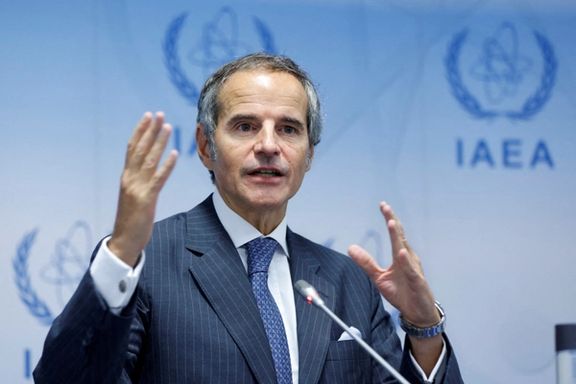
UN nuclear watchdog chief Rafael Grossi attends a press conference during the International Atomic Energy Agency's 35-nation Board of Governors meeting in Vienna, Austria, September 11, 2023.

The head of UN's nuclear watchdog, Rafael Grossi says ‘significant safeguards issues remain outstanding’ in Iran’s nuclear program.

Speaking at the IAEA General Conference on Monday, Grossi admitted that there has been no progress in ‘implementing the activities outlined in the most recent joint statement he made with Iran in March 2023.

Back in March, a few days before a quarterly meeting of the IAEA Board of Governors, Grossi visited Iran to reach an agreement that would avert yet another resolution requiring Tehran to cooperate to resolve long-standing disputes.

Out of that trip came a Joint Statement in which the Islamic Republic of Iran expressed readiness “to provide further information and access to address the outstanding safeguards issues.”

The major outstanding issue remains traces of uranium the UN inspectors found at three sites previously undeclared. Iran has failed to provide satisfactory answers.

A number of new generation Iranian centrifuges are seen on display during Iran's National Nuclear Energy Day in Tehran, Iran April 10, 2021.
100%
A number of new generation Iranian centrifuges are seen on display during Iran's National Nuclear Energy Day in Tehran, Iran April 10, 2021.

Critics of the Joint Statement said it was vague and too open to interpretation. They pointed out that the regime in Iran had made such promises many times without taking any meaningful step that would verify the peaceful nature of its nuclear activities.

Grossi, however, defended his endeavour, predicting a significant improvement in IAEA relations with Iran that would end several years of non-cooperation and evasion.

Seven months later, it seems his optimism was misplaced.

Iran is supposed to provide access to information, locations and people, Grossi told a news conference at Vienna airport soon after returning from Tehran in March, suggesting a vast improvement after years of Iranian stonewalling.

“I cannot but recognize that implementing the activities set out in the most recent Joint Statement between myself and Iran –in March this year– has not made the progress I was hoping for,” said Grossi at the IAEA General Conference, where he was formally appointed as head of the agency for another 4-year term.

Western governments have been hoping for a miraculous change of hearts in Tehran that would grant the IAEA the access they enjoyed right after the JCPOA (or the 2015 Nuclear Deal).

The Islamic Republic, however, has only pulled away.

A joint statement by UK, France and Germany to the most recent Board of Governors meeting in mid-September noted that “Iran has not allowed effective verification and monitoring activities in relation to the production and inventory of centrifuges and key components, heavy water and uranium ore concentrate for more than two and a half years.”

Despite Iran’s clear and continuing non-compliance, the E3 (and the US) have so far failed to come up with measures that would ensure the Islamic Republic’s cooperation with IAEA.

And their inaction seems to have emboldened the Iranian regime.

Some of IAEA’s most experienced inspectors were required to leave Iran not long after the E3’s recent statement that asked Tehran to cooperate fully and immediately on issues of concern, including explaining uranium traces found at undeclared sites.

A few days later came the official admission that the two issues were related.

“We have no problem with the inspections, but with some inspectors” President Raisi said in a press conference on the sidelines of the UN General Assembly, confirming that the decision to expel inspectors and further limit IAEA’s probing capability was a “reaction to some unfair statements by the Western members of the IAEA.”

Grossi’s admission Monday of his frustrated hopes can be read as a vindication of those who back in March criticized his Iran visit and his Joint Statement on the grounds that the regime in Iran cannot be trusted.

In his statement to IAEA General Assembly, Grossi repeated that “only full cooperation by Iran and tangible results will take us to credible assurances that Iran’s nuclear programme is exclusively peaceful.”

Grossi –like the E3 and of course the Biden administration– acknowledge that Iran’s nuclear program has reached “levels not seen in countries without a nuclear weapons program.”
Most Viewed

US blockade enters murky phase as tankers spoof signals and buyers hesitate
1
ANALYSIS

US blockade enters murky phase as tankers spoof signals and buyers hesitate

2
INSIGHT

Ideology may be fading in Iran, but not in Kashmir's ‘Mini Iran'

3
INSIGHT

Hardliners push Hormuz ‘red line’ as US blockade tests Iran’s leverage

4
VOICES FROM IRAN

Hope and anger in Iran as fragile ceasefire persists

5

US sanctions oil network tied to Iranian tycoon Shamkhani

Banner
Banner

Spotlight

  • Hardliners push Hormuz ‘red line’ as US blockade tests Iran’s leverage
    INSIGHT

    Hardliners push Hormuz ‘red line’ as US blockade tests Iran’s leverage

  • Ideology may be fading in Iran, but not in Kashmir's ‘Mini Iran'
    INSIGHT

    Ideology may be fading in Iran, but not in Kashmir's ‘Mini Iran'

  • War damage amounts to $3,000 per Iranian, with blockade set to add to losses
    INSIGHT

    War damage amounts to $3,000 per Iranian, with blockade set to add to losses

  • Why the $100 billion Hormuz toll revenue is a myth
    ANALYSIS

    Why the $100 billion Hormuz toll revenue is a myth

  • US blockade targets Iran oil boom amid regional disruption
    ANALYSIS

    US blockade targets Iran oil boom amid regional disruption

  • Iran's digital economy battered by prolonged blackout
    INSIGHT

    Iran's digital economy battered by prolonged blackout

•
•
•

More Stories

Iran International Re-Launches UK Studios From New Building

Sep 25, 2023, 15:30 GMT+1
•
Iran International Newsroom

After months of hiatus in Iran International broadcasting from the UK due to terrorist threats by Tehran, the network is back on track from a new London building.

Announcing the launch of the new location, Mahmood Enayat, General Manager of Iran International TV, said, "Britain is the home of free speech. The resumption of our programs from this country is evidence that we will not abandon independent and uncensored journalism to the people of Iran."

Following a significant escalation in state-backed threats from Iran and advice from the London Metropolitan Police, Iran International TV announced in February that it reluctantly and temporarily closed its London studios and moved broadcasting to Washington DC. Iran International was warned by authorities in November that its journalists were under threat from Iranian agents and the police took measures to strengthen security around the network’s offices. A man was arrested in the vicinity of Iran International’s headquarters in February and charged with a terrorism offence.

In his message celebrating the resumption of broadcasting from London, Enayat extended his gratitude to the reporters and staff for their unwavering commitment during this challenging period. He also expressed appreciation to the Metropolitan Police of London and the British government for their continuous support in safeguarding Iran International's personnel and facilitating their safe return to the London office.

The channel's broadcasts have gained special significance since popular anti-regime rallies broke out in Iran last September, providing uncensored coverage of the protests and the subsequent crackdown on the public by the regime. Iranian officials have repeatedly threatened Iran International and other Persian broadcasters based abroad as the government blocked the Internet to deny the population news and information. The Iranian regime has blamed foreign-based Persian broadcasters such as BBC Persian and Iran International for “fomenting unrest”, while all media in the country are under tight government control and present protesters as “rioters” and “terrorists”.

The Sunday Times featuring an article about the threats against Iran International  (September 2023)
100%
The Sunday Times featuring an article about the threats against Iran International

On Sunday, British daily The Times reported that Iran International’s workers are “ready to run the gauntlet again” seven months after the terrorist scare. “They said they were receiving information that there is going to be an immediate attack — maybe today, tonight or tomorrow,” Aliasghar Ramezanpoor, the head of news at the channel, told the newspaper.

“The Iranian government tried to make islands of people and sought to cut the flow of information about what was going on from one city to another,” Saeid Habil, a senior journalist at Iran International, told the paper. “They managed to cut the internet, so people [in Iran] needed an alternative link to each other. We were that link.”

Speaking last week at the station’s new studios in north London, Elnaz Kiani, a lead news anchor, told The Times that “For months, we were living whatever people were living in Iran — with all the emotions and hope. People trusted us. They were putting their lives in our hands by going out into the street and taking videos for us.”

Amid repeated threats by the Islamic Republic against Iran International’s reporters, the UK government vowed in December to step up protection of London-based Iranian journalists. British officials also expressed strong support for Iran International. Tom Tugendhat, the UK's Minister of State for Security, has repeatedly condemned Iran's threats against the network. He affirmed that the UK would continue its support for the network, ensuring its activities in a secure environment.

Iran International studio in London  (September 2023)
100%
Iran International studio in London

Regime authorities, including several Revolutionary Guard commanders, have repeatedly issued threats against Iran International and other foreign-based media outlets.

Earlier this month, Iran’s Intelligence Minister Esmail Khatib reiterated threats against Iran International media network throughout the globe "wherever and whenever deemed necessary." He emphasized that the Islamic Republic would not refrain from invasive measures against the workers of the channel. “We believe that Iran International is a terrorist network, and naturally we deem it our duty and mission to act against them wherever and whenever we deem appropriate,” he said, warning that “no terrorist media will be safe.”

Khatib stated, "Support from various countries will not deter us from taking invasive security measures," claiming that several foreign-based channels have promoted “terrorism,” and Iran International is one of the most important ones.

The US Department of State, Belgium-based International Federation of Journalists, and Australia’s Media, Entertainment and Arts Alliance are among entities that expressed support for Iran International and stressed the importance of safeguarding journalists' security and press freedom following the relocation of Iran International’s London office.

Following the relocation to DC, IRGC Commander-In-Chief Major General Hossein Salami said the threats against the channel’s journalists "show how far the Islamic Revolution's realm of power, field of infiltration and radius of influence has extended."

In May, Britain’s shadow security minister slammed the threats against journalists covering Iran’s protests. Speaking on World Press Freedom Day, Holly Lynch, the Labour MP for Halifax, said the threats by the Iranian regime include “assassination and kidnap plots against UK residents who are perceived as enemies of Iran owing to their coverage of the protests and the regime’s brutal crackdown”.

Saudi Arabia Says It Plans Tougher IAEA Checks On Nuclear Program

Sep 25, 2023, 13:33 GMT+1
•
Iran International Newsroom

Saudi Arabia said on Monday it has decided to accept full-blown nuclear safeguards by the UN’s watchdog, a change the agency has been demanding for years.

For years the International Atomic Energy Agency, the IAEA, has been demanding from Riyadh to accept complete safeguards protocols and the accompanying monitoring of its nuclear activities.

Saudi Arabia has a nascent nuclear program that it wants to expand to eventually include activities like proliferation-sensitive uranium enrichment. It is unclear where its ambitions end, since Crown Prince Mohammed bin Salman has said for years, it will develop nuclear weapons if regional rival Iran does.

He repeated the same policy in an interview with Fox news last week. When asked about Iran’s escalating nuclear program, MBS said, "If they get one, we have to get one, for security reasons and the balance of power in the Middle East. But we don't want to see that.”

For years, Saudi Arabia and its regional allies have been concerned about Iran’s uranium enrichment and were not happy when the United States signed the 2015 nuclear deal (JCPOA) with Iran in 2015, which allowed continued enrichment. However, Tehran also accepted close IAEA inspections.

US President Joe Biden participates in a bilateral meeting with Saudi Arabia's Crown Prince Mohammed bin Salman, at Al Salam Royal Palace, in Jeddah, Saudi Arabia July 15, 2022.
100%
US President Joe Biden participates in a bilateral meeting with Saudi Arabia's Crown Prince Mohammed bin Salman, at Al Salam Royal Palace, in Jeddah, Saudi Arabia July 15, 2022.

Saudi worries about Iran have not dissipated despite an agreement to restore diplomatic ties in March after seven years of strained and tense posturing. The complicated conflict in Yemen, where Iran supports the anti-Saudi Houthi forces has yet to be resolved.

Riyadh has yet to fire up its first nuclear reactor, allowing its program to still be monitored under the Small Quantities Protocol (SQP), an agreement with the International Atomic Energy Agency that exempts less advanced states from many reporting obligations and inspections.

IAEA Director General Rafael Grossi has been calling on the dozens of states that still have SQPs to amend or rescind them, calling them a "weakness" in the global non-proliferation regime. The IAEA has been in talks with Riyadh for years on making the switch to a so-called Comprehensive Safeguards Agreement (CSA) for years.

"The kingdom has recently taken the decision to rescind its Small Quantities Protocol and to move to the implementation of a full-scope Comprehensive Safeguards Agreement," Saudi Energy Minister Prince Abdulaziz bin Salman told the IAEA's annual General Conference, speaking through an interpreter.

If Saudi Arabia were to introduce nuclear material into its first nuclear reactor, a low-power research reactor in Riyadh that is near completion, it would void the SQP and its exemptions from regular safeguards.

Despite that, its SQP is a sensitive issue given the fears of an arms race in the Middle East. Iran denies seeking nuclear weapons, but it is enriching uranium to such high purity that Western powers say there is no credible civil explanation.

Saudi Arabia is also seeking US agreement and support for its nuclear program, a fact that becomes entangled in talks to normalize relations with Israel, expanding the Abraham Accords.

Prince Abdulaziz did not say whether on top of a regular CSA Saudi Arabia planned to sign up to the IAEA's Additional Protocol, which allows for more wide-ranging and intrusive checks such as snap inspections.

Iran applied the Additional Protocol under its 2015 nuclear deal with major powers but stopped after then-President Donald Trump pulled the United States out of the accord in 2018.

(With reporting by Reuters)

Raisis Blasted After Media Blitz During New York Visit

Sep 25, 2023, 10:59 GMT+1
•
Iran International Newsroom

The latest trip of Iran's president and his hijab-cladded wife to the UN in New York has seen the First Lady thrust into the limelight on a global media blitz.

Jamileh Alamolhoda, wife of Ebrahim Raisi, spoke to some of the world’s top media, including ABC and Newsweek as the pair embarked on a prolific propaganda effort.

To Newsweek, Alamolhoda, the daughter of a hardline cleric, spoke of the alleged “women’s rights” enjoyed by Iranian women, who for the last year have been protesting the oppressive conditions of living under the regime under the Women, Life, Freedom movement. Thousands remain in Iranian jails for protesting while hijab rebels remain locked out of public places including transport and education.

Alamolhoda -- who firmly believes a woman’s place is as a mother and wife — claimed Western feminism has no place in Iran where she says women are the center of life and society. Meanwhile, women are on the streets burning the hijab and morality police continue to punish them for not complying with mandatory hijab rules. Just last week, new laws to introduce harsher punishments for these women were passed in parliament as the battle against the rebellion continues to flounder.

Jamileh Alamolhoda, wife of President Ebrahim Raisi (Undated)
100%
Jamileh Alamolhoda, wife of President Ebrahim Raisi

On ABC, she continued to reiterate the regime’s lies that the tragic fate of 22-year-old Mahsa Amini, whose death in morality police custody for the ‘inappropriate’ wearing of her hijab sparked protests in which more than 500 civilians were murdered by the security forces, was due to pre-existing illnesses, in spite ample evidence showing she died of blows to the head.

It has sparked a huge backlash across the globe. Activist in exile, Nazanin Boniadi, wrote on X of her disgust at the airtime given to the First Lady when anyone living in Iran speaking out against the regime is silenced, including hundreds of people such as journalists and academics now in prison for their dissenting views.

“Islamic Republic officials crush dissent at home and use Western media and democratic institutions to legitimize themselves, spew their propaganda and whitewash their crimes. Appalling. We should instead give airtime to those who are risking their lives for freedom and are stuck between a homeland that is trying to destroy them and an international community that platforms and negotiates with their oppressors,” she wrote.

US-based Sarah Raviani also called on the world’s media to stop giving a platform to the Raisis whose attendance at the United Nations General Assembly came on the back of a prisoner swap deal releasing five American-Iranian hostages in Iran in exchange for regime agents in the US, and the freeing up $6bn of frozen Iranian funds in South Korea, to be managed by Qatar.

In a powerful open letter to American media and journalists, Raviani wrote on X that media has “become a conduit for the regime's agenda” while hundreds of voices inside and outside of Iran are begging to be heard.

“I hear from the families of the fallen freedom fighters, crying out for the international community to take notice of them as their homes and lives are destroyed by regime security forces. I hear from the families of American hostages abandoned in Iran, begging the media to take notice of their loved ones dire situation. How do you think they feel as you prop up those who are responsible for the death and suppression of their family members?”

UK-based activist and academic, Kasra Aarabi, called the latest propaganda mission a bid “to demoralize Iranians abroad to stop us from mobilizing”. Writing on X, he said, “This won’t work, it’ll only make us more determined”, slamming the decision of ABC to allow the First Lady airtime. “Very sad to see @ThisWeekABC fall into the regime’s propaganda trap.”

The President himself also made the most of the world watching, suggesting some high level orchestration happening behind the scenes, though no PR organization has so far been revealed for its part in the drama.

Not only did Raisi use the UNGA stage to air his views on the Saudi betrayal of the Palestinian people should the nation normalize ties with Israel, and deny his obstruction to International Atomic Energy Agency inspectors, he spoke to CNN and denied the country’s nuclear ambitions.

Earlier this year, the UN nuclear watchdog claimed that Iran's stock of uranium enriched to up to 60 percent purity, close to weapons grade, continues to grow. Just this month, the regime also banned one third of the IAEA’s inspectors. Speaking to CNN, Raisi claimed that “Iran has cooperated fully with the IAEA”, denying the reports announced by Director General Raphael Grossi who made a rare public criticism of the regime for its latest stonewalling.

In his latest bizarre claims, in spite of years of pursuing a potentially dangerous nuclear program and stockpiling highly enriched uranium, he even said, “we have stated many times that nuclear weapons have no place in Iran's defense doctrine, because we neither need them nor believe in nuclear weapons”.

Turning to Islam to defend his claims, he added, “In our opinion and based on the fatwa of the Supreme Leader of the Islamic Revolution, nuclear weapons are among the weapons of mass destruction, and therefore both their production and storage are forbidden, and we adhere to this fatwa. This approach obligates us from a jurisprudential and Islamic point of view not to pursue the production of nuclear weapons in any way, and so far no reason has been found that the Islamic Republic of Iran has acted against this belief”.

Jason Brodsky, United Against A Nuclear Iran, said Raisi's administration is clearly trying to “normalize him in the West”. Writing on X, he said, “I hope @ThisWeekABC invites someone on the show who is actually representative of the people of #Iran and the Woman, Life, Freedom movement to respond to Jamileh after this interview.”

Russia Says Saudi Arabia Not Tempted To Pursue Nuclear Arms

Sep 24, 2023, 17:55 GMT+1

Russia, in response to the recent comments by Saudi Arabia's Crown Prince, stated that no one desires the emergence of new nuclear powers in the world.

Foreign Minister Sergei Lavrov, speaking at a press conference on the sidelines of the United Nations General Assembly on Saturday, described Riyadh's expressed interest in acquiring nuclear weapons as a "factual statement," but he deemed it unlikely for the country to pursue the path.

Lavrov's remarks were in reference to a statement made by Crown Prince Mohammed bin Salman of Saudi Arabia on Wednesday. In his interview with Fox News, the Saudi Crown Prince referring to Iran’s nuclear program stated, “If they get one, we have to get one, for security reasons and the balance of power in the Middle East.”

However, the Russian foreign minister said Moscow believes that "Iran will not have nuclear weapons, so Saudi Arabia won’t be tempted to obtain them."

Furthermore, Lavrov accused Western countries of escalating tensions in international conflicts and expressed the view that the West is making every effort to prevent the formation of a multipolar world.

There have been reports that Mohammed bin Salman has approached the Biden administration seeking assistance in establishing a civilian nuclear program for his country. Some US officials harbor concerns that such a program could potentially serve as a guise for developing nuclear weapons as a countermeasure against Iran.

Iran’s Chief Diplomat Says Efforts To Reach A Nuclear Deal Continue

Sep 24, 2023, 09:42 GMT+1

Iran’s foreign minister Hossein Amir-Abdollahian told UN General Secretary Antonio Guterres that diplomatic contacts continue to revive the JCPOA nuclear deal.

Amir-Abdollahian, stated that communications with the United States are taking place, and an initiative by Oman remains on the table. If the other parties are willing, Iran is determined to return to the JCPOA (Joint Comprehensive Plan of Action).

The Iranian foreign minister met with Guterres, the Secretary-General of the United Nations, at the UN headquarters in New York on Friday.

The diplomatic efforts of the United States and Europe to address the Iranian nuclear issue come at a time when Israel considers these actions insufficient and emphasizes the need to increase pressure and resort to serious military threats.

Negotiations to resurrect the JCPOA, which former US President Donald Trump abandoned in 2018, collapsed about a year ago. Washington has been exploring alternative approaches to encourage Tehran to curb its nuclear program. Recently, the Biden administration released a total of $8.7 billion in Iran’s funds blocked in Iraq and South Korea.

Amir-Abdollahian also had a meeting with his Saudi counterpart in New York. According to the Iranian Ministry of Foreign Affairs, where the two sides discussed bilateral relations and regional issues.

Saudi Crown Prince Mohammed bin Salman, in an interview with Fox News on Thursday, highlighted the danger posed by Iran potentially acquiring nuclear weapons. He stated, "If they obtain one, we'll have to acquire one for security reasons and to maintain the balance of power in the Middle East. However, we do not wish to see that happen."