• العربية
  • فارسی
Brand
  • Iran Insight
  • Politics
  • Economy
  • Analysis
  • Special Report
  • Opinion
  • Podcast
  • Iran Insight
  • Politics
  • Economy
  • Analysis
  • Special Report
  • Opinion
  • Podcast
  • Theme
  • Language
    • العربية
    • فارسی
  • Iran Insight
  • Politics
  • Economy
  • Analysis
  • Special Report
  • Opinion
  • Podcast
All rights reserved for Volant Media UK Limited
volant media logo

Suspected Israeli Strikes Killed 18 IRGC Commanders, Advisers Since October 7
Iran International Newsroom
Apr 4, 2024, 18:46 GMT+1Updated: 10:49 GMT+0
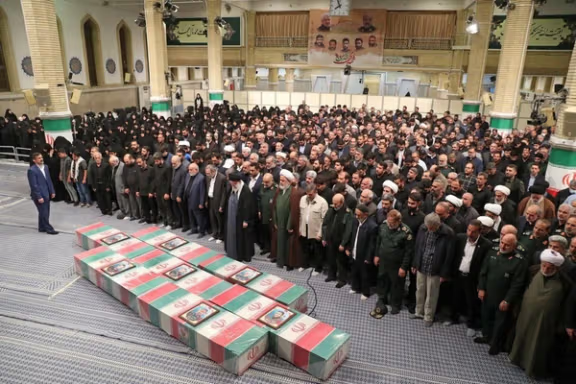
Iran’s Supreme Leader Ali Khamenei leading a funeral prayer for the Revolutionary Guards who were killed in an Israeli attack on Tehran’s consulate in Damascus, April 4, 2024

The Financial Times reported that suspected Israeli strikes have claimed the lives of 18 IRGC commanders and advisers since the Gaza war broke out on October 7.

According to the report, all of the slain IRGC forces were targeted in Syria, with 16 in Damascus, one in Deir ez-Zor and one in Baniyas.

Since the Gaza war broke out, Iran’s proxies have attacked Israel from Lebanon, Syria, Iraq and Yemen, and attacked US targets in the region as punishment for the US backing of Israel’s right to defend itself in the wake of October 7. In the most deadly day for Jews since the holocaust, over 1,200 mostly civilians were murdered and over 250 taken hostage.

Israel’s Monday attacks against Iran's consulate building in Damascus have been the deadliest since the inception of the ongoing conflict in the region, killing seven IRGC forces, including two top commanders.

The most prominent figure killed in the recent attacks was Mohammad Reza Zahedi, the highest-ranking commander of the Iranian Revolutionary Guards Quds Force (IRGC-QF) in Lebanon and Syria. Qods Force is the IRGC’s overseas branch coordinating proxy activities.

Iran’s Supreme Leader Ali Khamenei (right) and IRGC Quds force general Mohammad Reza Zahedi  (undated)
100%
Iran’s Supreme Leader Ali Khamenei (right) and IRGC Quds force general Mohammad Reza Zahedi

Zahedi, 63, joined the basij militias as a teenager and became involved in suppressing protesters. He was a mid-level commander during the Iran-Iraq war and was known by the pseudonym Ali Zahedi. In the mid-2000s, he went to Lebanon where he quickly established a strong network within Hezbollah, to the point he became “the only non-Lebanese member of the group’s council,” Amwaj Media reported.

Zahedi was appointed by Supreme Leader Ali Khamenei as the commander of the IRGC ground forces in 2006. He was later transferred to the IRGC Qods Force. According to his son, Zahedi had not returned to Iran since the start of the Gaza war, sparked by Iran-backed Hamas’s invasion of Israel, and only recently spent a few days in the country on the occasion of Nowruz, Iranian New Year.

The second most important person killed in Israel’s Monday strike was Zahedi’s deputy Mohammadhadi Haji Rahimi. Iranian media have called him the deputy coordinator of the IRGC Qods Force. According to reports, he had been a member of the Quds Force since it was formed and was one of its first commanders. Like Zahedi, Haji Rahimi was also a veteran of the Iran-Iraq war and participated in other regional wars in which Iran was involved in some way.

Hossein Amanollahi, Mehdi Jalalati, Mohsen Sedaghat, Ali Agha-Babaei, and Ali Salehi Rouzbahani were the other five members of the IRGC Quds Force who lost their lives in Israel’s Monday strikes.

In the past few months, two other high-ranking IRGC commanders were killed in suspected Israeli attacks in Syria: Razi Moussavi and Hojjatollah Omidvar.

Razi Mousavi (aka Seyyed Razi) was targeted by a direct airstrike on December 25. He headed IRGC’s ‘logistics’ and military coordination in Syria, getting weapons for and coordinating Iran-backed forces in Syria and Lebanon.

On January 20, a building in Damascus’s Mazzeh neighborhood was struck in an attack which claimed the life of Hojjatollah Omidvar (also known as Hajj Sadegh), a senior IRGC commander. He served as the deputy intelligence chief of Qods Force in Syria. Four other IRGC officers were also killed in the strike: Ali Aghazadeh, Saeed Karimi, Mohammad Amin Samadi and Hossein Mohammadi.

Among other IRGC victims of the alleged Israeli attacks are Behrouz Vahedi (targeted in Deir ez-Zor, March 26), Reza Zarei (targeted in Baniyas, March 1), Saeed Alidadi (targeted in south of Damascus, February 2), and Mohammadali Ataei Shourcheh and Panah Taghizadeh (both targeted in Damascus, December 2). The Iranian media have described them as “military advisers.”

Most Viewed

US blockade enters murky phase as tankers spoof signals and buyers hesitate
1
ANALYSIS

US blockade enters murky phase as tankers spoof signals and buyers hesitate

2
INSIGHT

Ideology may be fading in Iran, but not in Kashmir's ‘Mini Iran'

3
INSIGHT

Hardliners push Hormuz ‘red line’ as US blockade tests Iran’s leverage

4
VOICES FROM IRAN

Hope and anger in Iran as fragile ceasefire persists

5

US sanctions oil network tied to Iranian tycoon Shamkhani

Banner
Banner

Spotlight

  • Hardliners push Hormuz ‘red line’ as US blockade tests Iran’s leverage
    INSIGHT

    Hardliners push Hormuz ‘red line’ as US blockade tests Iran’s leverage

  • Ideology may be fading in Iran, but not in Kashmir's ‘Mini Iran'
    INSIGHT

    Ideology may be fading in Iran, but not in Kashmir's ‘Mini Iran'

  • War damage amounts to $3,000 per Iranian, with blockade set to add to losses
    INSIGHT

    War damage amounts to $3,000 per Iranian, with blockade set to add to losses

  • Why the $100 billion Hormuz toll revenue is a myth
    ANALYSIS

    Why the $100 billion Hormuz toll revenue is a myth

  • US blockade targets Iran oil boom amid regional disruption
    ANALYSIS

    US blockade targets Iran oil boom amid regional disruption

  • Iran's digital economy battered by prolonged blackout
    INSIGHT

    Iran's digital economy battered by prolonged blackout

•
•
•

More Stories

Iran's Rial Hits Historic Low Following Consulate Attack

Apr 4, 2024, 16:40 GMT+1

On Thursday, Iran's national currency experienced another plunge to an unprecedented low with the US dollar trading at 646,000 rials following this week's Israeli airstrike on Iran's consulate in Damascus.

It marks the highest recorded exchange rate for the American currency in Iran and represents an over 25 percent drop since early January. The Euro was also traded at 701,500 rials, while the British pound hovered near 818,000 rials, reflecting the economic turmoil within the country.

The airstrike this week resulted in the deaths of two high-ranking IRGC commanders and five officers, sparking vows of retaliation from the Iranian regime.

Abdolnasser Hemmati, the ex-chief of the Central Bank, voiced criticism against President Ebrahim Raisi's economic policy amid the crisis, stating, "Despite numerous assurances, the pricing trends of essential items and assets are taking an intolerable course. The public's perception of unfolding events... validates the economic neglect. Even among its proponents, doubts are arising regarding the government's effectiveness and management!"

The decline of the rial has been a long-standing trend since the 1979 revolution, but it notably accelerated in 2018 following the US withdrawal from the JCPOA nuclear deal and the subsequent imposition of sanctions on Iran's oil exports and banking sector. Remarkably, the currency was valued at 70 rials per dollar in 1978.

The sharp devaluation of the rial has exacerbated inflationary pressures over the past five years, pushing millions of Iranians below the poverty line. Official government statistics indicate an annual inflation rate of over 40 percent, though many experts believe the actual figure to be higher.

Iranian authorities have consistently displayed ambivalence towards the impact of international measures on the nation's economy. While attributing any shortcomings to the actions of the US and its allies, they simultaneously assert that these punitive measures lack substantial efficacy, further complicating the economic landscape within Iran.

Republican Senators Probe Biden's Decision On Iran Sanctions Waiver

Apr 4, 2024, 16:35 GMT+1

Republican senators are launching a probe into President Biden’s decision to issue a sanctions waiver to Iran, granting access to more than $10 billion, as first reported by the Washington Free Beacon.

The probe comes after the White House issued the third sanctions waiver to let Iraq pay Iran for electricity through non-Iraqi banks, less than a month ago.

Led by Republican Senator Tim Scott, the group of 13 lawmakers is pressing the State and Treasury Departments for exactly how much money Iran will be permitted to access in the next several months.

The probe is backed by several Republican foreign policy leaders, including Sens. Ted Cruz, Tom Cotton, Marco Rubio.

In their letter, the lawmakers wrote: “First, the waiver makes restricted Iranian funds more accessible to the Ayatollah’s regime, at a time when Iranian-backed aggression in the region is at a peak. Second, the administration appears to be disregarding congressional intent that any payments made to Iran remain severely restricted.”

Iranian proxy groups have increased their attacks in the region since Hamas’ attack on Israel on October 7 – with its attacks on American personnel in Jordan and vessels in the Red Sea.

CENTCOM Commander Gen. Erik Kurilla recently told the Senate Armed Services Committee that Iran remains undeterred in its support for Hamas, Hezbollah and the Houthis – and is not paying a price for its nefarious activities in the region.

While the Biden administration has maintained that the regime in Tehran can only access the money for humanitarian purposes, the letter suggests that the White House "appears to be disregarding congressional intent that any payments made to Iran remain severely restricted".

On that front, foreign policy expert Walid Phares argued on X that the US – alongside Israel and the “Arab Coalition” – could defeat Iran’s proxy militias in the Middle East in one month.

“But the #IranDeal & the #IranLobby are paralyzing the administration unfortunately. In 2025, a possible change in policy may occur. Until then, the #IslamicRepublic is not going to be deterred,” Phares wrote.

MP Refutes Claim Israeli Strike Equaled Attack On Iranian Territory

Apr 4, 2024, 15:26 GMT+1

Iranian Member of Parliament Mohsen Pirhadi rejected the notion that Israel's recent attack on the Iranian embassy in Damascus constituted an assault on Iranian territory.

In an interview with Rouydad 24, Pirhadi emphasized that interpreting the attack in such a manner is not accurate, stating, "The Zionist regime's action is a heinous act and a violation of international law principles, but it should not be equated with an attack on our Iranian soil."

The airstrike on Monday targeted the Iranian embassy building in Damascus. The airstrike resulted in the deaths of seven Revolutionary Guards, including two senior commanders.

"Given the importance of the issue, the MPs will definitely delve into the details of the terrorist act and the plans of relevant agencies for how to respond to the crime and defend the country's security in the first session of the parliament after the end of the Norouz holidays," stated Pirhadi.

Despite tensions and conflicts in the region, Iran has refrained from direct engagement with Israel, particularly amid the six-month conflict involving Iran-backed groups in Gaza.

Pirhadi’s comments come as IRGC General Esmail Kowsari, a member of the Iranian parliament, asserted on Wednesday that Israel's attack on Iran's consulate in Damascus constitutes an encroachment upon Iranian territory, demanding a robust response from Iran. He dismissed the concept of "strategic patience" in the face of such incidents, affirming that Iran will promptly retaliate against Israel.

Kowsari further stressed that the United States should anticipate Iran's retaliatory measures, cautioning Israel against further attacks on Iran's interests.


US Court Finds Iran Liable for Israeli-American Killed by Hamas

Apr 4, 2024, 13:53 GMT+1

A US federal court says the Islamic Republic of Iran and the Syrian government are liable for the death of Ari Fuld, an Israel-American man killed by a Hamas attack in 2018 in Israel.

In his ruling, US District Judge Royce Lamberth ordered Tehran and Damascus to pay $191 million in damages to Fuld’s family.

Fuld was killed in the West Bank by a Hamas member with an eight-inch blade, according to court documents seen by the Jerusalem Post.

Due to Iran’s and Syria’s roles as state sponsors of Hamas terrorism, the court said it found Fuld’s estate and surviving family members are entitled to receive damages.

Iran and Syria "intentionally supported and encouraged a proxy actor who specifically sought to inflict violence upon innocent civilians," Judge Lamberth wrote.

In addition, the court found evidence to establish Hamas was responsible for the killing of Fuld – including online posts in which Hamas claimed responsibility for the attack.

The court also found the terrorist sought out an "English-speaking Israeli soldier of American origin”.

The Fuld family's attorney, Richard Heideman, stated in a statement that after the Hamas attack on Israel on October 7, it was well understood how the group specifically targets Americans and English speakers, not just Israelis.

Fuld, a prominent advocate for Israel, was widely recognized for his efforts in delivering care packages to the Israeli military.

Thousands of people attended Fuld's funeral, among them Israeli Prime Minister Benjamin Netanyahu, who tweeted at the time: "I embraced [the family] in the name of the entire nation in this time of terrible grief. We are alive thanks to heroes like Ari. We will remember him forever."

Fuld was 45 years old when he was stabbed by 17-year-old Palestinian teenager Khalil Jabarin.

In 2020, the Judea Military Court convicted Jabarin of the intentional murder of Fuld and attempting to kill another person, sentencing him to pay over $365,000 to Fuld's family.

US Federal Courts vs. Islamic Republic

This comes half a year after another ruling by a US federal court against the Islamic Republic of Iran.

Last June, a US federal court in Washington, DC, ruled in a default judgment that the regime in Tehran is obligated to compensate Iranian-American journalist and human rights activist Masih Alinejad for detaining her brother, Alireza Alinejad.

At the time, Alinejad posted a picture of the court ruling on X, adding that she would not accept the $3.325 million in damages awarded by the court.

In 2023, the same court ruled that Iran should pay nearly $20 million in damages to the family of an Iranian politician, who was arbitrarily imprisoned and tortured for 40 years.

The lawsuit was launched on behalf of former politicians Abbas Amir-Entezam’s children -- Ardeshir, Anoush, and Elham – who were 2, 6, and 9 at the time of his imprisonment.

Amir-Entezam was Iran's first post-Shah Deputy Prime Minister and became one of the Islamic Republic’s most prominent and longest-jailed dissidents.

Iran Criticizes EU's Call For Restraint Following Attack On Embassy

Apr 4, 2024, 13:23 GMT+1

Iran’s foreign minister, Hossein Amir-Abdollahian, voiced anger towards Josep Borrell, the EU's high representative for foreign affairs, following the EU's urging restraint on Iran after Israel’s Monday attack on its embassy in Damascus.

"It is expected that the European Union will strongly condemn these crimes in a practical and immediate step," Amir-Abdollahian was quoted as saying.

The European Union's call for restraint came in response to an airstrike on the Iranian embassy in Damascus, which resulted in the deaths of seven Revolutionary Guards. Iran attributed the attack to Israel, holding them responsible for the deaths of two generals and five military personnel at the embassy compound. However, Israel has not acknowledged responsibility for the strike, which marks one of the most significant attacks on Iranian interests in Syria to date.

Peter Stano, a spokesperson for the executive European Commission, on Wednesday condemned the attack emphasizing the need for utmost restraint in the tense regional situation. However, Amir-Abdollahian claimed that the security of diplomats and diplomatic premises had been violated by Israel in what he termed a terrorist act.

However, criticism has emerged from some observers who view the EU's stance as continuing to act as the "protective shield" of the Islamic Republic. Jason Brodsky, policy director for the think tank United Against A Nuclear Iran, lambasted the EU's response, stating, "The European Union is condemning an attack targeting the IRGC terrorists commander Mohammad Reza Zahedi, whom it has sanctioned, and in the process falls hook, line, and sinker for the Iranian fiction that this was a diplomatic compound."