• العربية
  • فارسی
Brand
  • Iran Insight
  • Politics
  • Economy
  • Analysis
  • Special Report
  • Opinion
  • Podcast
  • Iran Insight
  • Politics
  • Economy
  • Analysis
  • Special Report
  • Opinion
  • Podcast
  • Theme
  • Language
    • العربية
    • فارسی
  • Iran Insight
  • Politics
  • Economy
  • Analysis
  • Special Report
  • Opinion
  • Podcast
All rights reserved for Volant Media UK Limited
volant media logo

Iranian Intelligence Warns: Presidential Candidates Under Surveillance

Niloufar Goudarzi
Niloufar Goudarzi

Iran International

Jun 6, 2024, 23:56 GMT+1Updated: 16:38 GMT+0
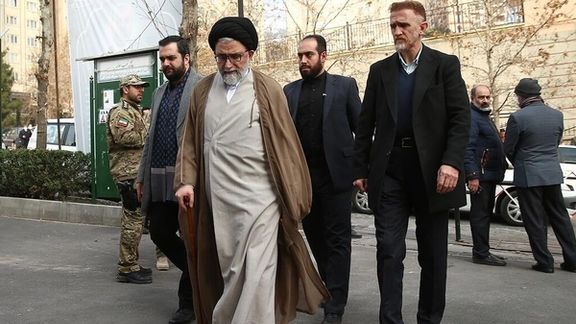
Esmail Khatib, the Minister of Intelligence of the Islamic Republic

Iran's Minister of Intelligence has declared that his agency is keeping a close watch on the behavior of presidential candidates and their supporters, warning that those promoting "subversive" narratives will face prosecution.

While not providing extensive details, state media cited Esmail Khatib as saying that the warning was in response to 'misconduct' displayed by some candidates.

Iran’s Press Supervisory Board also issued a directive concerning the elections, warning that violators will be punished with 74 lashes. The instructions, published on Wednesday, specified that disseminating content aimed at “the boycott of the elections and the lowering of participation” and “organizing any form of unauthorized protest gathering, strike, or sit-in” constitutes a "crime.”

The warnings follow Supreme Leader Ali Khamenei's speech on Monday in which he urged contenders to avoid slander and refrain from smearing each other. Conspicuous confrontations have already emerged among several of the 80 candidates who enrolled during the designated five-day registration period, with the election campaign officially starting June 12 until June 26.

The snap elections have been called following the sudden death of Ebrahim Raisi with First Vice President Mohammad Mokhber taking the helm as acting president on the orders of Khamenei.

On Sunday, Tasnim, a news outlet affiliated with the Islamic Revolutionary Guard Corps (IRGC) and reportedly a supporter of Mohammed Bagher Ghalibaf, the speaker of parliament, criticized Vahid Haghanian, a prominent figure in the office of the Supreme Leader, without explicitly naming him, asserting that he is not the Supreme Leader’s preferred candidate.

"Some individuals have registered for the presidential race despite lacking relevant experience and executive responsibility. More concerning, their campaign materials imply endorsement by the Supreme Leader's office, a tactic that is unethical and undermines the dignity of this esteemed institution," Tasnim wrote.

The next day, Haghanian responded that the news agency uses military funds for matters unrelated to the public interest.

“People recognize that all these desperate efforts by the passive media in the most sensitive areas of the country are rooted in their candidate’s defeat,” the statement read.

The ongoing process of narrowing the circle of trusted regime insiders, criticized as political "purification," seemingly aimed at preparing for the eventual death of the 85-year-old Supreme Leader, has intensified power struggles among the conservative spectrum.

Last week, physical confrontations erupted in parliament between supporters of two MPs, one reportedly failed the credential verification to remain a parliamentarian.

Record low turnout for the elections is expected amid mass discontent and disenfranchisement. In the March elections, while official figures claimed around 40 percent of the population came to the polls, independent figures suggest closer to 10. In the last two rounds of presidential elections figures have also seen Iranians boycott the polls, aware that ultimately the Supreme Leader himself will decide the incoming Presidential candidate.

The last presidential elections in 2021 saw the lowest recorded turnout since the founding of the Islamic Republic. While official figures claimed around 41 percent voted, like March, the real numbers are believed to have been much lower.

Most Viewed

US blockade enters murky phase as tankers spoof signals and buyers hesitate
1
ANALYSIS

US blockade enters murky phase as tankers spoof signals and buyers hesitate

2
INSIGHT

Ideology may be fading in Iran, but not in Kashmir's ‘Mini Iran'

3
INSIGHT

Hardliners push Hormuz ‘red line’ as US blockade tests Iran’s leverage

4
VOICES FROM IRAN

Hope and anger in Iran as fragile ceasefire persists

5

US sanctions oil network tied to Iranian tycoon Shamkhani

Banner
Banner

Spotlight

  • Hardliners push Hormuz ‘red line’ as US blockade tests Iran’s leverage
    INSIGHT

    Hardliners push Hormuz ‘red line’ as US blockade tests Iran’s leverage

  • Ideology may be fading in Iran, but not in Kashmir's ‘Mini Iran'
    INSIGHT

    Ideology may be fading in Iran, but not in Kashmir's ‘Mini Iran'

  • War damage amounts to $3,000 per Iranian, with blockade set to add to losses
    INSIGHT

    War damage amounts to $3,000 per Iranian, with blockade set to add to losses

  • Why the $100 billion Hormuz toll revenue is a myth
    ANALYSIS

    Why the $100 billion Hormuz toll revenue is a myth

  • US blockade targets Iran oil boom amid regional disruption
    ANALYSIS

    US blockade targets Iran oil boom amid regional disruption

  • Iran's digital economy battered by prolonged blackout
    INSIGHT

    Iran's digital economy battered by prolonged blackout

•
•
•

More Stories

US, E3 Play Good Cop Bad Cop Over Nuclear Deal, Says Iran Official

Jun 6, 2024, 19:20 GMT+1
•
Niloufar Goudarzi

A high-ranking aide to Iran's Supreme Leader, purportedly entrusted with Iran's nuclear negotiations said the US and the E3 have been orchestrating a "good cop, bad cop" dynamic to navigate Iran's responses.

“From the JCPOA until the recent International Atomic Energy Agency (IAEA) Board of Governors meeting, in compliance with their roles as good and bad cop, the US and the European Troika have been trying to manage Iran’s reactions to their misbehavior by creating false hope in Iran. They have never been successful & never will be,” Ali Shamkhani wrote on X.

On Wednesday, the Board of Governors of the UN nuclear watchdog passed a resolution censuring Iran and demanding it resolve outstanding issues with the IAEA regarding its nuclear program.

The resolution, initiated by the E3 coalition, France, Britain, and Germany, garnered substantial backing, with 20 member states endorsing it. Notably, the dissenting votes came from China and Russia, staunch allies of Iran. Additionally, 12 countries opted for abstention during the decision-making process.

The United States was widely reported to have opposed the resolution in the days leading up to the IAEA board meeting. Seemingly, Washington was concerned that Tehran might respond to the sanctions with an expansion of its nuclear program marked by the enrichment of uranium and the stockpiling of enough fissile material for several warheads.

Shamkhani had previously stated that Iran would retaliate against any condemnation from the IAEA board. "If some misguided European countries intend to adopt a hostile stance towards Iran's peaceful nuclear program at the upcoming IAEA Board of Governors meeting, on the eve of Iran's presidential elections, they will face a serious and effective response from our country,” Shamkhani had warned.

The Iranian state media also reacted by suggesting that the UN nuclear agency's Board of Governors resolution was premature, particularly given the recent death of Iranian president Ebrahim Raisi in a helicopter crash and the upcoming snap elections.

The Iran-based Fararu news site highlighted “the current executive vacuum in the country” and expressed doubts about “the temporary decision-makers' ability to reach a conclusive decision” regarding nuclear matters.

Another news outlet, KhabarOnline, took a particularly bleak stance, suggesting that "The European Troika [E3] is preparing the groundwork for the activation of the 'snapback' mechanism."

The term "snapback" denotes the procedural mechanism outlined in UN Security Council Resolution (UNSCR) 2231, pertaining to the potential reinstatement of UN sanctions and constraints on the Islamic Republic of Iran. This resolution endorsed the 2015 Iran nuclear agreement, formally recognized as the Joint Comprehensive Plan of Action (JCPOA).

In 2015, Iran and several global powers, including the United States, signed the JCPOA, which imposed significant constraints on Iran's nuclear activities in exchange for sanctions relief. However, then US President Trump withdrew the United States from the agreement in 2018, citing its purported failure to effectively address Iran's missile program and regional influence. Consequently, Iran has continued to disregard the stipulated limitations on its nuclear endeavors. The UN nuclear chief, Rafael Grossi, recently said Iran was “weeks not months” away from a nuclear weapon in spite of Tehran denying it has ambitions for a nuclear weapons program.

Since then, Iran has been non-cooperative with the IAEA on various fronts, and tensions between Tehran and the agency have steadily escalated. The Iranian administration has dismantled surveillance apparatuses, rebuffed senior inspectors' access requests, and withheld information regarding the whereabouts of new nuclear installations. This stance persists despite Iran's assertion that its uranium enrichment endeavors are exclusively for civilian applications and disavowal of any intention to pursue nuclear armaments.

As per an IAEA assessment, Iran is enriching uranium up to 60% purity, nearing the 90% threshold indicative of weapons-grade material. Moreover, it has stockpiled sufficient material for further enrichment, potentially yielding three nuclear warheads.

Iran Election: Young Voters Face Limited Choices, Outdated Narratives

Jun 6, 2024, 15:41 GMT+1
•
Behrouz Turani

Former President Mohammad Khatami, respected by a majority of ‘reformists’ in Iran said he will take part in the June 28 presidential election only if at least one of the Reform Front candidates is allowed to run.

Centrist daily Ham Mihan also quoted Khatami on Wednesday as having said that Iran has a long way to achieve a standard free, fair and competitive election.

A reformist paper noted that the 80 politicians who registered their candidacy are vastly different from the general population in terms of political views, affiliations, ethnicity, religious values, and lifestyle. In the best-case scenario, they can represent only 30 to 35 percent of the people. The small number—perhaps four to six—whose qualifications will be approved will most certainly be even less representative.

Javad Emam, the spokesperson for the Reform Front, an umbrella organization of several ‘reformist’ groups and political parties, had said earlier that based on the Front's election strategy, the coalition will take part in the election only if one of its nominated candidates receives approval by the Guardian Council.

The 12-member Council, which is under Supreme Leader Ali Khamenei’s control, has rejected hundreds of candidates in parliamentary and presidential elections over the years and specially since 2020. This policy has directly contributed to the dominance of conservatives and hardliners both in the parliament and in the government.

The Reform Front had boycotted the parliamentary election in March and at least one presidential election in 2020 because none of its candidates were endorsed by the conservative-dominated Guardian Council.

Emam who has always been pessimistic about prospects for reformists' participation in the June 28 presidential election accused the Guardian Council in a post on social media platform X on June 5 of violating the Iranian Constitution by usurping Iranians' right to choose their president.

Despite statements by Khatami and Reform Front spokesman Emam, the coalition has not officially nominated any candidates. The press has speculated about potential reformist candidates, including former Roads Minister Abbas Akhundi, former Deputy Intelligence Minister Mohammad Shariatmadari, and moderates such as former Vice President Es'haq Jahangiri and former Majles Speaker Ali Larijani.

However, it remains unclear whether the Reform Front would be satisfied with centrists like Jahangiri or Larijani being approved to run, or if they will demand a more committed reformist to receive approval from the Guardian Council.

This leaves only the outspoken Akhundi who is better known as a moderate figure than a reformist, and Shariatmadari. None of them are known by young pro-reform voters if they ever decide to vote in the June 28 election.

In fact, Iran's reformist figures have long been criticized for failing to train younger cadres over the past 20 years. Even when they held the presidency from 1997 to 2005, Khatami had to select most of his cabinet ministers from his predecessor President Rafsanjani's team of technocrats. Furthermore, under immense pressure from Supreme Leader Ali Khamenei and the hardliner-dominated judiciary, the reformist government was significantly less effective in its second term (2000-2004). Most of its achievements, including relative media freedom, were dismantled, and dozens of journalists and political activists ended up in jail or were forced to flee the country and live in exile.

The question arises: why do reformists, despite the pressures, sometimes accept the humiliating situation imposed on them by hardliners, and why are some so eager to participate in the elections? They certainly know that hardliners will ensure that, even if they must endorse one or two reform-minded candidates, they will choose those with the least popularity among voters.

The bigger question is whether voters will support a reformist candidate. Khatami, who has tarnished his reputation by not forcefully opposing a totalitarian government, may not be able to rally support. The embarrassing silence of dozens of reformists in the parliament (2016-2020) during the deadly crackdown on the 2019 protesters further undermines their credibility. It remains to be seen if reformists can convince the new generation of voters to support them.

A still bigger question is why there aren't any younger candidates. Many named as reformist candidates are in their 70s. Is the reform front going to recognize the younger generation of Iranians? Is it aware of the fundamental change in the political narrative and rhetoric after the 2022 Woman, Life, Freedom movement?

It is uncertain if younger voters can identify themselves with politicians such as Khatami, who are still trying to walk a political tightrope with hard core of the Islamist rulers.

Ironically, the same newspaper that carried Khatami's statement ran another story that said most of the candidates in this election are older than 65, and asked: Should there be a retirement age for those interested in executive positions?

Iran Files Case Against Actor Over Social Media Post

Jun 6, 2024, 14:38 GMT+1

The Iranian judiciary has initiated a legal case against Hossein Pakdel, a playwright and theater director, for allegedly "disrupting the psychological security of society" as crackdowns on dissent continue. 

Pakdel's Instagram post suggested that politics transform "stupid men into special diet cutlets". The term "cutlet" gained notoriety following the death of IRGC commander Qassem Soleimani in a 2020 US drone strike, which left his body mutilated.

The crackdown has intensified in the wake of the helicopter crash that killed President Ebrahim Raisi and several companions in East Azarbaijan province last month. The incident, which led to widespread public celebrations, was seen by many as a repudiation of Raisi's oppressive policies with the government responding harshly to the expressions of joy.

Dozens were detained for their online celebrations, actions that the Tehran Prosecutor's Office claimed were necessary to maintain social order.

He is one of dozens of public figures from fields such as entertainment and sport to be heavily punished as the government fights ongoing dissent in the wake of the 2022 uprising. Many have been punished not only with prison sentences but with the likes of bank account freezes, travel bans, pay cuts and working bans.


Ahmadinejad Campaigns in Tehran’s Bazaar

Jun 6, 2024, 13:09 GMT+1
•
Niloufar Goudarzi

Former Iranian President Mahmoud Ahmadinejad convened with a crowd of his supporters on Thursday, staging a campaign-like event at Tehran’s Bazaar, a bustling hub of commercial activity.

The controversial politician, largely marginalized by the ruling establishment for almost a decade, has submitted his candidacy for the forthcoming snap presidential elections, pending approval from the Guardian Council.

Aligned with Supreme Leader Ali Khamenei, the Guardian Council prohibited Ahmadinejad from participating in both the 2017 and 2021 presidential contests. After his disqualification in 2017, the polarizing figure became a prominent detractor of the governing elite, openly criticizing Supreme Leader Ali Khamenei.

Ahmadinejad's show of force on Thursday could be an attempt to demonstrate his popularity among ordinary Iranians to the ruling establishment that commentators say will not allow him to run for the presidency.

In an act of defiance against the Guardian Council's previous disqualification, Ahmadinejad met his supporters as they showered him with compliments and fervently declared him their chosen president.

The Guardian Council will announce the approved candidates next week, with the election scheduled for June 28. Candidates who have been approved will have the opportunity to campaign in the two weeks prior to the election. If no candidate receives more than 50% of the votes, a run-off election will be held on July 5.

Mahmoud Ahmadinejad among his supporters in Tehran, June 6, 2024 (undated)
100%
Mahmoud Ahmadinejad among his supporters in Tehran, June 6, 2024

After two years of relative silence, which some attribute to his reinstated membership in the Expediency Council by the Supreme Leader, Ahmadinejad emerged from obscurity to offer commentary on a promising future for Iranians following President Ebrahim Raisi’s death in a helicopter crash last month.

According to political commentator Jaber Rajabi, speaking on an Iran International panel show, the Supreme Leader's decision to renew Ahmadinejad's membership in the Expediency Council is perceived as an attempt to appease him to some extent, although genuine trust in him is lacking.

“When queried about his decision to retain Ahmadinejad within the council, Khamenei reportedly likened it to housing a man whose arm has been removed, within a mosque to prevent the recurring theft of footwear,” Rajabi said on Chashm Andaz panel show.

Ahmadinejad, known for his outspokenness regarding the regime's corruption and covert activities, notably acknowledged that Israel's Mossad stole significant documents about Iran's nuclear endeavors from within the country.

In 2021, Ahmadinejad said the highest-ranking Iranian intelligence official in charge of countering Israeli spies in Iran was himself an agent of Israel.

Iran Confirms Death Sentence for Sunni Cleric

Jun 6, 2024, 12:36 GMT+1

Iran’s Supreme Court confirmed the death sentence and 16 years of imprisonment for Mohammad Khezrnejad, a Sunni cleric and outspoken critic of the government.

The 45-year-old cleric from Bukan in West Azarbaijan Province was arrested in November 2022 amid the nationwide protests for his participation in a memorial service for Asad Rahimi, a victim of the nationwide uprising, and was charged with "corruption on earth" by the Revolutionary Court.

The Kurdistan Human Rights Network reported that the sentence was upheld by Branch 41 of the Supreme Court under Judge Ali Razini. The initial trial was criticized for its lack of due process, conducted over four brief sessions without legal representation for Khezrnejad, and based on reports without considering his defense.

Despite his advocacy for religious tolerance and opposition to extremism, Khazranejad was accused of collaborating with extremist groups as the regime continues its oppression of the Sunni minority.

His arrest and subsequent sentencing are part of a broader pattern of repression following the Woman, Life, Freedom uprising, during which Khezrnejad criticized the government's harsh responses to protests. Reports indicate he was subjected to torture and coerced into making false confessions while detained.

More than 240 Kurdish Sunni clerics and 14 religious reformists have called for his release, appealing to the United Nations to intervene.

A report by Amnesty International highlights that Iran spearheaded an increase in recorded executions in 2023, with at least 853 individuals officially executed.