• العربية
  • فارسی
Brand
  • Iran Insight
  • Politics
  • Economy
  • Analysis
  • Special Report
  • Opinion
  • Podcast
  • Iran Insight
  • Politics
  • Economy
  • Analysis
  • Special Report
  • Opinion
  • Podcast
  • Theme
  • Language
    • العربية
    • فارسی
  • Iran Insight
  • Politics
  • Economy
  • Analysis
  • Special Report
  • Opinion
  • Podcast
All rights reserved for Volant Media UK Limited
volant media logo

Hardliners in Iran oppose talks, say US unlikely to lift sanctions

Behrouz Turani
Behrouz Turani

Iran International

Jan 21, 2025, 11:36 GMT+0Updated: 11:50 GMT+0
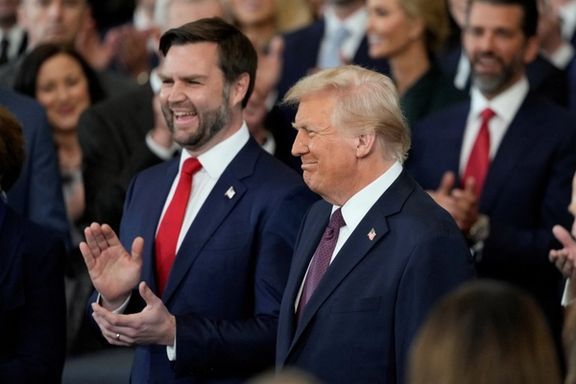
US President and Vice President during inauguration ceremonies on January 20, 2025

Iranian officials and media remain sharply divided over Tehran's relationship with Washington, as President Donald Trump's inauguration speech focused almost entirely on US domestic politics.

Tehran's media landscape showcased the sharp divide, with various factions and their associated outlets voicing opinions on engaging in talks with the US. Optimistic reformists, such as those at Jamaran News and Ham Mihan newspaper, speculating that "Trump might visit Iran to mend ties broken since 1979," while hardliners like the ultraconservative Kayhan daily wrote, "Trump can only come to Tehran to face punishment for ordering the killing of IRGC top commander General Qassem Soleimani."

A few voices sought a middle ground between the extremes.

The pro-reform outlet Fararu questioned whether Trump can put an end to the deadlock between Tehran and Washington, outlining what it sees as three potential paths for Trump in his second term as US president: "diplomacy, war, or simply ignoring Iran."

The outlet also addressed the "maximum pressure” policy that Trump implemented during his first term (2017-2021), noting that "the policy did not achieve the results Trump expected."

Fararu predicted that "although Trump's America will continue to support Israel against Hamas and Hezbollah, yet it is unlikely that he would plunge America into a war with Iran."

The site also opined that "diplomacy can create a historic opportunity for resolving the chronic deadlock between Iran and the United States."

Meanwhile, an aide to Vice President Mohammad Javad Zarif, Sasan Karimi, argued, "Tehran should try to use Trump's Iran policy in a way that serves its own interests rather than allowing Israel to exploit the situation."

Karimi echoed the stance of President Masoud Pezeshkian and Foreign Minister Araghchi, saying, "Basically, we have no problem with furthering honorable negotiations." However, he overlooked Araghchi's earlier clarification that Iran is unwilling to discuss anything beyond the nuclear issue in negotiations with the West.

Karimi remarked, "Now Iran knows Trump has some experience with how Iran operates. The situation is more transparent now." He also quoted Zarif, who stated, "Iran cannot expect much from Europeans. They can blind you, but they cannot cure your eyes."

Karimi emphasized that "the Americans are the main party to any negotiations, while Europeans can only play a supporting role." In a subtle critique of Iran's inaction and lost opportunities, he added, "We should not continue as Cold War soldiers," likely alluding to the country's persistent confrontation with the US and reliance on Russia and China.

On Monday, the Javan daily, linked to the Islamic Revolutionary Guard Corps (IRGC), released a collage showcasing political figures known for their public support of direct talks with the US, including presidential aide Ali Abdolalizadeh, Vice President Zarif, former reformist government spokesman Ali Rabiei, and centrist politician Mohammad Hashemi.

The publication conveyed a message to these individuals, writing: "There is only one condition for direct negotiations with the Trump administration: Be prepared for execution if you do not reach an agreement within two months!"

The daily also accused the four politicians of "bribing the US," and, in a pointed reference to Zarif, declared, "Pezeshkian's vice president in particular should picture the noose around their neck on the gallows."

The IRGC-affiliated publication further warned, "Even if you send the best messages to America and employ the most skilled negotiators, you must understand that the United States has no intention of lifting the sanctions it has imposed on Iran."

Most Viewed

US blockade enters murky phase as tankers spoof signals and buyers hesitate
1
ANALYSIS

US blockade enters murky phase as tankers spoof signals and buyers hesitate

2
INSIGHT

Ideology may be fading in Iran, but not in Kashmir's ‘Mini Iran'

3
INSIGHT

Hardliners push Hormuz ‘red line’ as US blockade tests Iran’s leverage

4
VOICES FROM IRAN

Hope and anger in Iran as fragile ceasefire persists

5

US sanctions oil network tied to Iranian tycoon Shamkhani

Banner
Banner

Spotlight

  • Hardliners push Hormuz ‘red line’ as US blockade tests Iran’s leverage
    INSIGHT

    Hardliners push Hormuz ‘red line’ as US blockade tests Iran’s leverage

  • Ideology may be fading in Iran, but not in Kashmir's ‘Mini Iran'
    INSIGHT

    Ideology may be fading in Iran, but not in Kashmir's ‘Mini Iran'

  • War damage amounts to $3,000 per Iranian, with blockade set to add to losses
    INSIGHT

    War damage amounts to $3,000 per Iranian, with blockade set to add to losses

  • Why the $100 billion Hormuz toll revenue is a myth
    ANALYSIS

    Why the $100 billion Hormuz toll revenue is a myth

  • US blockade targets Iran oil boom amid regional disruption
    ANALYSIS

    US blockade targets Iran oil boom amid regional disruption

  • Iran's digital economy battered by prolonged blackout
    INSIGHT

    Iran's digital economy battered by prolonged blackout

•
•
•

More Stories

IAEA chief urges Iran to address nuclear concerns with Trump administration

Jan 21, 2025, 11:10 GMT+0

The chief of the UN's nuclear watchdog has called on Iran to reach an understanding with the new Donald Trump administration over its nuclear program, warning of the risks of escalating tensions in the Middle East.

“There was an agreement that existed before President Trump decided that was not the path he wanted to follow,” IAEA Director General Rafael Mariano Grossi was quoted by Bloomberg as saying in Davos on Tuesday.

“Now we need to come to terms with how we deal with this, excluding, of course, a war.”

Grossi also reiterated concerns about Iran’s growing stockpile of highly-enriched uranium (HEU), which has surged since the US exited the 2015 nuclear deal.

He emphasized the importance of US involvement in resolving the issue. “We are engaging with Russia, with China, with the European countries, but it’s clear for everybody that the US is indispensable,” he said.

“What we need is to find an understanding. This is going to be our mission in the next few weeks.”

According to the IAEA, Iran’s production of HEU has increased dramatically. In December, the country boosted its production capacity sevenfold to about 34 kilograms (75 pounds) per month, following a diplomatic censure in November.

Iran’s stockpile of 20% enriched uranium also grew by 18 kilograms in the last quarter, further raising concerns.

European powers, including France, Germany, and the UK, are also increasing their scrutiny. They have directed the IAEA to prepare a special report on Iran’s nuclear activities during the first half of 2025.

The report is expected to be presented to the United Nations Security Council, which may consider reimposing UN sanctions before they expire in October.

“This is something that needs to be put back on track,” Grossi said, noting his intention to meet with Trump administration officials in the near future.

Trump fires his former Iran envoy Brian Hook on first day

Jan 21, 2025, 09:58 GMT+0

US President Donald Trump announced he has fired Brian Hook, the special envoy for Iran during his previous term, as he marked his return to the White House on Monday.

"Our first day in the White House is not over yet! My Presidential Personnel Office is actively identifying and removing over a thousand presidential appointees from the previous administration who are not aligned with our vision to Make America Great Again," Trump wrote in a post on Truth Social shortly after midnight.

He added, "Brian Hook from the Wilson Center for Scholars… YOU'RE FIRED!"

It was not clear which position Hook was being fired from because he was also involved in managing Trump's hiring for the state department.

During Trump’s previous presidency, Hook played a key role in championing the administration's heavy sanctions, which targeted Iran's economy and strained the Islamic Republic’s finances.

Tehran says it's ready to sit for talks on removal of sanctions

Jan 21, 2025, 09:37 GMT+0

Tehran is prepared to start sanctions-lifting negotiations if other parties show readiness, Iran's deputy foreign minister for international and legal affairs said on Tuesday.

Kazem Gharibabadi's remarks follow President Donald Trump's Monday speech, where he referenced Iran's oil revenue, potentially hinting at a continuation of a maximum pressure policy in his new term.

Speaking to reporters the next day, Gharibabadi laid out Tehran's consistent willingness for dialogue.

“We have always been prepared for negotiations, and if the other parties share this readiness, talks will proceed and yield results,” he said, adding, “However, if their policies change, Iran will adjust its approach accordingly.”

At his first rally since being sworn in on Monday, Trump said that during his previous presidency, Israel would not have been attacked on October 7 by Hamas because Iran was financially strained. "Iran was broke," he said, adding "Anyone that bought oil from Iran ... China passed, everybody passed."

During his first presidency, Trump imposed sanctions that put pressure on Iran's oil revenue and aimed to curtail Tehran's spending on armed allies in the region.

In his comments after Trump's inauguration, Gharibabadi touched on Iran’s nuclear program, repeating Tehran's line that it is peaceful and that unilateral sanctions have failed to meet their objectives.

“Sanctions impact people’s lives in any targeted country, but they have not achieved their goal of forcing changes in Iran. The logical path is to return to proper dialogue and lift sanctions,” he said.

Gharibabadi also said that talks with European parties on lifting sanctions are set to continue.

“We have agreed to hold further talks, with the date to be determined through mutual consultations,” he said.

With Trump back, Tehran seeks Iraqi mediation for talks - UAE outlet

Jan 21, 2025, 09:25 GMT+0

As Donald Trump returned to the White House, Iran is seeking Iraqi mediation to facilitate talks with the United States, according to UAE-affiliated Erem News on Monday.

An unnamed political figure in Iraq has received approval to create a special channel for mediation between Washington and Tehran, the outlet said, citing its sources.

The report noted that with the growing possibility of Israeli attacks on Iran, Iraqis feel concerned about the potential harm to their country’s security and stability.

"Iranian political leaders, on behalf of Masoud Pezeshkian’s government, told Iraq they are ready to start talks and sit at the table with the US," Erem News said, quoting one of its anonymous sources.

Last week, Iraqi Foreign Minister Fuad Hussein stated that his country aims to maintain good relations with the US during Trump’s presidency.

Donald Trump was sworn in for his second, nonconsecutive term as US President on Monday.

During his first term, Trump introduced a series of measures in order to curb Tehran's regional influence, focusing on its nuclear program. Washington's sanctions also significantly impacted the Iranian economy.

Trump withdrew his country from the nuclear agreement with Tehran, but, despite some overtures for talks, avoided pursuing negotiations for a new deal, focusing instead on a "maximum pressure" campaign.

Meanwhile, on Tuesday, Iranian Deputy Foreign Minister Kazem Gharibabadi said Tehran is ready to negotiate, calling it "the wisest course of action to start lifting sanctions."

"We have always been ready, and if others are prepared too, we believe talks will begin and succeed. If others take a different approach, Iran will adjust its strategy," he added.

Former Iranian parliamentarian Ali Motahari told the Rouydad24 website that Iran should hold direct talks with the US, stating, "Using a mediator cannot solve the issue."

Earlier this month, the country's Supreme Leader Ali Khamenei called supporters of talks with the US "intimidated by the enemy" and urged officials not to bow to "unreasonable American expectations" when addressing issues like hijab, inflation, and currency.

In recent weeks, the Kayhan newspaper, funded by Khamenei, has repeatedly criticized officials who discussed negotiating with the US.

On Monday, Kayhan doubled down on its narrative, writing that President Trump could only "enter Iran" under one condition—"to face punishment for ordering" the assassination of Qassem Soleimani.

Khamenei visits expo held at high-security compound at his residence

Jan 21, 2025, 08:14 GMT+0

Iran's Supreme Leader Ali Khamenei attended an exhibition at the Imam Khomeini Hussainiya in Tehran on Tuesday, and met with private sector representatives.

The event, like a number others recently, took place within the high-security leadership compound near Pasteur Street, which houses both the hussainiya and the official residence of the Supreme Leader, the so-called the House of Leadership (Beite Rahbari).

These venues serve as Khamenei's administrative and ceremonial hub.

On Sunday, Khamenei led the funeral prayers for two Supreme Court judges killed by an assailant, donning a visibly bulky bulletproof vest during the ceremony at the same hussainiya.

Last month, he also delivered a speech on Syria’s recent developments from this secured location.

Khamenei’s recent repeated use of the hussainiya for public appearances suggests an increasing preference for staying within the confines of his headquarters.